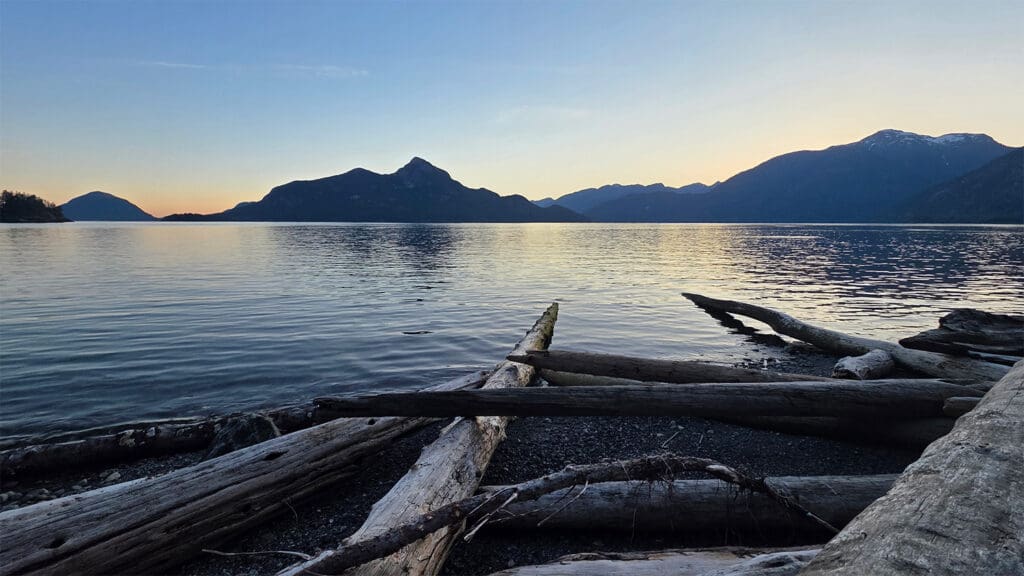
Once in a while, you get to test a totally new innovation and see how it stacks up to the establishment it claims to be beating. I’ve just spent the past three months testing out the Unrestricted cooler on our family adventures: hiking, camping, and biking around the Sea to Sky region of British Columbia. And while the bag isn’t breaking any ice-retention records, it does its job extremely well for a day trip as a mobile snack station and cool-drink provider. It also stays relatively watertight.
Read on for why this earned a spot in our regular rotation as the best low-bulk backpack cooler we’ve tested for day missions.
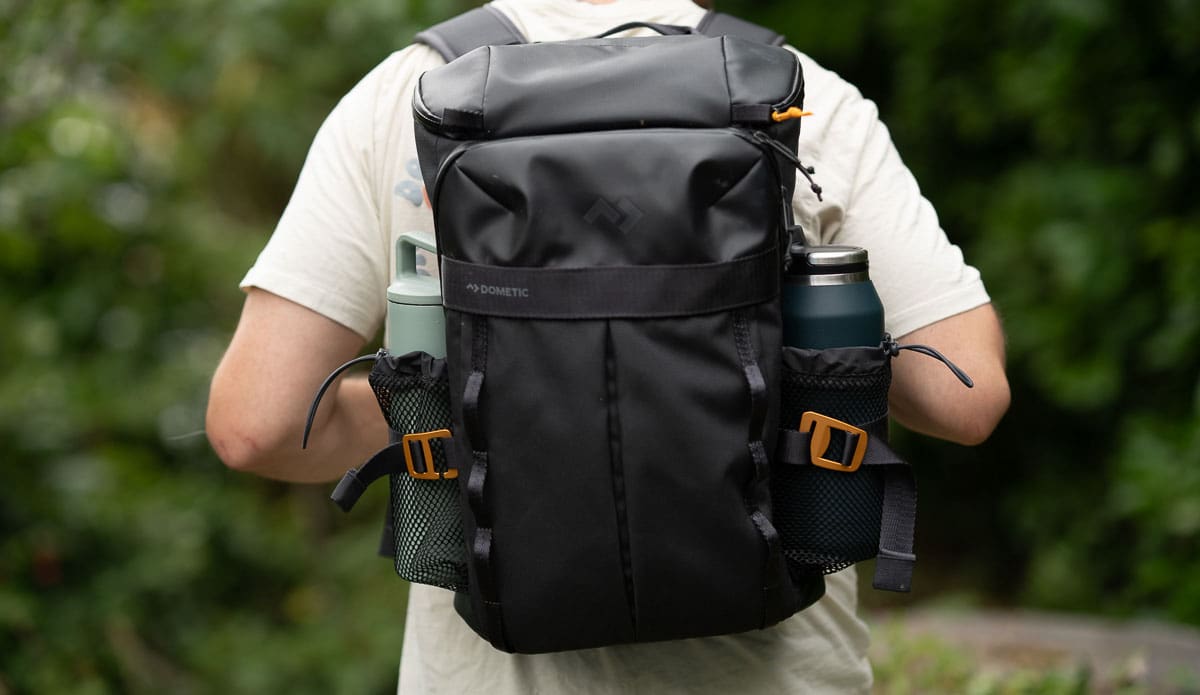
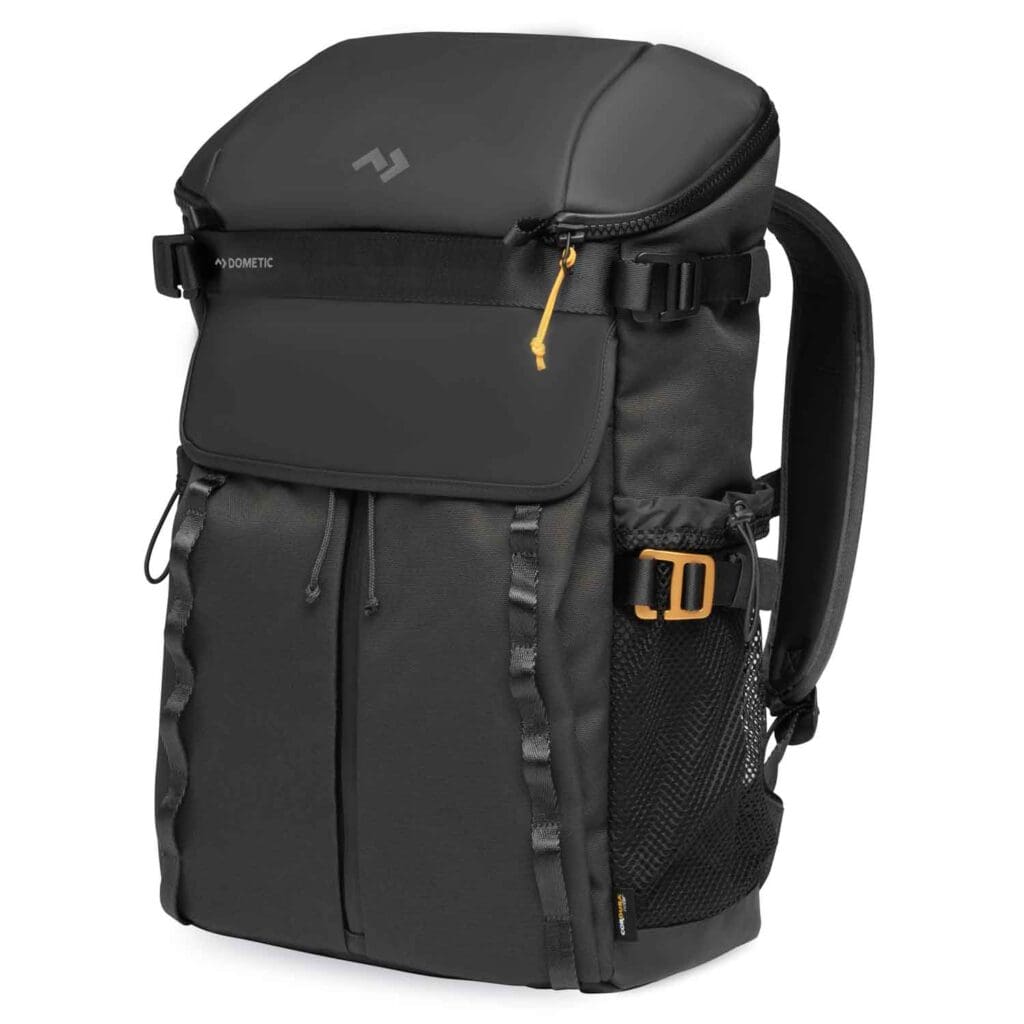
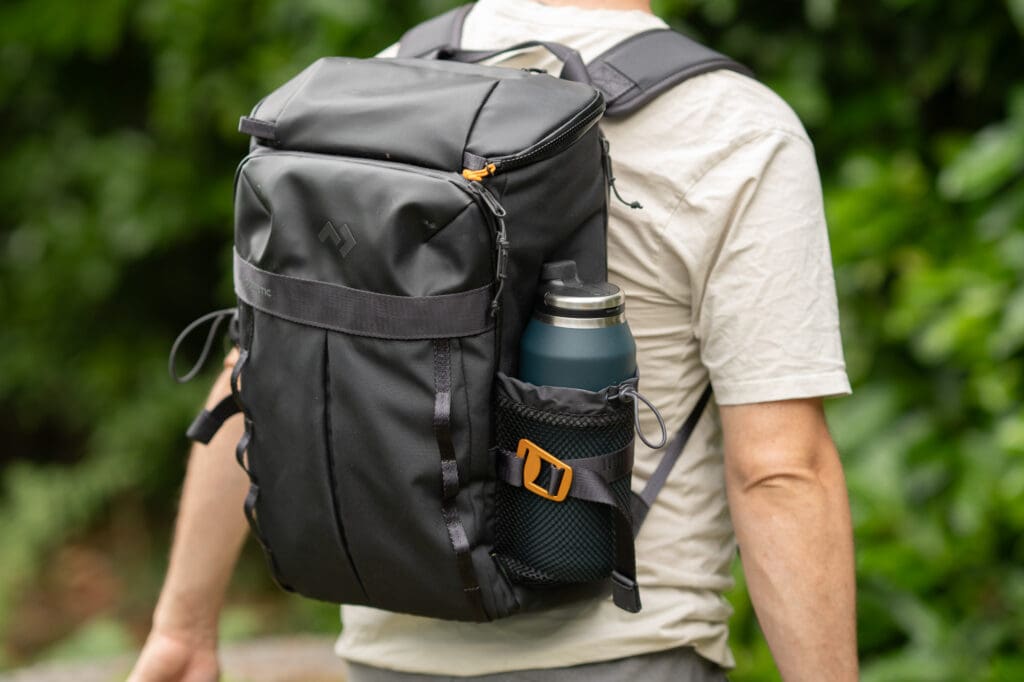
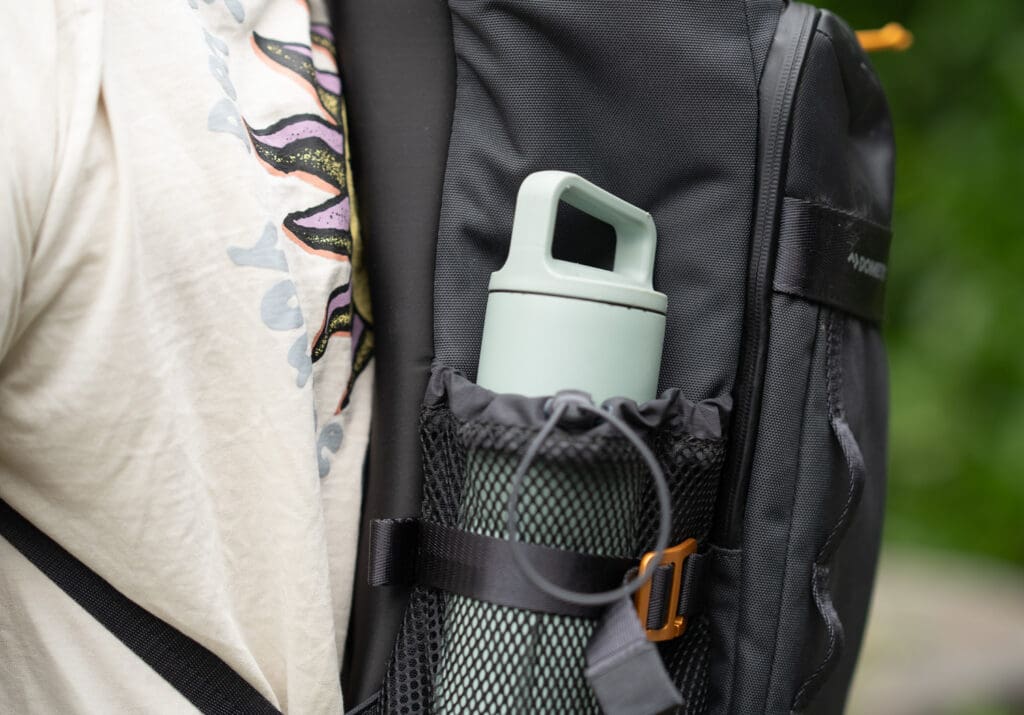
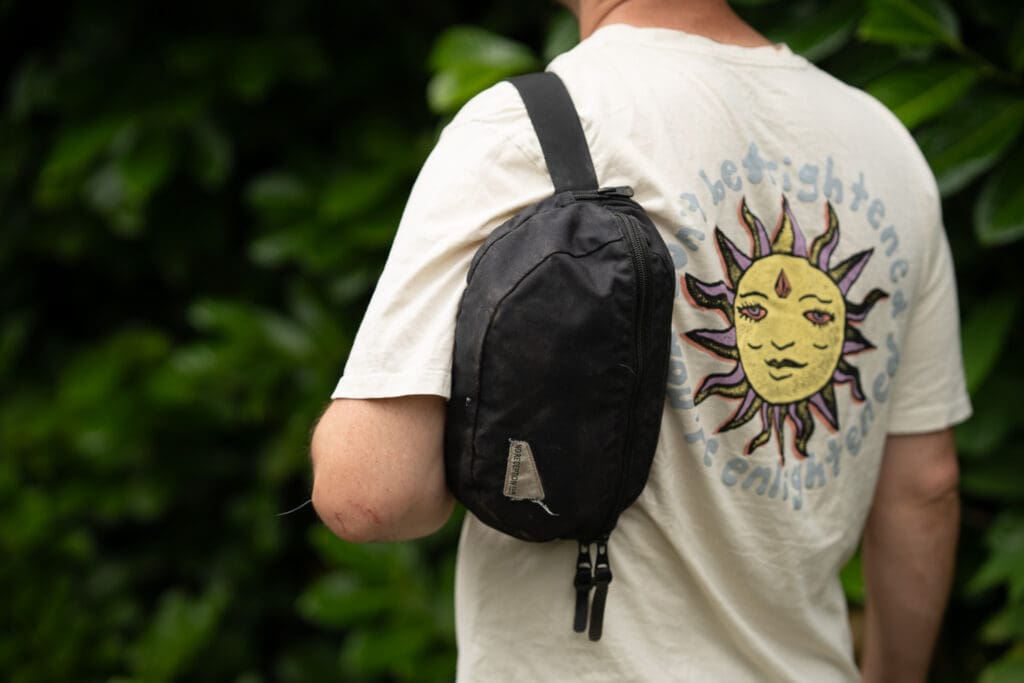
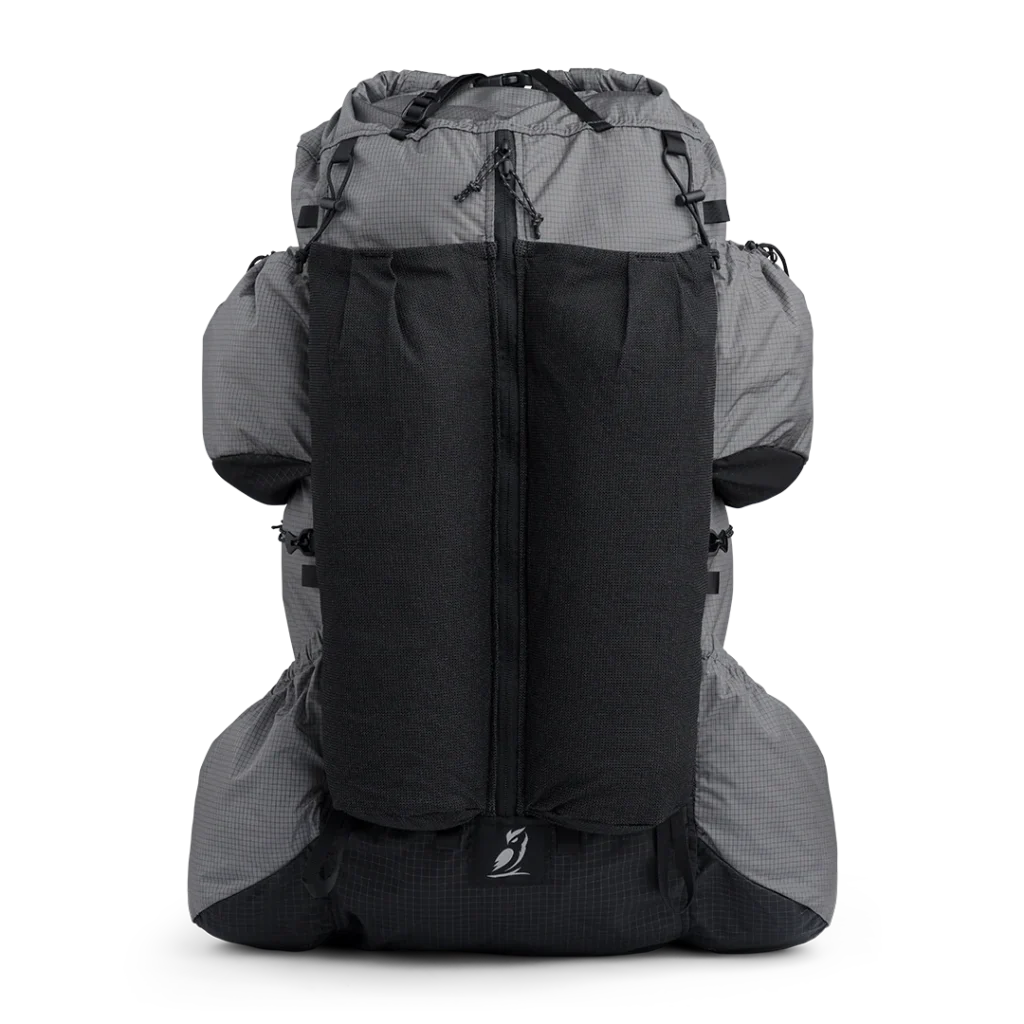
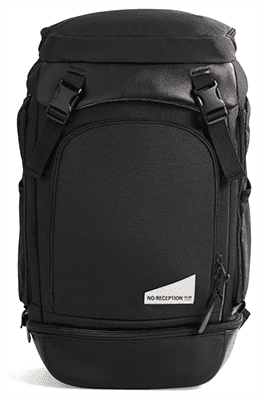
The first thing that struck me about the Unrestricted is that it doesn’t present itself as a backpack cooler. No bulky, boxy shell, no “I’m carrying beer to the beach” silhouette. It reads as a normal daypack, right down to the integrated laptop sleeve, and that’s the whole point: it’ll moonlight as a carry-on or a commute bag on the days it isn’t keeping lunch cold.
You can’t tell it’s a cooler from the outside!
Why I trusted the insulation before I packed it
Before I even knew what it was, I brought a PrimaLoft-lined shirt with me on an expedition to Mount Logan while filming for Nat Geo. One of the older crew members was ribbing me for not having a puffy jacket as a midlayer, but he soon got pretty quiet when I’d stand around camp in comfort without a massive parka on. It was the only thing that worked as a good insulating layer where I didn’t feel overheated, and when I did sweat, it didn’t become a soggy mess. So when I saw the same insulation wrapped around a cooler, I was pretty confident that it’d do well.
How it held up from the car to the trail
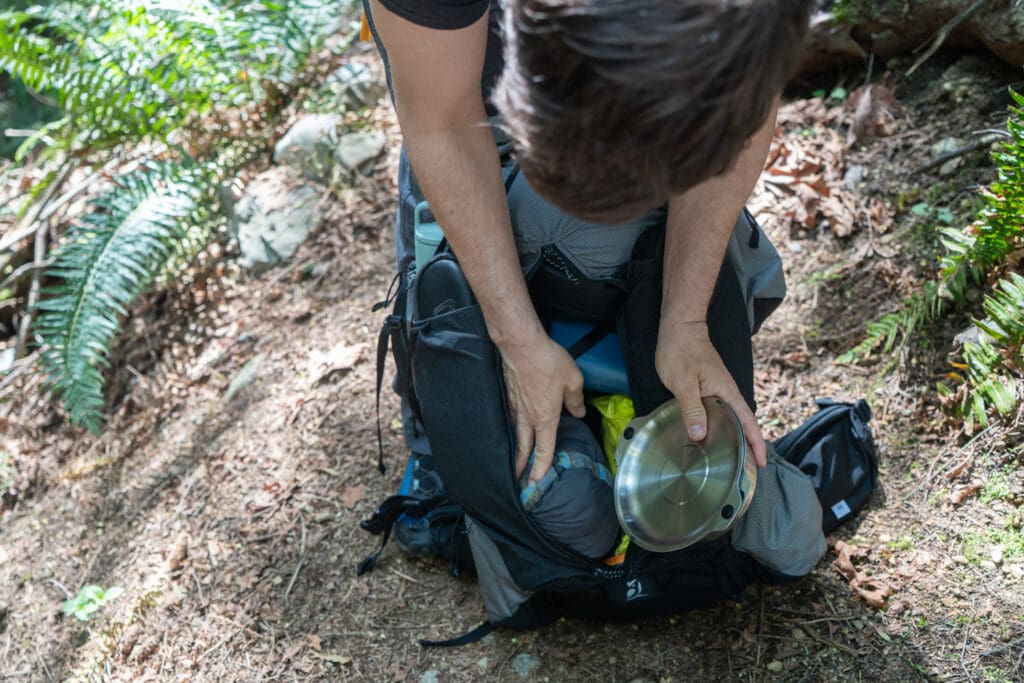
Over three months we ran it through a proper Sea to Sky gauntlet: a hot summer car ride up to Whistler, lake-to-lake along the Valley Trail with the Chariot in tow, a few nights camping at Porteau Cove, and a string of day missions to Squamish. Through all of it, our food and drinks stayed properly refrigerated. The catch is that the cold only stays put if you keep it zipped. Leave it gaping open at the picnic table and you’ll feel the difference pretty quickly.
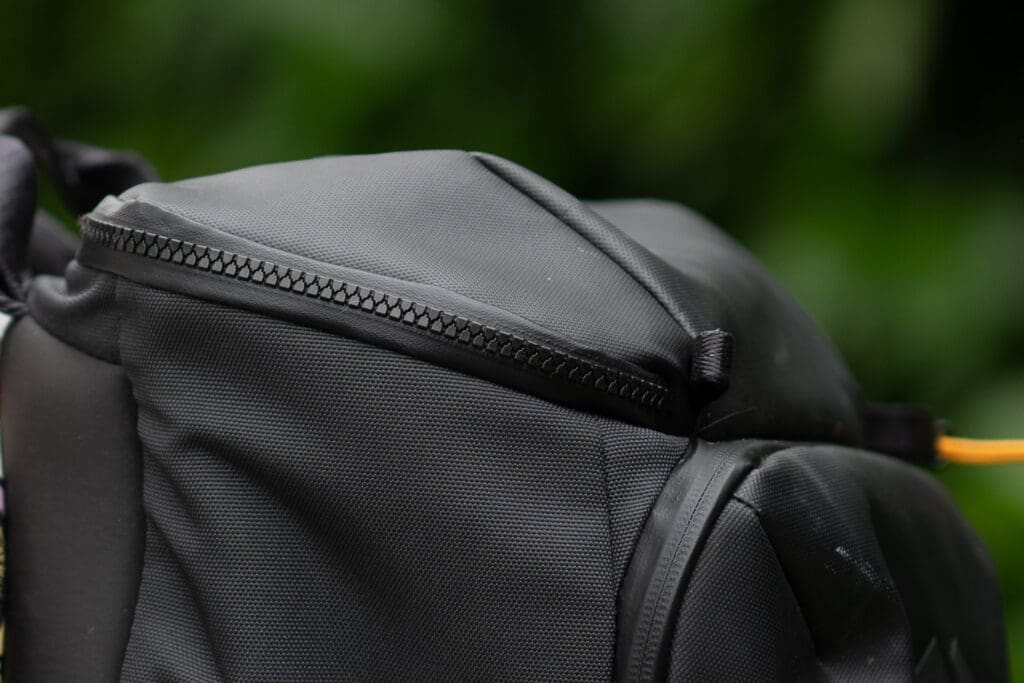
The zippers are robust enough to help seal out the heat, but just make sure you zip them all the way!
The size-to-insulation sweet spot
Let’s be honest about the cold retention: it doesn’t match something like the IceMule Boss, or even a Yeti backpack cooler. But both of those are cumbersome. The Unrestricted has a better size-to-insulation ratio, which makes an excellent sweet spot that’s good for a day, but not so good for a week, if that makes sense. For the kind of day-tripping a family actually does, that trade is the right one, and the compact package is exactly why it ends up coming along.
The ice pack situation
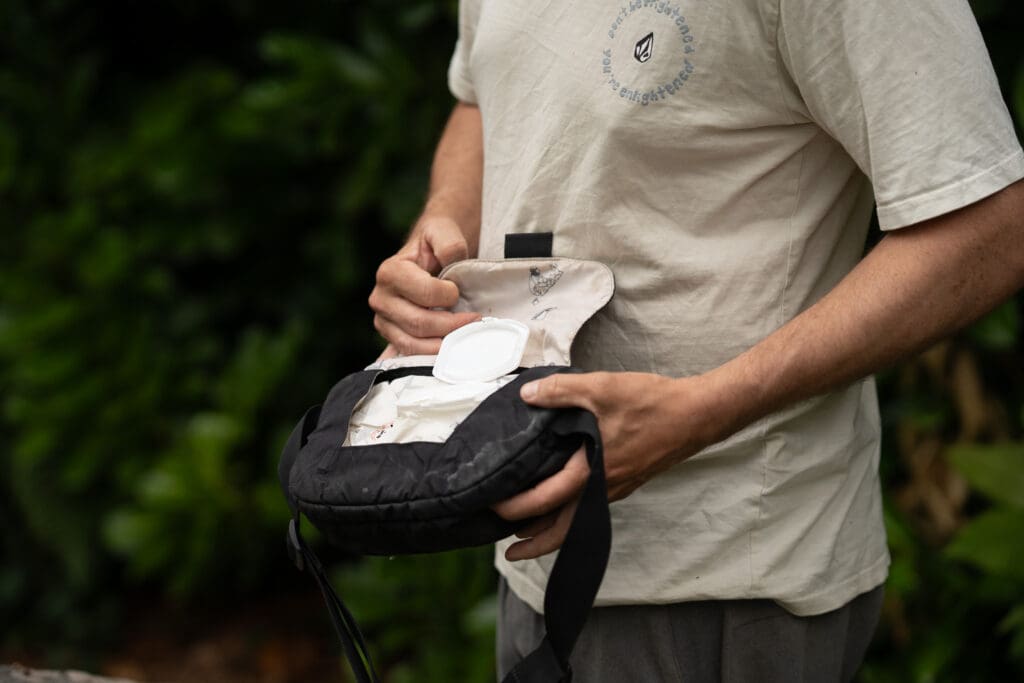
The clip-on Connect Ice pack isn’t that exciting. I usually just used gel freezer packs instead, which did the job for less. That said, if you’re in a pinch and don’t want to pay five bucks for a bag of ice that’s far more than you need, the system is a tidier option than dumping raw cubes in. Just know it’s sold separately, so factor that into the price.
Buy it if you want a day-trip cooler that carries like a normal pack and doesn’t have the bulk of a Yeti or an IceMule. It’s the right call for hikers, bikers, paddlers, and beach-bound families who value a smart size-to-insulation ratio. If genuinely recycled materials matter to you, the PrimaLoft story here is the real thing, not a sticker.
Skip it if you need ice to survive a multi-day trip. This is a day cooler, full stop, and a hard-sided chest will serve you better for car-camping a week out. Ultralight backpackers counting grams will find it heavier than they’d like for the volume, and bargain hunters will balk at the premium price. And if you assumed the cooling packs came in the box, know up front that they don’t.
Final Thoughts
The Dometic Unrestricted is the soft cooler that finally solved the problem of looking and carrying like a soft cooler. For day missions a little further out of reach, it’s a fantastic mobile snack station and cold-drink provider. It’s versatile enough to double as an everyday pack, built from materials I’m happy to stand behind, and watertight enough to trust. It won’t win an ice-retention contest against a hard cooler, and the separately sold ice packs aren’t anything special, but for a family that wants one civilized way to keep food and drinks cold on the trail without the bulk, this one earns its spot on trips a little further out.
Heads up: This guide contains affiliate links. If you buy through one, we may earn a small commission at no extra cost to you — it helps keep our guides free. It never changes our picks or their order. Read our Gear Review Policy.
Even if we had all the money in the world, we’d choose sleeping under the stars over a fancy four poster bed (at least that’s what I like to fool myself into believing 😬). But my goodness, a night in a Fairmont bed is always worth writing home about. So here it is.
We were fortunate to have a couple excellent family adventures at the Chateau Whistler last spring/summer. Before that, I was no stranger to the epic landmark (thanks to the good eats), situated at the base of Blackcomb mountain, in Whistler’s (quieter) Upper Village, a short stroll away from Whistler’s (busier) Main Village. We used to live in Whistler, and recently moved about an hour down the Sea to Sky highway to Horseshoe Bay, but it’s still our go-to for a quick and easy getaway. The Fairmont Chateau Whistler makes it something special, that’s for sure.
Daisy enjoying the complimentary apples and fragrant lilies in the hotel’s lobby
Aprés visits to The Mallard, their lux and cozy, couch filled lounge open to the hotel’s large main lobby, cannot be beat imo. We have also been making it an annual tradition to eat at The Wildflower‘s famous Mother’s Day Brunch since my daughter was just a wee bébé. Portebello has also been a staple in my pre-snowboarding regimen, to fuel my days up in the mountains.
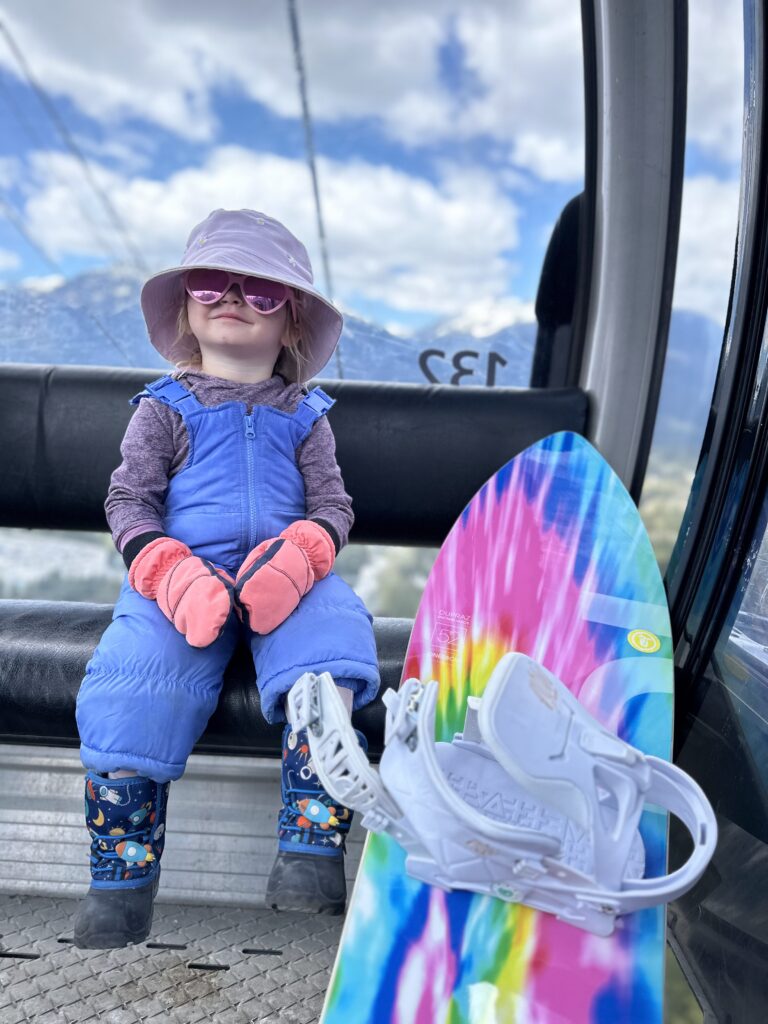
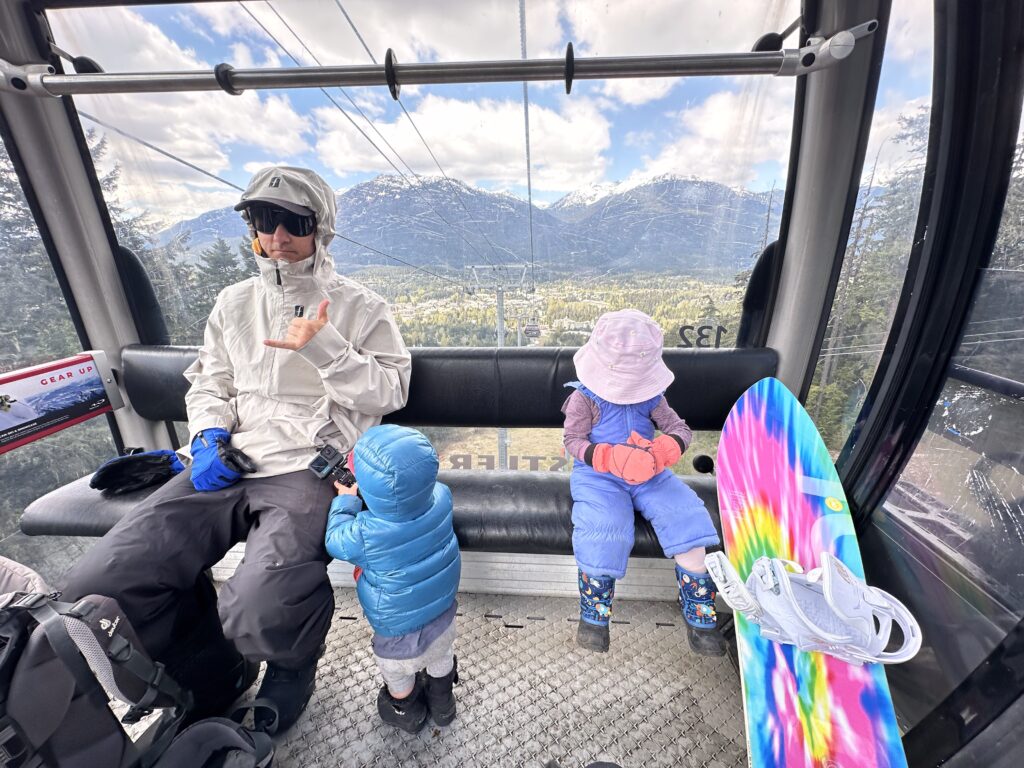
Pleasantly pleased Daisy, in her element, riding up the Blackcomb village gondy
The hotel couldn’t be more convenient, situated right at the base of the Blackcomb Gondy. Thanks to its name, Blackcomb tends to be the lesser known of Whistler resort’s mountains, where the ratio of locals to visitors tends to be higher. It funnily happens to be the larger of the two mountains, has shorter lift lines, and is insanely fun. My best days on both mountains have hands down been on Blackcomb, off Seventh Heaven, and behind on the Blackcomb Glacier/Bowl. It basks in the afternoon sun, so is super cruisy to finish the day off on, before returning back to your evening’s cushy digs.
Suiting up for spring shreddin’ and Rendezvous hangouts
Tell me a better way to relax ye olde muscles after a long day on the slopes than in a hot tub, and I won’t believe you. The Fairmont’s Vida Spa and pools are worthy of a visit in themselves. Many locals have caught onto this and get monthly under the table/non-advertised passes in the winter to soothe and warm their weary woes.
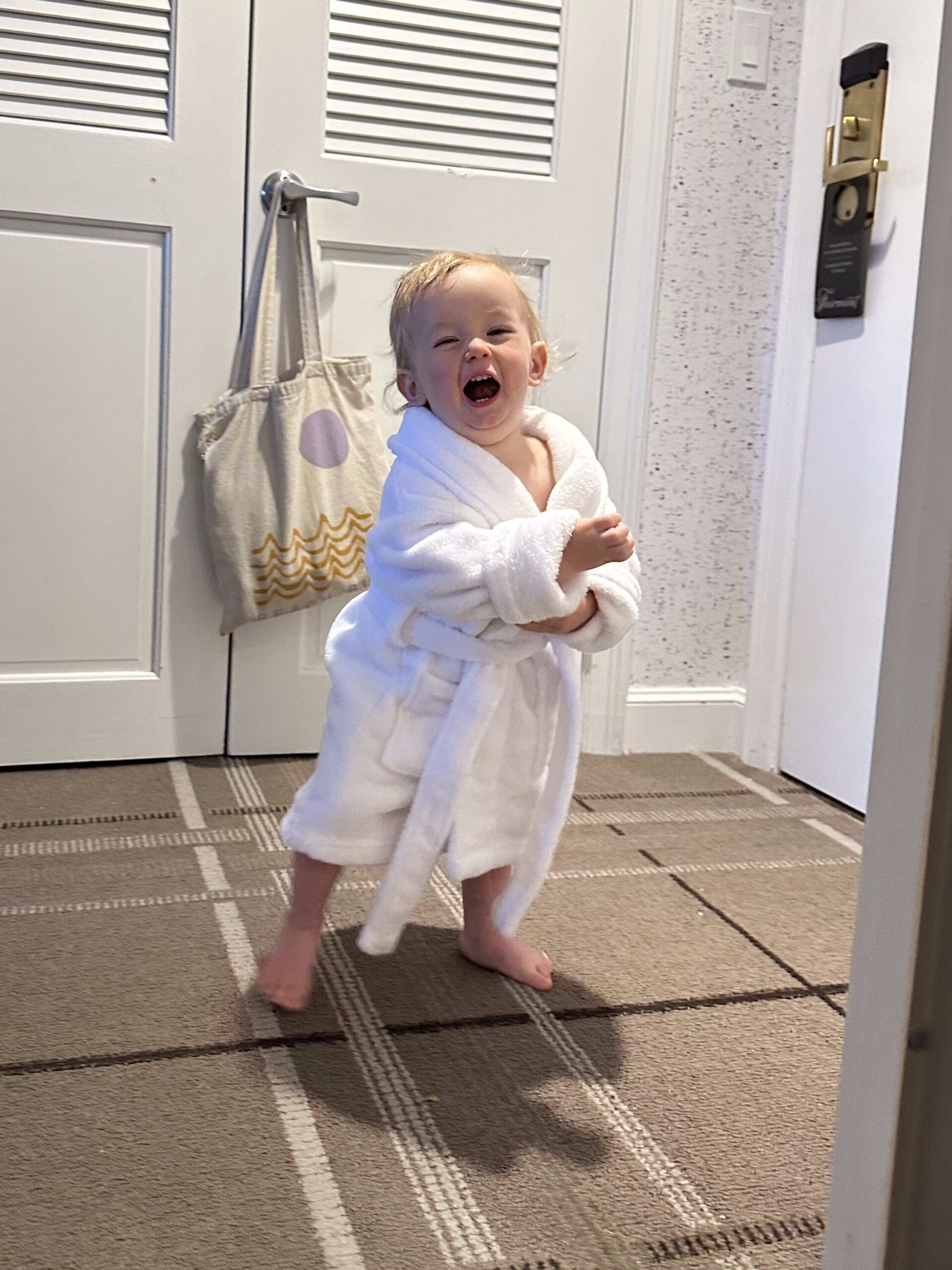
I mean, matching family bathrobes?! C’mon, couldn’t get much cuter (and cozier)
A nice restorative yoga class after a long day could possibly tie with the hot tubs, in terms of rejuvenating bliss. To coincide with the spa, the Chateau offers top notch yoga classes, whether to limber you up to start your day, or to soothe said sore muscles at the end. If you’re lucky, you may time your visit with a sound bowl experience to revel in complete relaxation to soothe the soul.
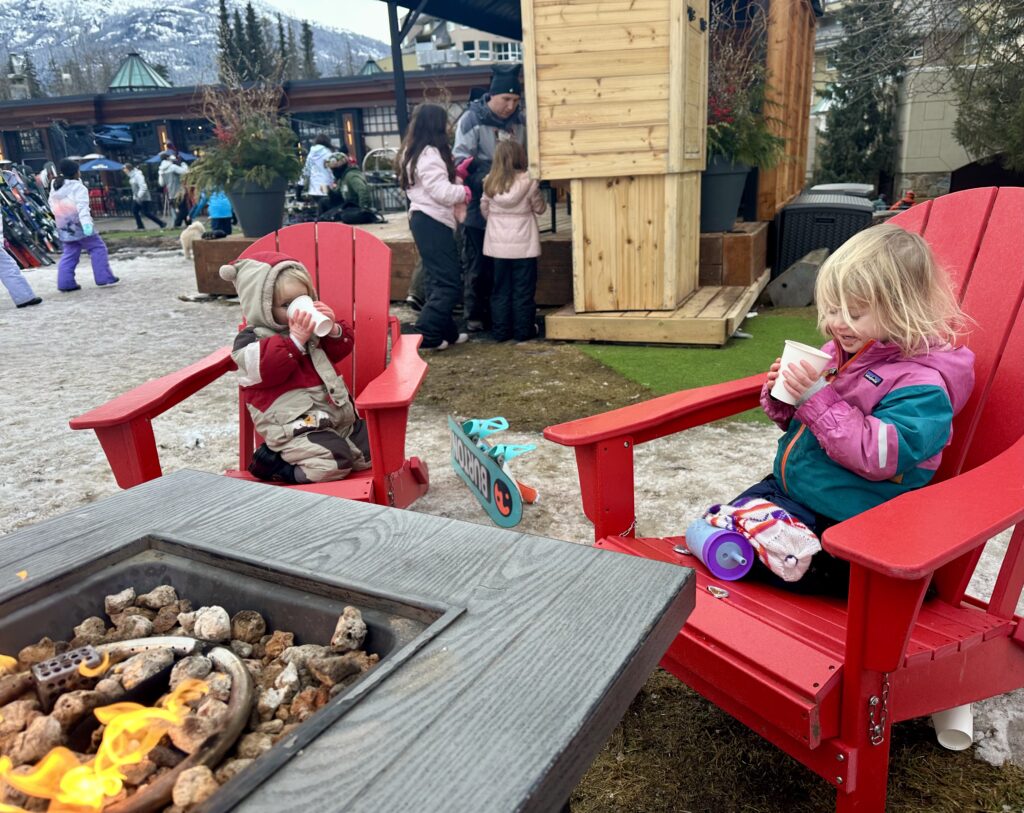
They make things super simple and efficient with their slopeside ski valet and ski and snowboard rentals. Also slopeside, maple infused hot chocolate awaits to warm yourself in the afternoons, sittiing on their red adirondack chairs next to propane fire pits. Picturesque, and oh so quintessential.
Yummmy
If you haven’t thought of visiting Whistler in the summer, than get on it, as each summer the visitors increase, making no season an off-season. The world’s best mountain and downhill biking are at the Chateau’s doorstep. Hiking more your thing? Strap the hikers on and head up the Blackcomb Ascent Trail/Grind to get to the top, and take the gondola down to save your knees. If you’re a seasoned golfer, you’ve probably heard of the Fairmont Chateau Whistler’s namesake golf course.
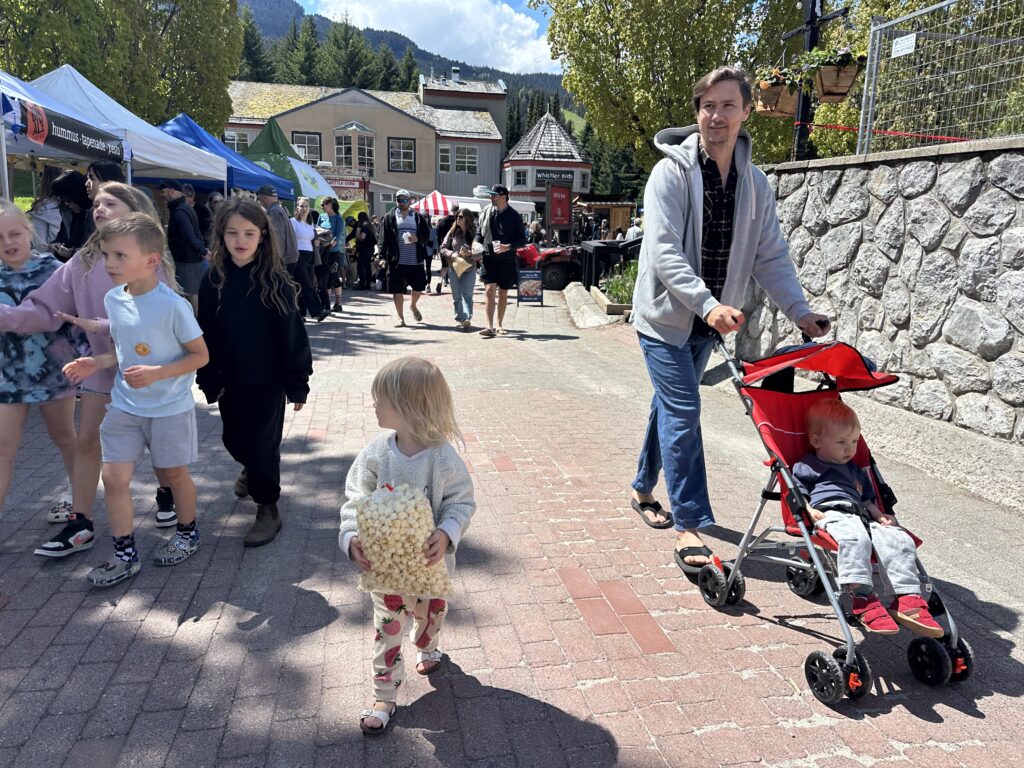
Hiking up the Ascent Trail, stopping to smell the Daisy’s 🙂The summertime farmer’s market is a hoot as well!
Spring and Fall, also known as the ‘shoulder seasons’ are the quietest time to visit Whistler, where you can find sweet lodging and dining deals. The nostalgia and anticipation fall brings, with the cooler temps and first signs of snow, feels like magic. Some of the top restaurants in town offering $50 (or less $) a la carte 5 course meals/experiences.
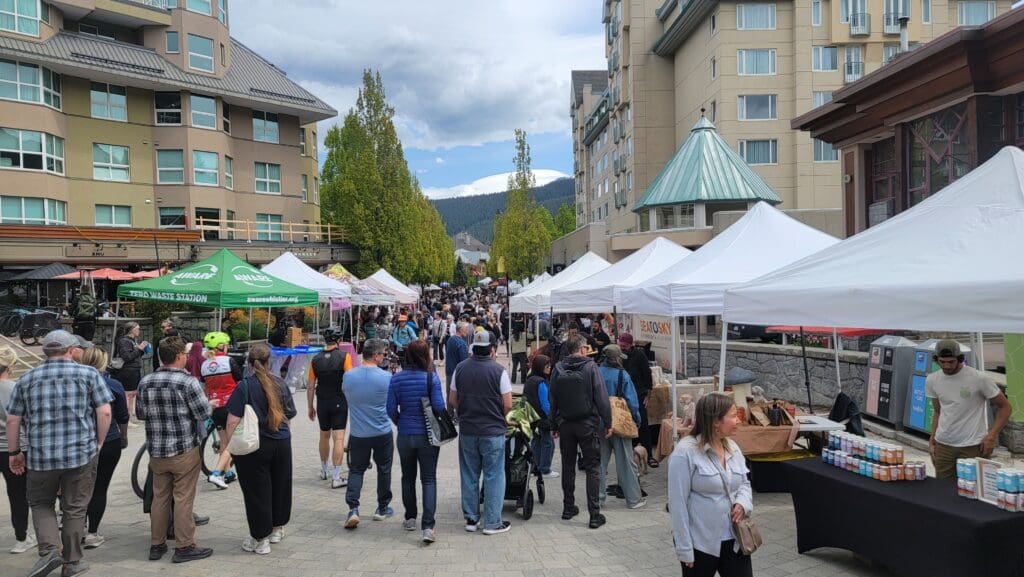
We love eating local and getting a taste of what life is like wherever we visit by checking out the local markets. Right outside the hotel’s doors, you can find the Whistler Farmer’s market, filling up the village stroll with local art, goods and yummy eats, May to mid-October, on Sundays from 11am-4pm.
Farmer’s market strollin’
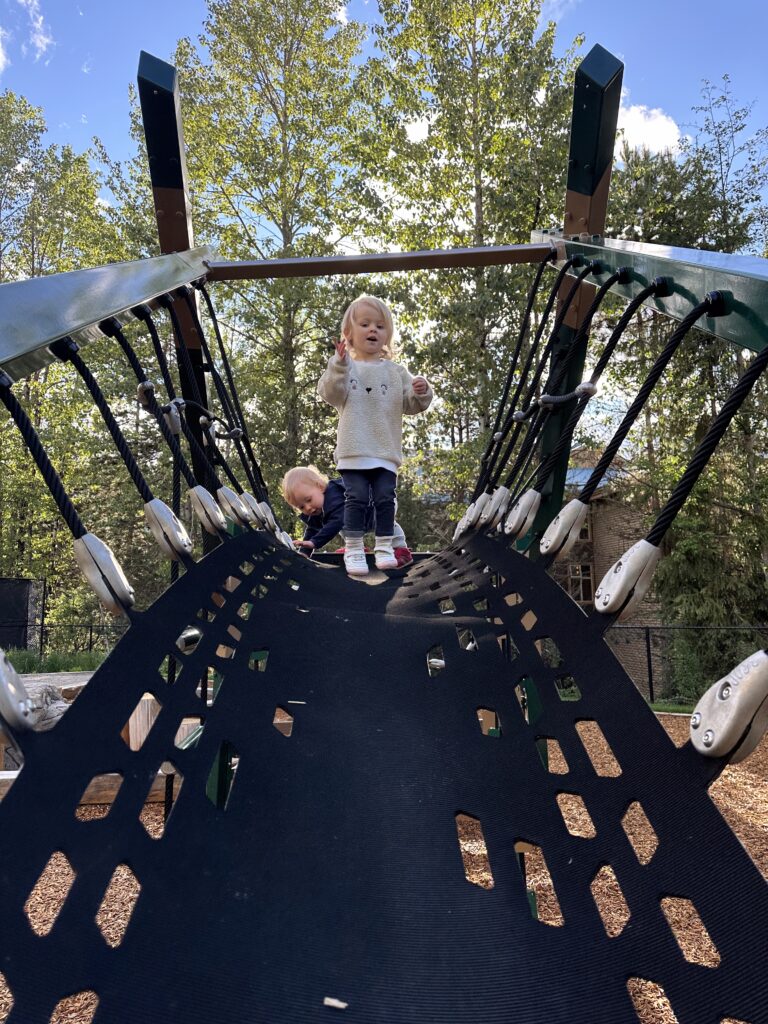
The Chateau also comes complete with it’s own tennis and pickleball courts. Also, tucked beyond the courts is the hotel’s own playground, encompassing a large fenced-in area for kids to run around, complete with a climbing play structure and swings. We found this incredibly convenient plus the kids adored going. It was entertaining for all of us, as we met families (and friends for the kids) from all over the world.
If all the perks, the brilliant Blackcomb location, the good food and amenities, weren’t reason enough, Fairmont is making steps towards a sustainable future. They are showing that they care about the environment, knowing that Whistler, and many of their hotel’s locations, are so popular due to being surrounded by incredible nature at their doorsteps. So let’s preserve that! And they’re trying, and also prompting guests to think about their own impact, when they travel and what they can learn and take home with them.
The friendly staff are also a fond memory for us. From checkin, to our room servicing crew, smiles were had all around. From delivering our bags to bringing the kids their own bathrobes, the service is top notch, making you feel welcomed, and truly feeling like it is a home away from home during your stay.
Roarrr
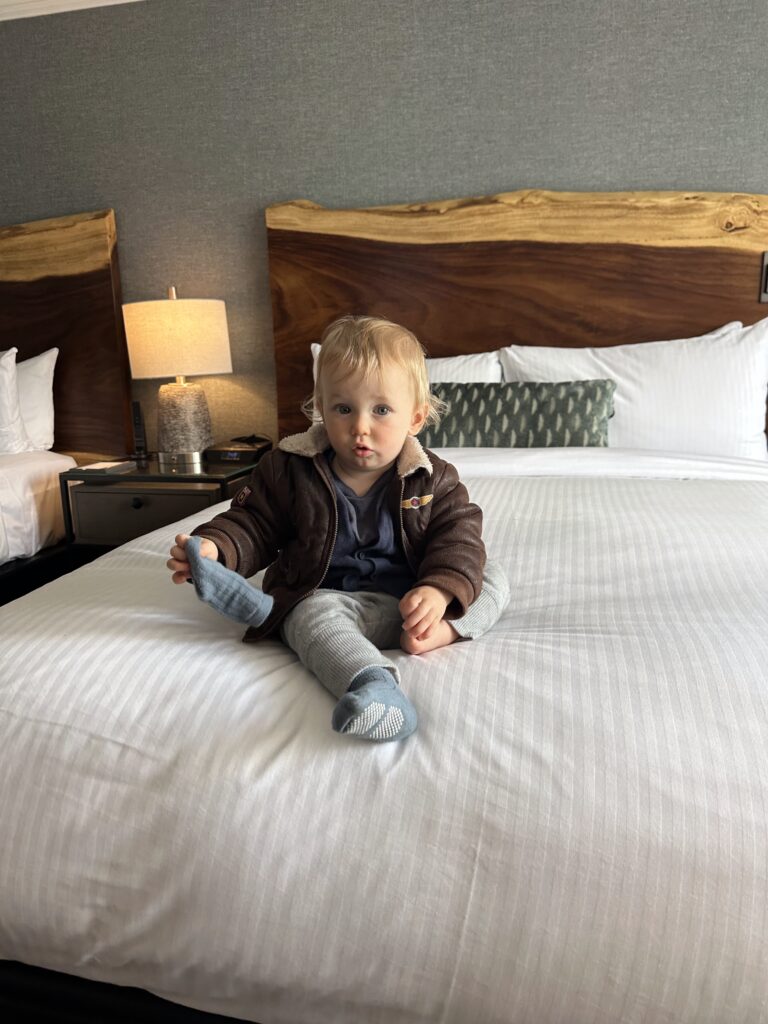
With all this said, the main reason to choose the Fairmont over all the rest… The bed! The crisp white linen, the cushy mattress, it is enrapturing, I sink into it, and could stay tucked in it all day, everyday (if it weren’t for the kids telling me they’re hungry). Open the curtains, I know I’m in Whistler, I can watch the sun cast its shadow over the mountains, all from the comfort of those stunning beds. The natural live edge wooden headboards. The room. The towels. The (reuseable and refillable) toiletries. All a bonus.
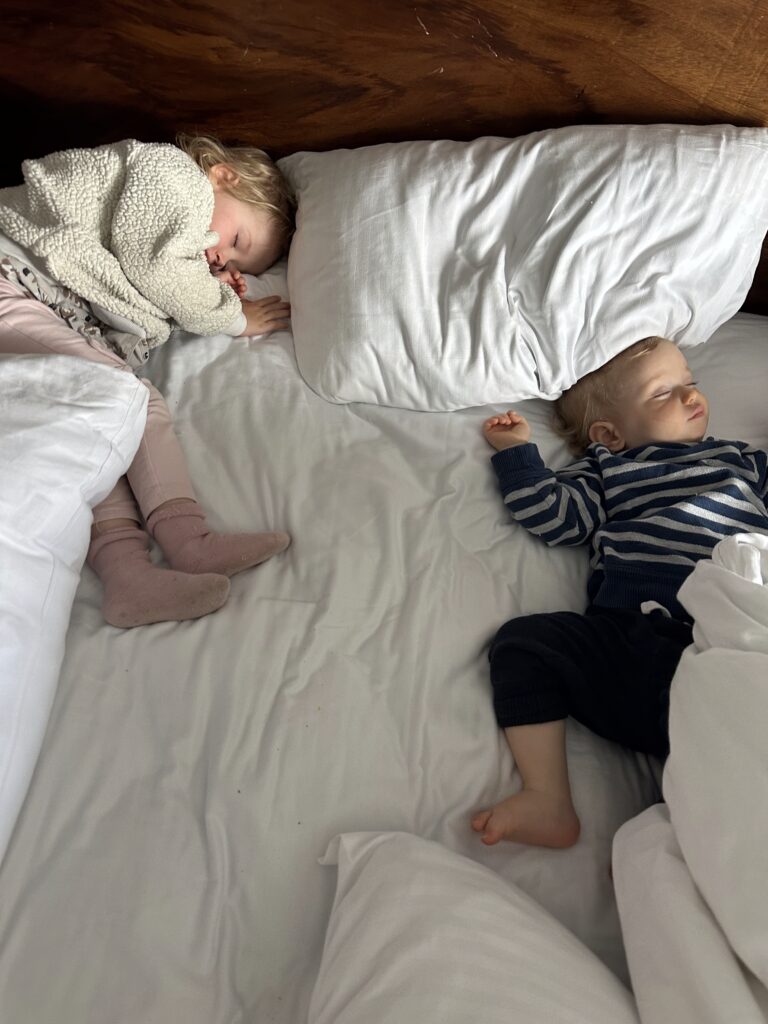
BeforeAfter – amidst the soft sea of pillows, excellent naps were had.
In summary, if you’re looking for a most excellent stay, warm cozy beds, good food, great amenities, and the best location, the Fairmont Chateau Whistler is your answer. We give it 4 sets of luxurious thumbs up!
Heads up: This review contains affiliate links. If you buy through one, I may earn a small commission at no extra cost to you — it helps keep these reviews free to read. It never changes my verdict. Read my Gear Review Policy. — Steve
I’m not as big of a football fan as I once was. Family life has certainly cut into leisure time. So when I heard that OluKai, a brand known more for the waterman’s ethos of Hawaii, was collaborating with NFL stars Travis and Jason Kelce, I kinda went “meh,” and wondered if this collab was genuine.
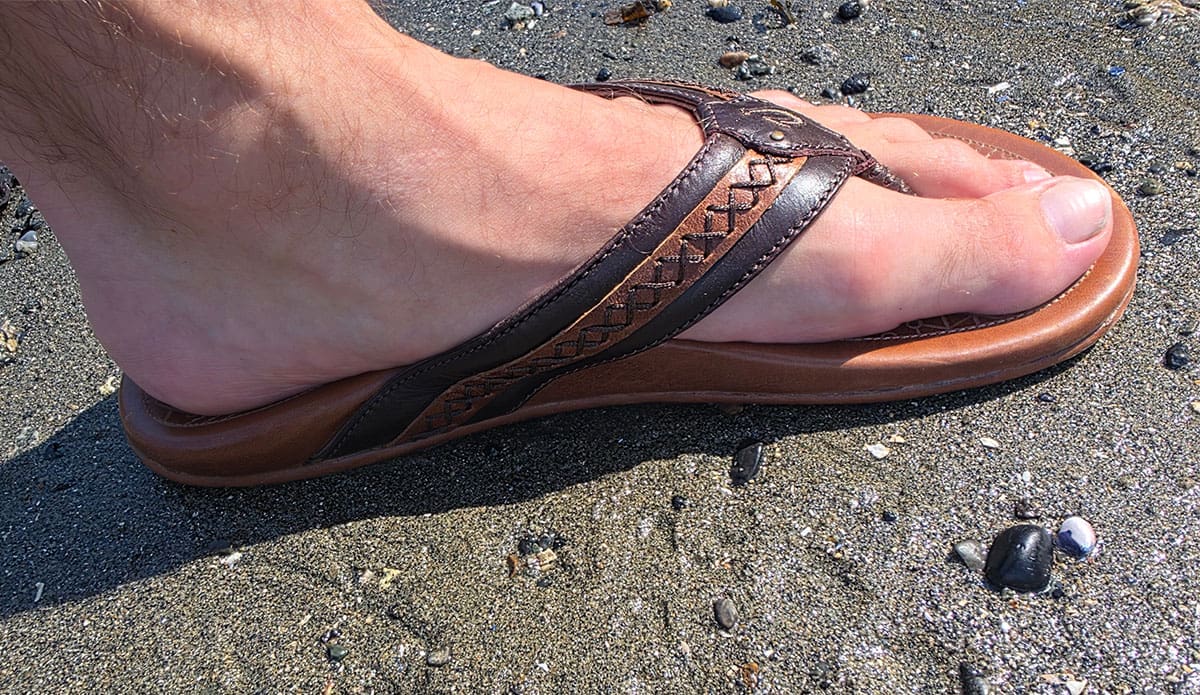
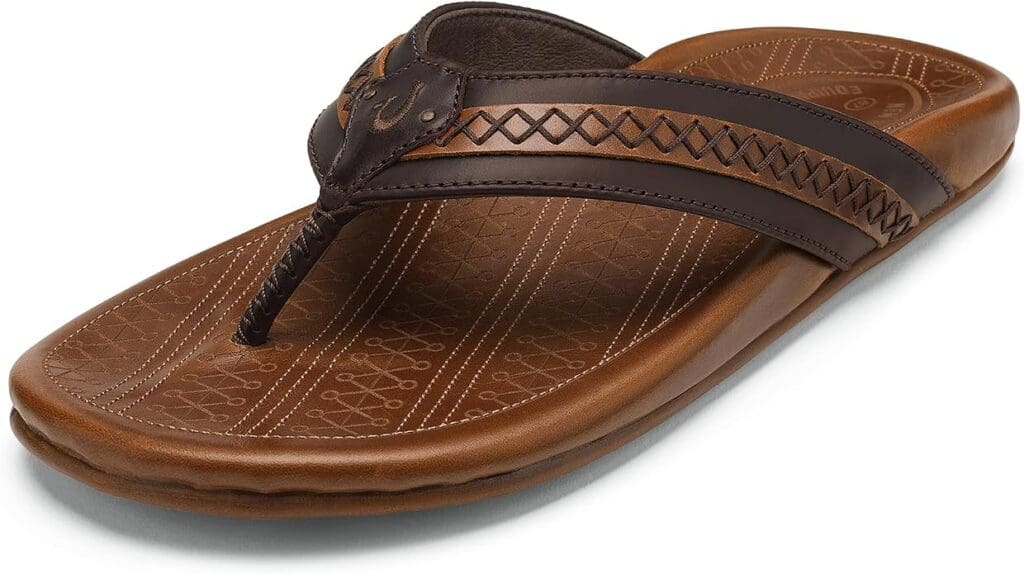
Then I tried the sandals out. And whatever the reasoning behind the collab aside, the reality is that it’s a damn fine pair of flip flops. The leather is what you’d expect with OluKai, but the big difference is the footbed. Maybe having some of the top athletes in a sport that has them abusing their feet designing some leisure footwear wasn’t such a strange idea, after all.
As a dad, comfort is key, and so is quality, although both come at a premium. So were they worth the $160 price tag? Read on to find out!
Bottom line: It’s a lot to spend on a sandal, but the full-grain leather and rugged outsole mean it’ll last. It’s the type of sandal that gets better with age, as long as you aren’t the amphibous type.
Pros
✓ Full-grain leather that softens and shapes to your foot instead of wearing out
✓ The footbed is noticeably more supportive underfoot than a flat foam flip-flop
✓ Grippier than it looks: rubber traction pods set into a leather-wrapped outsole
✓ The football details stay subtle, but is a nice touch.
Cons
✕ $160 USD is a lot of money for a pair of flip flops
✕ It’s a beach sandal you shouldn’t swim in. OluKai builds the Mea Ola for dry sand and shorelines, not soaking
✕ Sizing guidance conflicts between OluKai’s own page and its Amazon listing (see The Facts, below)
Dark Java / Tan (single limited-edition colourway)
Sizes
Men’s US 7–15, whole sizes
Upper
Full-grain leather
Lining
Soft microfiber
Toe post
Handsewn
Footbed
Contoured leather footbed with laser-etched New Heights artwork and embroidered logo accents
Midsole / outsole
Compression EVA midsole, with spotted rubber outsole on top of leather.
Fit
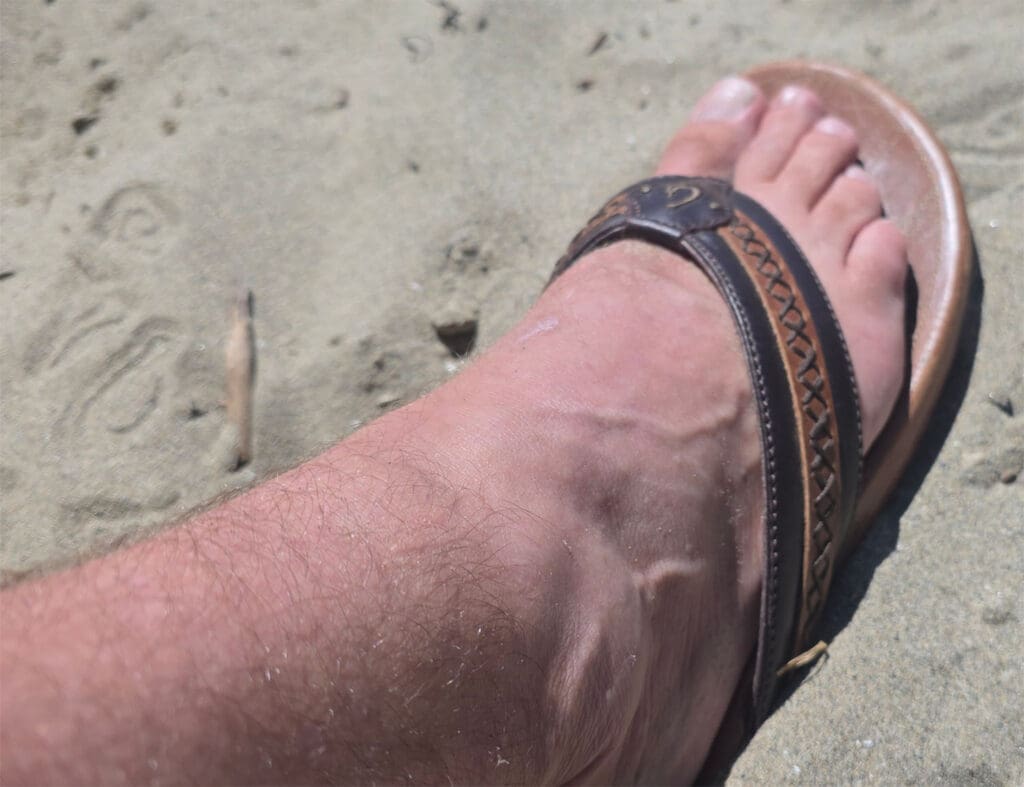
OluKai’s product page lists it true to size, standard width, standard arch. OluKai’s own Amazon listing for the same sandal says it runs small and narrow with a high arch, and recommends sizing up. See the sizing note below.
Weight
17 oz (pair)
Water use
Built for dry sand and shorelines; prolonged water contact can damage the leather
Warranty
1 year from date of purchase
Availability
Limited edition, while supplies last
Specs verified August 3, 2026. Prices drift — check before you buy.
A note on sizing
OluKai gives two different answers depending on where you shop. The product page on olukai.com says the Mea Ola Nuʻu fits true to size with a standard width and arch. OluKai’s own Amazon listing for the same sandal says it runs small and narrow with a high arch, and tells you to order a size up. I found it to be fairly standard for me, and ordering a size up would have been way too much underfoot. As someone who oscillates between a size 10 and 9.5, the 10 was actually slightly big, but a 9.5 would probably have my toes creeping over.
How I tested them
I’ve been wearing these over the past few months in a classic west coast summer. I’m not taking them hiking or anything, but wearing them on the day-to-day when it suits. I try to not
Notable Features of the Mea Ola Nuʻu
Full-grain leather upper. It breaks in rather than breaks down, and darkens where your foot touches it. OluKai says the leathers here nod to vintage pigskins and old-school helmets. It’s a nice touch.
Contoured footbed with real arch shape. This is what separates it from a $20 rubber flip flop: there’s structure under the arch, so your foot isn’t doing all the work. The result? I can wear these all day without the usual foot pain from cheap sandals.
Leather-wrapped outsole with rubber traction pods. The outsole truly is grippy and a step above (no pun intended) a cheap, flimsy plastic outsole. But the sporadic use of it means you still get some flex in the step, and it doesn’t feel clunky. It’s a great compromise.
Handsewn toe post and microfiber lining. The toe post is the first thing to fail on a cheap sandal. This one is stitched, not glued, and lined so it doesn’t saw at your foot.
The New Heights details. Laser-etched footbed artwork, stitching that echoes football lacing, gold foil signatures from both brothers, and a “New Heights Equipment Co.” stamp. Subtle enough that nobody at the beach is going to clock it as merch. But it’s there for the fans who appreciate some details.
One-year warranty, and a B Corp behind it. A portion of every purchase goes to Hawaiian nonprofits through OluKai’s Ama foundation.
The pigskin stiching on top is the big standout feature that separates this version from the standard Mea Olua Nu’u
Drawbacks
The price. $160 USD buys a lot of sandal, and it also buys a lot of other things. This only makes sense if you’re the kind of person who keeps footwear for years and takes care of it along the way.
It’s leather, so it needs care. Rinse it in the ocean all summer and you’ll get a fraction of the life out of it. OluKai is explicit that the Mea Ola is made for dry sand and shorelines, not swimming.
Sizing is a coin flip online. Two official sources, two different answers. Order from somewhere with free returns, just to be safe.
Limited edition. One colourway, men’s sizing only, and when it’s gone it’s gone.
Not vegan, not synthetic. Leather upper, leather footbed, top to bottom. The only rubber is at the very bottom of the outsole.
Who This Is For
Buy them if you want a sandal that will still be in the rotation in five years. This isn’t the typical “dad shoe.” It’s a notch above and is perfect for a gift to show you really care about a guy. If they’re a football fan, and especially a fan of the Kelce brothers, it’s a no-brainer. If they aren’t the type to change out of their workboots… even better, and maybe this set of premium leather slippahs will help them do the trick.
Yes, it’s expensive, but a lot of things are these days, and it’s got more utility than a fancy golf shirt that probably costs around the same.
Who Should Skip This
Skip them if your sandals live in the water. If you’re spending the summer at the lake, launching a boat, or handing them to a kid who will absolutely wear them into the ocean, buy something synthetic and stop reading. Leather will lose that fight to water, especially over time. Skip them if you don’t use animal products, because there’s no synthetic version of this sandal. And skip them if you’re the kind of buyer who replaces flip flops every June for twenty bucks and is perfectly happy doing it: the whole argument for the Mea Ola Nuʻu is longevity, and if you don’t care about longevity, you’re just paying for leather.
Final Thoughts
I went in skeptical about a celebrity collab and came out with a sandal that gets more comfortable with each wear. The Kelce details are probably something peole will eithe gravitate to or avoid, but they’re not the reason to buy it. The leather, the footbed and the outsole are and those are all OluKai’s, collab or not. Make no mistake, it’s a lot to spend on a sandal. But the quality craftsmanship and rugged outsole means it’ll last.
Leather isn’t for everyone, but it’s the type of sandal that will only get better with time, and should last for a very long time if you know how to take care of them.
Are the OluKai Mea Ola Nuʻu sandals worth the money?
At $160 USD they cost roughly eight times a drugstore flip flop, so the math only works if you keep them for years. The full-grain leather, contoured footbed and stitched toe post are built to be kept. If you’re hard on sandals or you swim in them, you won’t see that value.
Do the OluKai Mea Ola Nuʻu run true to size?
OluKai recommends sizing up, however I found them to be pretty true to size, or even a hair larger than usual. Shopping for foot sizing is always a bother, but if you can’t try them out in person before buying, make sure you can return them. Amazon is a clear winner here for that reason… love ’em or hate ’em, their return policy allows you to give them a try.
Can you wear OluKai leather sandals in the water?
Not really. OluKai describes the Mea Ola as built for dry sand and shorelines, and warns that prolonged water contact can damage the leather. If you want an OluKai you can soak, look at their synthetic or water-ready models instead.
Did Jason and Travis Kelce actually design the sandal?
It’s a collaboration, not a ground-up design. OluKai built it on its existing Mea Ola platform. It’s a sandal Jason Kelce has worn for years, and they reworked the materials and detailing with football references: vintage pigskin leathers, lacing-style stitching, gold foil signatures and a “New Heights Equipment Co.” stamp. The comfort underfoot is OluKai’s, not the Kelces’. Like any collab, it’s more just a way for a brand to reach a new market. Whether or not it’s enough for you to want to pony up dough for depends on if you like the style or not.
Is the New Heights x OluKai collab still available?
It launched in June 2026 as a limited edition, sold while supplies last, in one colorway and men’s sizing only. Check current stock before you get your hopes up.
Heads up: This guide contains affiliate links. If you buy through one, we may earn a small commission at no extra cost to you — it helps keep our guides free. It never changes our picks or their order. Read our Gear Review Policy.
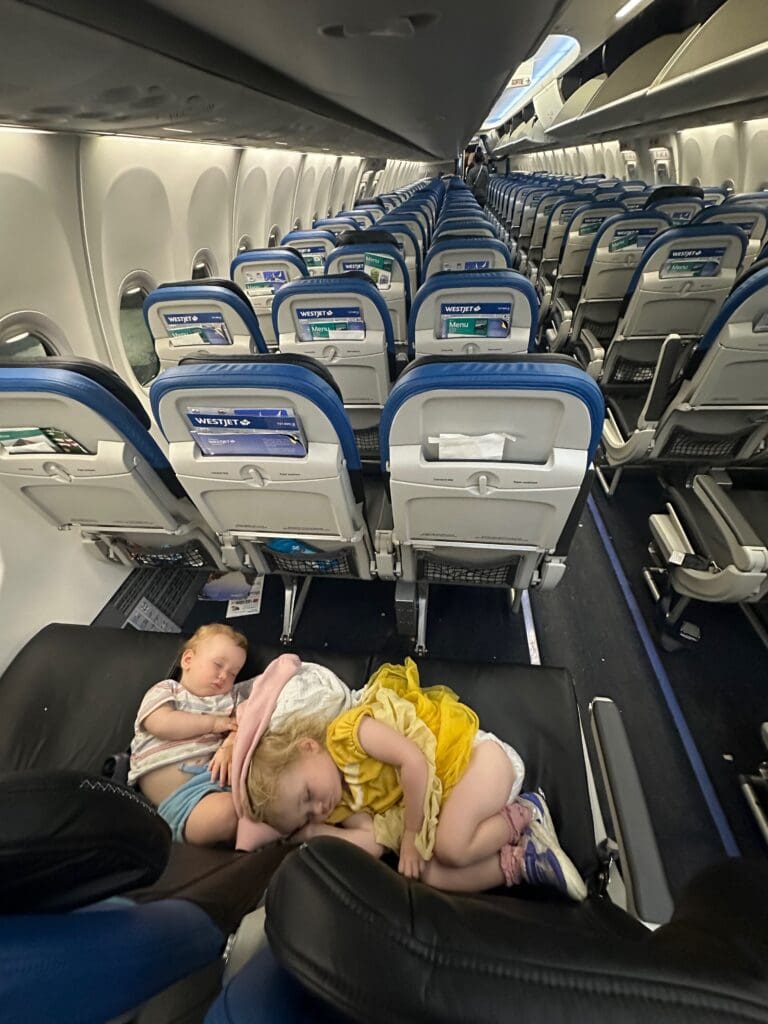
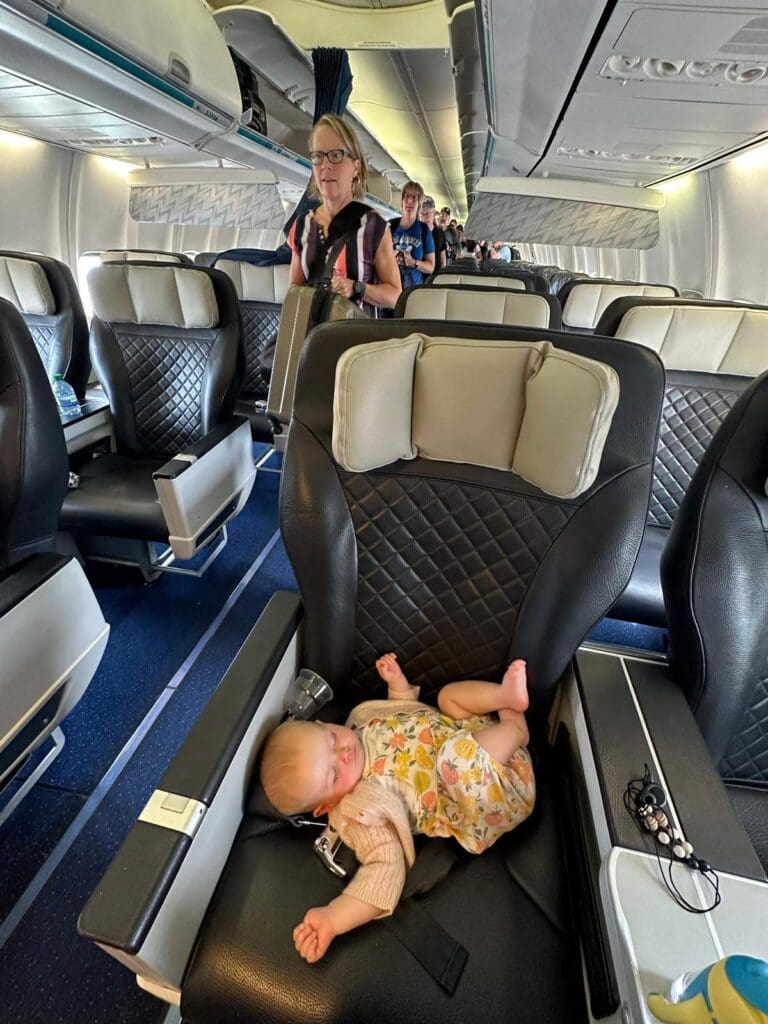
Traveling with kids is a special kind of madness. No matter how many times we do it and how prepared we may think we may be, something always goes wrong. We’ve been puked on when the seatbelt sign is on. Luggage has been lost, connections missed, and snacks forgotten.
But somehow, we always come back to do it again. Not because it’s easy, but because the experiences will leave lasting imprints on our kids (and us) to help form good character throughout life. One hack we’ve learned is to have a good travel bag. And after receiving and testing dozens of bags the past few years, we’ve found a few that really stand out.
Take a look at these bags and give them a try. We’re confident that there will be one to suit your need, whether the tiny and packable to the extra large and premium.
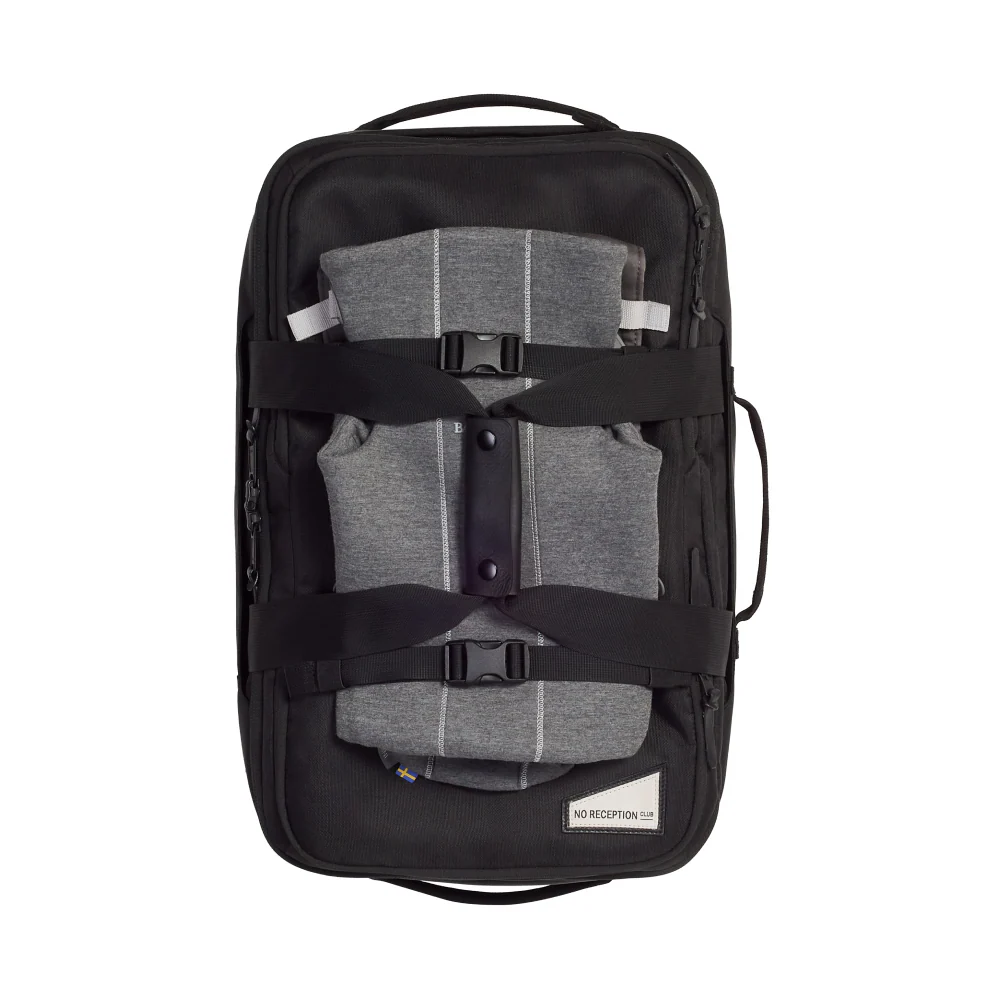
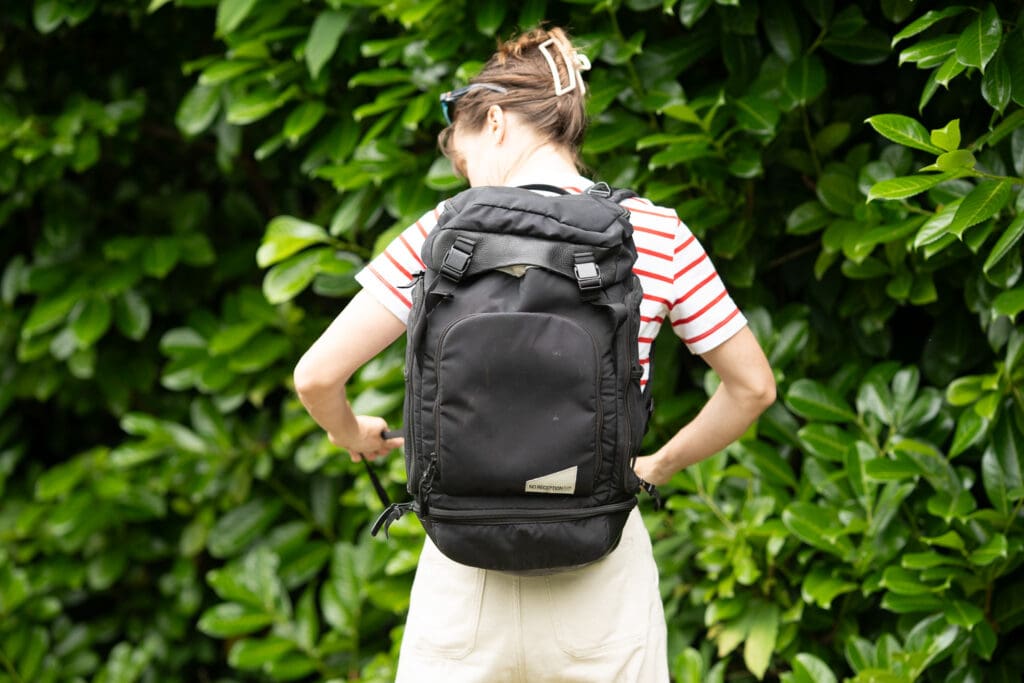
We are big fans of the No Reception Club bags, in all their different shapes and sizes.
Bottom line: If you need only one bag, the No Reception Club Hideaway Duffel is the premium piece of equipment that will keep you organized and build better packing habits.
How We Tested The Travel Bags
These bags have been taken on planes, trains and automobiles; to sandy beaches, and to cold mountain cabins. Since having kids we have spent most of our time at home in British Columbia, home to the coastal rainforest, west coast beaches, and the mountains of the Sea to Sky. We’re also fortunate enough to have friends in Hawaii that we house-sit for, so we go there at least once a year — sometimes two or three (with gratitude). So the bags we take along the way have been through pretty much every climate except arctic and desert.
Our Picks for the Best Family Travel Bags
Pick
Best for
Price (USD)
Capacity
No Reception Club Hideaway Duffel
Organization
$295
42L
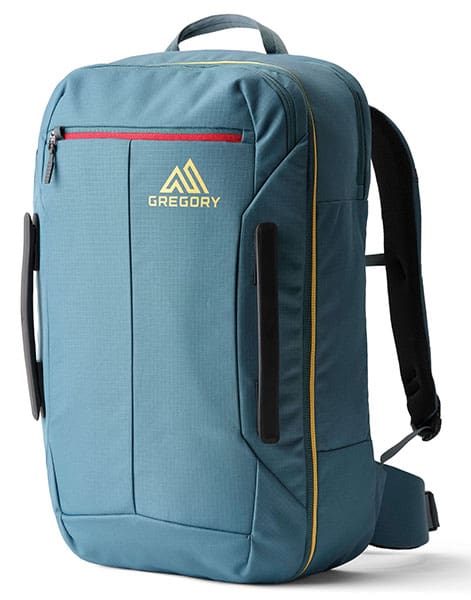
Gregory Border Carry-On 40
Weekender carry-on
~$180–200
40L
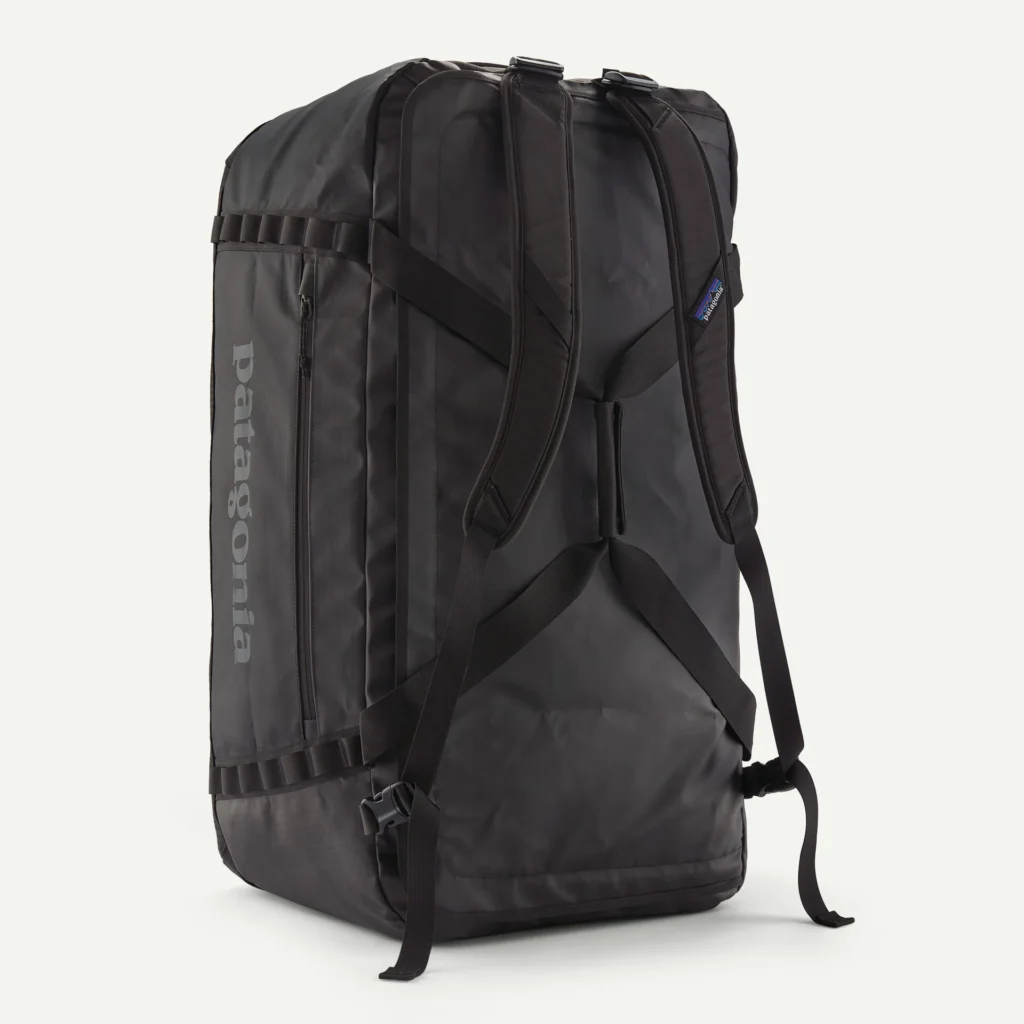
Patagonia Black Hole Duffel 100L
Large hauls
~$225
100L
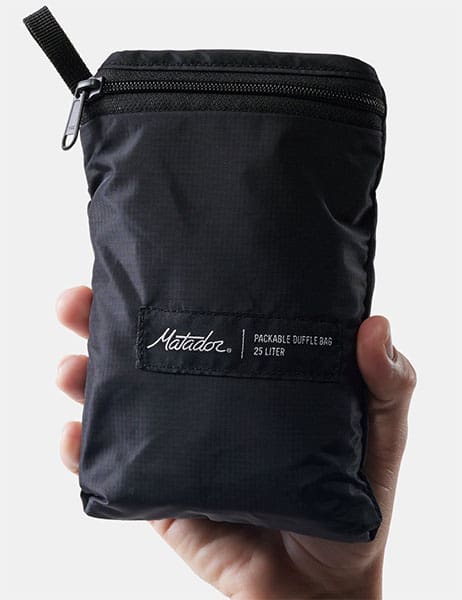
Matador ReFraction Packable Duffle
Packable day bag
~$55
25L
Specs verified July 2, 2026 against manufacturer pages. Prices vary by retailer and region — check before you buy.
Best Overall: No Reception Club Hideaway Duffel
Bottom line: Thoughtful design that made us better at packing. You learn how to be more organized just by using this bag.
Pros
✓ Organizing is a breeze
✓ Bag is durable
✓ Removable laundry sack keeps dirty clothes separate
Cons
✕ It’s pricey
At a glance
Price: $295 USD [VERIFY: CAD price — you listed $340 CAD; confirm on noreceptionclub.com]
You don’t get many mom-and-pop brands out there making game changing equipment these days, but that’s just what Gemma and and Daniel Ng have done with No Reception Club. As parents themselves, they were frustrated with what the current market offered for a diaper bag on the go. Several years later and their bags have been a huge success.
It started with the backpack-enabled Getaway bag, which made taking kids on the plane a whole lot more bearable and organized. Their latest offering, the Hideaway Duffel, expands on that success by offering more space for longer adventures.
Our favourite feature is the removable laundry bag that allows you to separate the filthy from the flawless. While the price is up there, the time saved is well worth it.
Gregory makes some excellent backpacks for overnight hikes, so I was curious to try out a different offering of theirs. The Border is a travel backpack is well thought out, allowing you to stash a bunch of stuff in a carry on and open it up in a hotel room without things going everywhere.
The pockets have a good flow to them, from the two large main ones on either side to the multiple smaller item zips that attach to the outside. It’s great for speedy packing on the go, which seems to always happen to our family as we rush to beat the checkout time.
It’s not necessarily family-sized, but will suit the parents, at least, or do well in warmer climates when less clothing is needed. Either way, it’s durable and easy to pack quickly, which is why it earned its keep on this list.
Best Large Travel Bag: Patagonia Black Hole Duffel 100L
Bottom line: If you just want to toss everything in and go, this will do it for you.
Pros
✓ Packs up for easy storage
✓ Super durable
✓ Now PFAS-free [VERIFY: confirm current DWR/PFAS status for this exact model on patagonia.ca]
Cons
✕ Can be awkward to carry if you have other bags too
At a glance
Price: ~$225
Capacity / weight: 100L/56.3 oz
Best for: When space or weight isn’t an issue
Good to know: 100% recycled polyester ripstop with recycled TPU laminate, stuffs into its own pocket, removable backpack straps, Fair Trade Certified
Patagonia needs no introduction, but most people know about their clothing and outerwear. Their bags are no slouch either. This duffel is the go-to for big family adventures when we want to pack it all. We have even made it a traveling beach getaway in one kit.
It’s large, durable, and even packs up to stash away when you don’t need it. It’s nothing fancy, but that’s the point. It’s a big duffel bag to toss in as much as you can, and won’t easily rip. Plus, you can add shoulder straps to lug it on the back. Not the easiest solution, but its better than one of those massive suitcases that takes up space in the closet when not being used.
Best Packable Bag: Matador ReFraction Packable Duffle
Bottom line: A perfect day-tripper that packs to practically nothing and weighs a few ounces, but still holds 25L of essentials.
Pros
✓ Really packable — folds into its own pocket
✓ Strong straps
Cons
✕ Easy to stain — we prefer the black for this reason
At a glance
Price: ~$55 USD
Capacity / weight: 25L · 7.9 oz (225 g)
Best for: A day bag that packs into your luggage when travelling
Good to know: 100D recycled nylon, PFAS-free, YKK zippers, 3-year warranty
We all need a day bag, but packing an empty one can waste some precious cargo space. Matador makes some excellent travel bags that are easy to pack,a nd we found the ReFraction to be in a sweet spot for carrying a good amount of gear during the day, and packing up to a tiny size when in transit.
There’s nothing special about how its organized, but we can attest to its durability, having been a diaper bag tossed in the car, a mobile beach diaper bag, and a snack kit that always held up over the past few years.
How to Choose a Family Travel Bag
Choosing the right travel bag for your family depends a lot on your style. Are you already super organized? Do you have some extra cash or are on a budget? Do you need compartments, or just one big place to stash and spray out when getting to your rental? Answers to these questions and more will help you narrow it down.
Pockets: Is there a good mix of large and small?
Wet/dirty space: Is there a spot for wet or dirty clothes and/or diapers?
Material: Is it water/mud repellent? And how will it look with some rogue marker artwork by your toddler? Black is usually best — unless you enjoy a bit of DIY design from your kid.
Sanity space: Can you fit a book/tablet/laptop in as well, for when you need some time to yourself?
Space for valuables: Is there a small pocket for keys/wallet/phone that’s easy to access when needed — and safe from a stray hand?
Attaches to other bags: Can it fix onto a pull handle for rolling luggage? Can it be worn as a backpack?
FAQ
What size bag do we need for a family trip?
Rough rule of thumb: a 40–42L carry-on covers a few days for one or two people, while a 100L duffel swallows a full family’s clothing for a longer haul. Many families run one big bag plus a packable day bag.
Carry-on or checked?
The odds are you’ll need both. Kids require so many accessories. We fought it for a while but realized that it’s not an easy task to pack light. But a carryon is essential when you need to entertain kids, keep them fed, and have spare diapers. If you can travel with only a carry-on, please reach out so we can interview you and hear your secrets for the world to hear!
How do you keep dirty or wet clothes separate?
Some bags have special compartments or features. The Hideaway Duffel has a laundry sack built-in that has saved us numerous times. Gregory’s Border bag has
The Final Word
If you want one bag to rule them all, go for the Hideaway Duffel. It has literally made us better at organizing things by its layout. But each bag in this review stands out in its category, and we use them all for their specific reasons, going as far as packing them all on long-haul flights. We’ve tested others, but these ones rose to the top.
Whatever the best bag for your family is, make sure it’s built to last. They will get punished over the years, if everything goes to plan. Hopefully this guide helped you narrow some choices down a bit further. If you need any help, please get in touch, we’re happy to answer any questions and help families navigate the beautiful chaos of traveling with little ones.
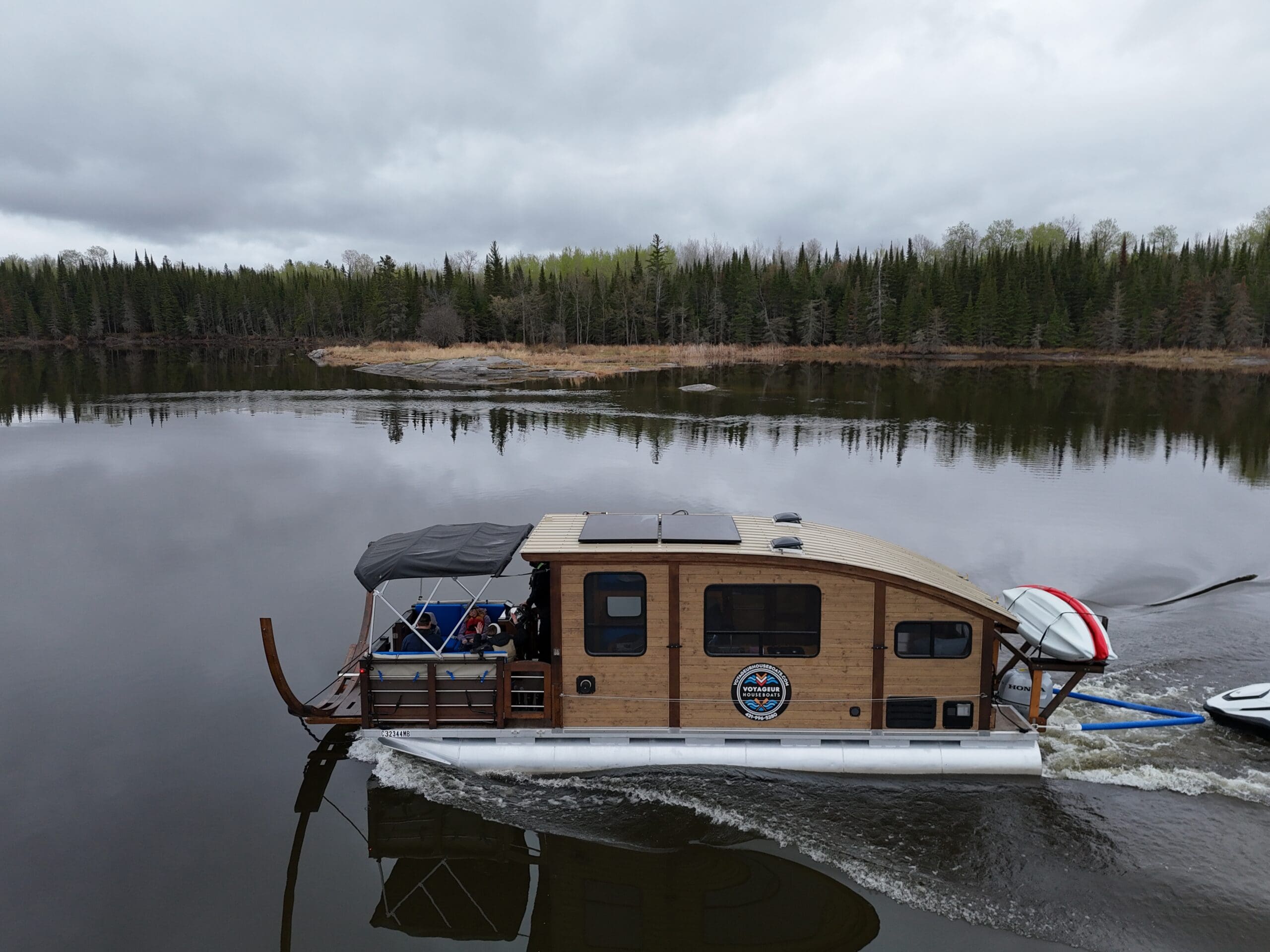
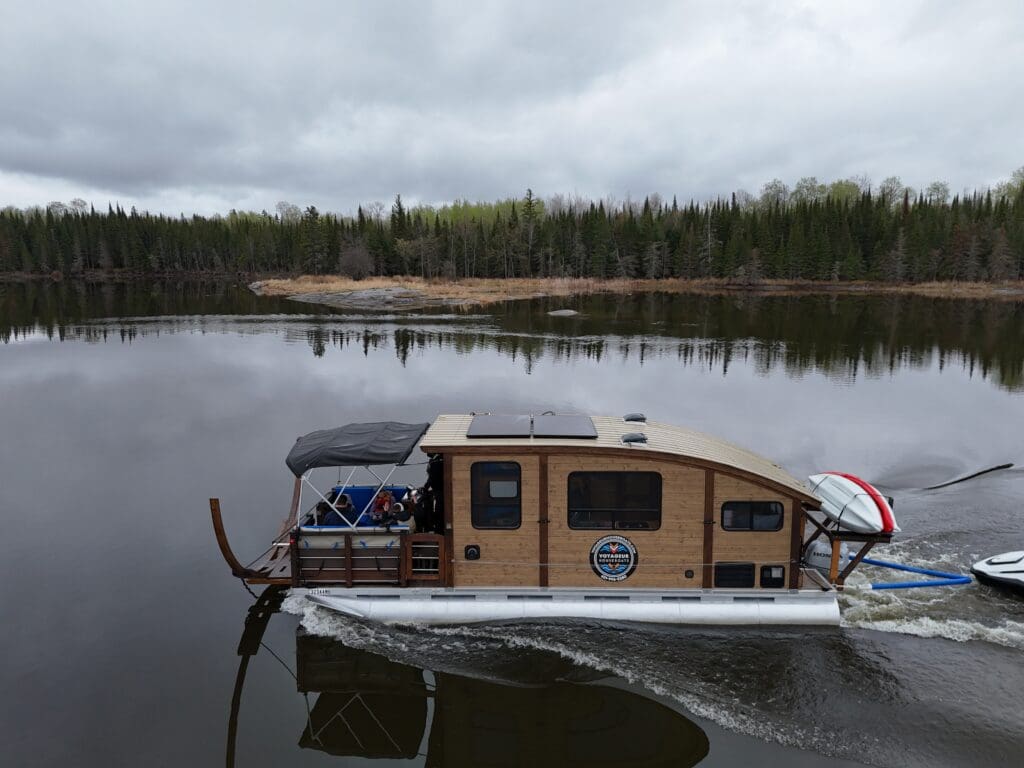
Sometimes life throws you lemons, while other times, sumptuous summer strawberries. Here is the latter, an excellent adventure aboard a comfortable and cozy houseboat along the scenic Winnipeg River. With summer upon us, so is the season of the houseboat.
A splash of inspiration pour vous, whether or not you’ve experienced adventures aboard a houseboat. If you’ve thought what family life on the water might look like, but feel it slightly daunting, not knowing where to begin or what the weather conditions may bring, a houseboat adventure is a good place to dip your toes, get your feet a little wet, so to speak.
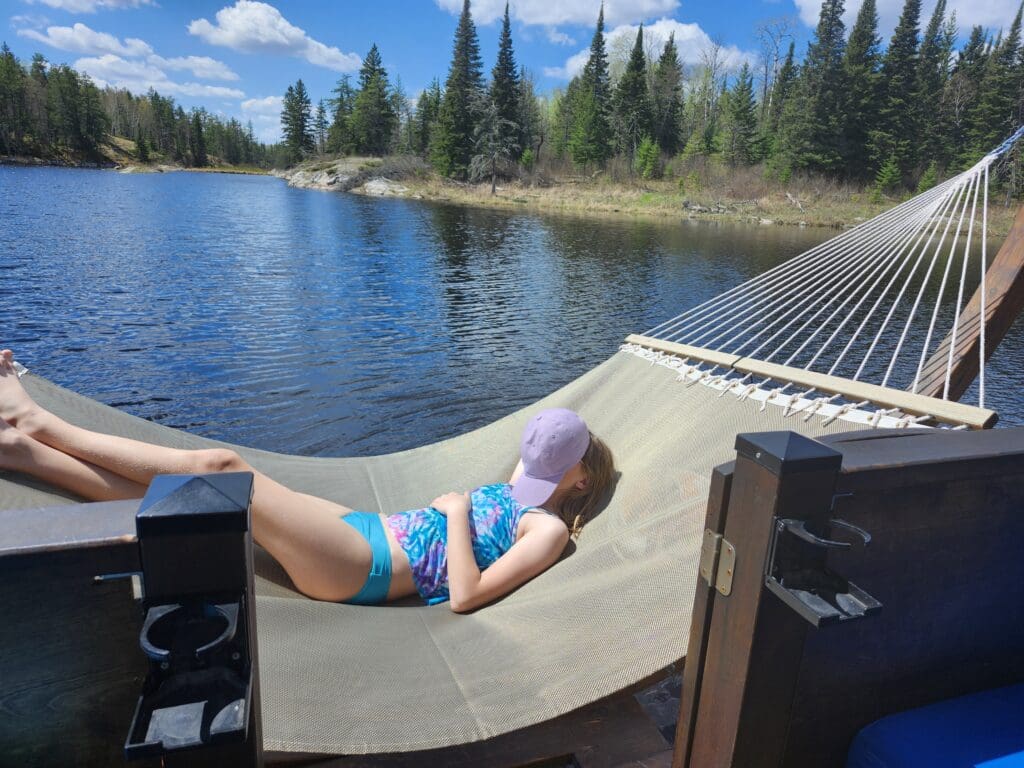
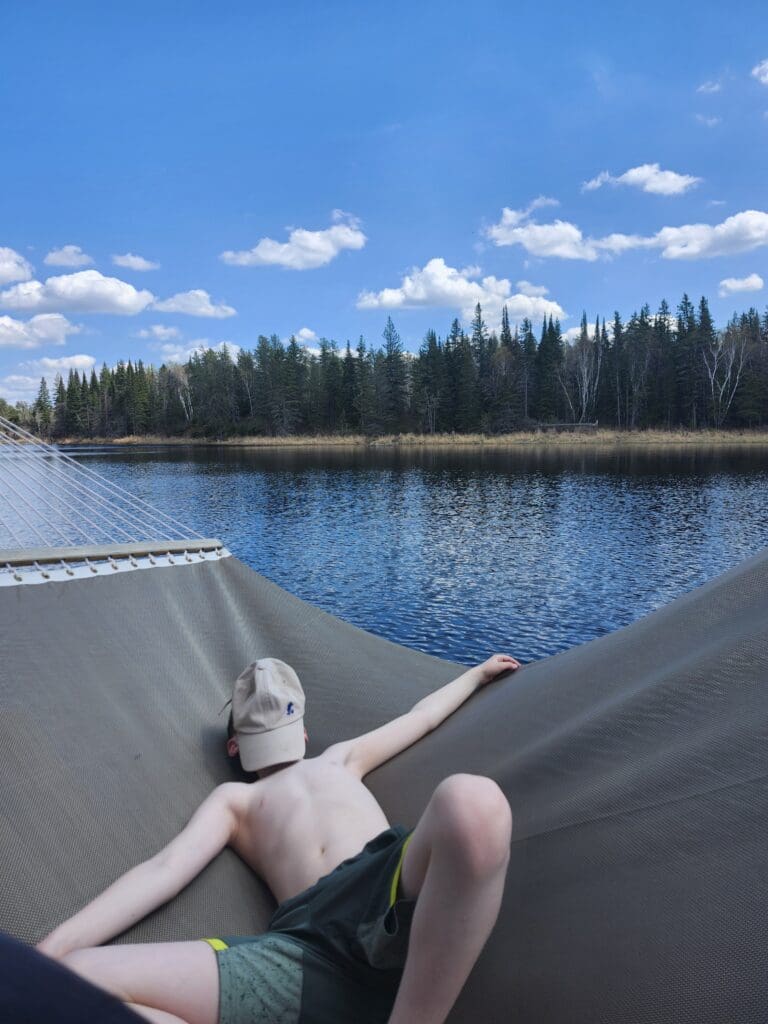
With that, I bring you a guest post from our most excellent pals living over yonder in ye olde Manitoba. Thanks to Alicia for your inspiring words, Eric for capturing the moments, and to Emi and Everett for soaking up that hammock!
You’re speaking my language Emi. Could there possibly be a better spot to relax on a hammock?In case you’re not convinced. Everett chillin’ and inspiring.
A Family Adventure We Won’t Soon Forget: Houseboating on the Winnipeg River
Some of the best family memories are the ones you never quite expect.
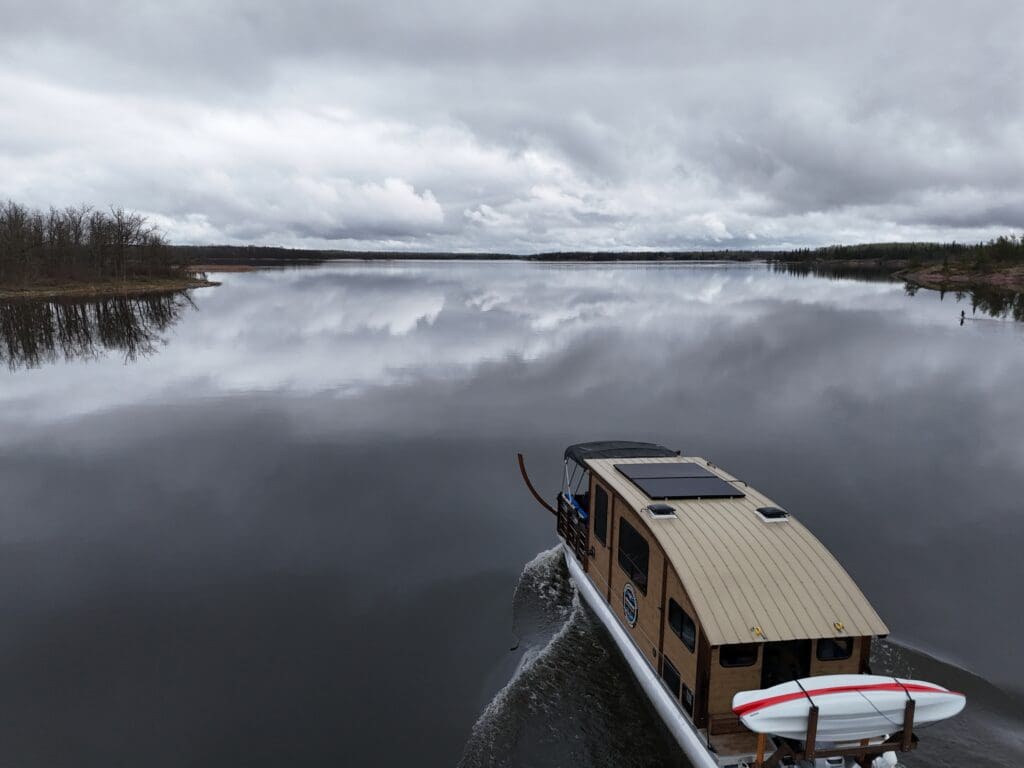
At the end of May, we went on a family adventure aboard a Voyageur Houseboat on the Winnipeg River. The weather wasn’t exactly cooperating (we got plenty of rain and cooler temperatures), but we wouldn’t have changed a thing. In fact, we discovered that there is something very special about a cozy, off-season adventure with your family.
Living in Pinawa for the past five years, we’ve come to appreciate life on the Winnipeg River. For my husband, though, these waters have been part of his life since he was a kid. He grew up spending summers at his family cottage in Pointe du Bois, exploring the river and later working as a fishing guide. We’ve spent many days boating and sailing as a family, but experiencing the river from a houseboat gave us a whole new perspective.
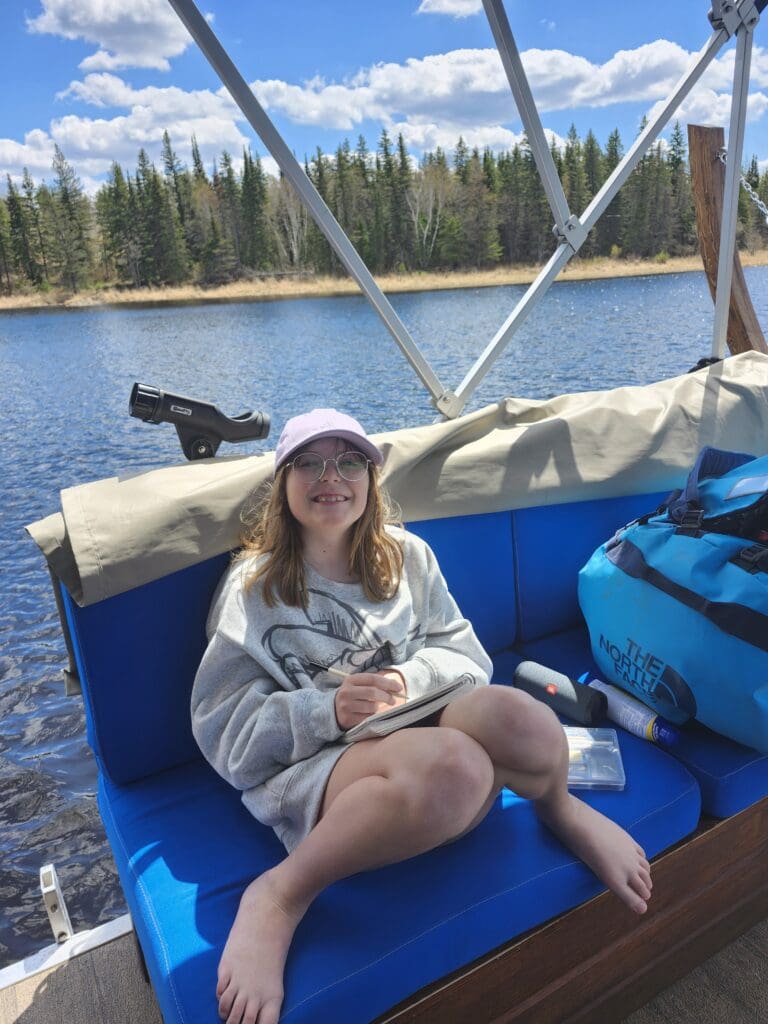
The thing I loved most about the experience was how easy and stress-free it was. Being an outdoorsy family, we are used to canoeing into the wilderness and packing all our food and lightweight gear over portages – and while we love doing this, there is a lot of work involved. What was so different was that this trip was completely guided, and everything was thoughtfully set up for us, from the cozy hammock on the front deck to the perfect spots to anchor and spend the night. The adventure also included kayaks so that we could set off and do some exploring ourselves. While it felt a bit strange at first (mainly for Eric) we very quickly got used to just sitting back and enjoying all the extra time we had available to us by not having to do the work.
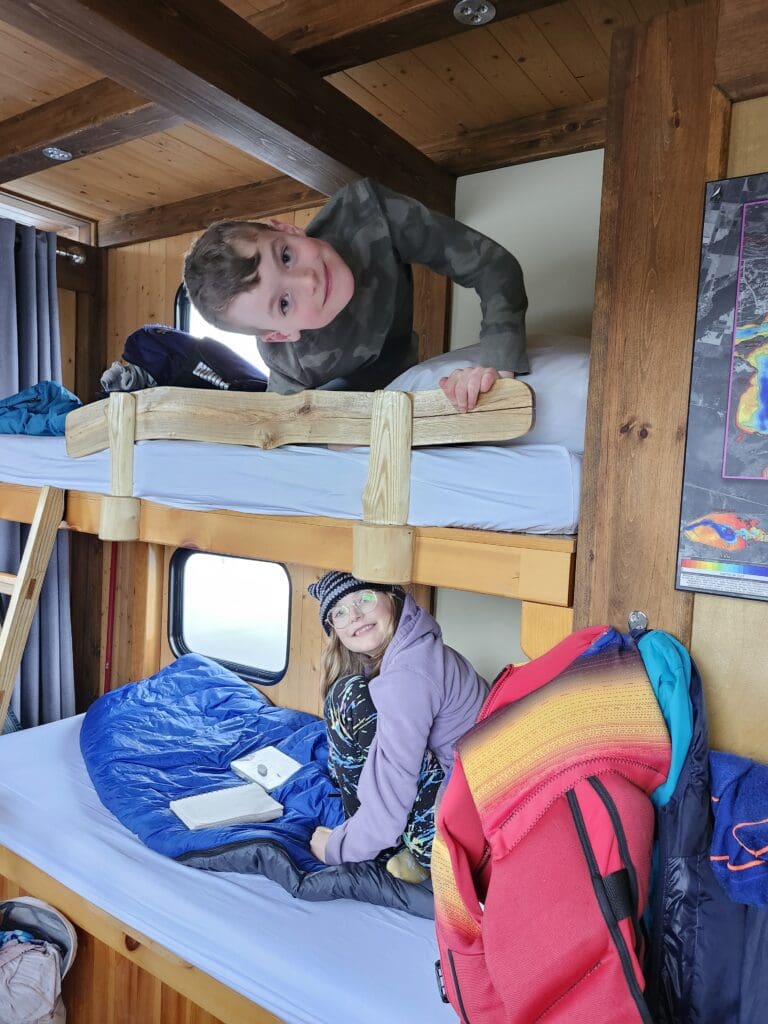
Our kids, ages 9 and 11, embraced houseboat life immediately. The front hammock quickly became their favourite place to relax (and a spot to fight over – I’m sure many parents can relate;). And, of course, the bunk beds were instantly a source of entertainment (luckily there was some agreement there!). Every night felt like a fun sleepover peacefully floating on the water.
The rain didn’t slow us down (we always pack our rain gear!). We played games, got out for a hike, and relaxed in the comfort of our floating cabin. One evening, we paddled over to Otter Falls Resort for a delicious supper and ice cream – a definite highlight of the trip.
As parents, we often feel pressure to fill vacations with activities and schedules, but this trip reminded me that a great getaway doesn’t have to be complicated. One of the things I appreciated most was how little planning was required. The houseboat came stocked with a lot of great stuff. A fully equipped kitchen, a bbq, up to 4 kayaks, binoculars, towels, a hot shower, to name a few! The dry composting toilet turned out to be surprisingly smell-free and became a fun science lesson for our kids (haha). Everything was thoughtfully designed, so we could spend less time organizing and more time enjoying ourselves!
Is the idea of flying with your kids enough to make you stop in your tracks, stay home and dream of the ‘one day’ when things will become easier? Word on the street – that ‘one day’ ain’t coming. It’s time to embrace doing the hard things now, and the more ya do it, the easier it’ll become. Especially when equipped with the right tools.
The tools of the travel trade begin with your luggage. Believe you me, as an ex-flight attendant with ADHD, I wholeheartedly know the value of staying organized while on the fly. Your bags are the backbone of your trip, to feeling grounded while on the move, lugging your gear and your kids prized possessions.
Bags that make travelling with kids a little simpler.
Look no further than No Reception Club. These thoughtfully designed bags have come from a set of real-life (local Vancouverite) parents whom found a gaping hole in the market of organized travel with kiddos.
The idea of No Reception Club was birthed when their first was just a wee babe, on a 6 hour flight to Hawaii. Where, oh where were their diapers and wipes? With limited opportunity to get up and use the lavs on bumpy busy flights, you don’t want to be stuck questioning where your essentials are, believe you me. Thus came the idea of creating the best possible carry-on baby/toddler/kid bags on the market. They have succeeded, with not 1, but now 3 said bags, and rumour has it a wheelie bag is in the near future.
Blending Gemma’s background in fashion design and Daniel’s idea-generating mind in tech, they care deeply about creating the best kid travel bags out there and the world our children inherit. They know the importance of travel, the lived experience education gained and the connection that comes from being disconnected – to have No Reception.
We could’ve written their mission statement ourselves:
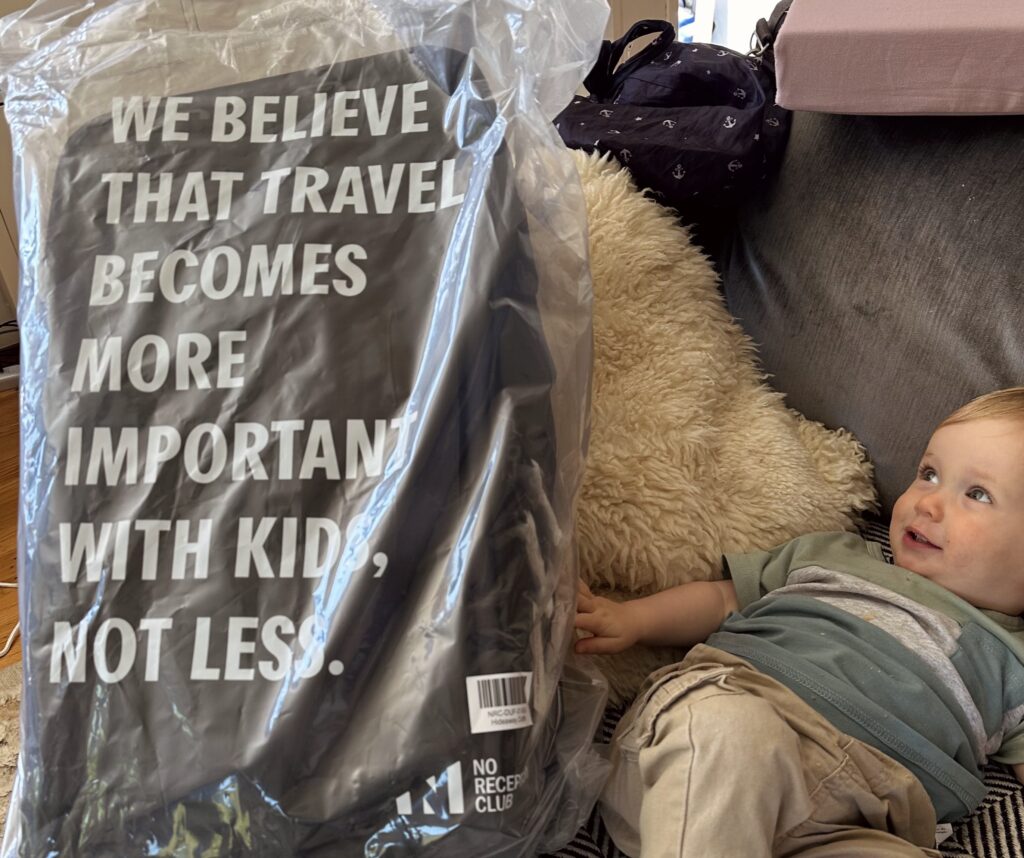
‘We empower parents to go on family adventures because we believe travel becomes more important with little ones, not less.’
Yup. We can get behind their motto. What’s a motto? Nuthin, what’s a motto with you? 😉
With their lifetime warranty, they stand behind their product. And so do we.
Their multi-award winning travel bags, the Hideaway Duffel and the Getaway Bag are so beautifully planned, they’ve kept my jet-lagged and sleep-deprived mind far less messy on the road. No more forgetting which pocket the passports are in when you’re struggling with sleeping kids off a red-eye. I will give a brief summary of why we choose their bags. You can find far more info, more specs and a great blog on their website.
Have we all been here? When the kids finally fall asleep towards the end of the flight, and you wanna maximize their zzz’s, so you wait until the very last minute once you’re organized, to pick ’em up.And again. Too hard waking up a sleeping bébé.
The Sidekick Bag
Our well loved Sidekick bag, kickin’ around for the past 3+ years.
We’ve used the Sidekick bag on the daily since our now nearly 4 year old was just a baby. It’s handy, it’s light, it’s simple and straightforward. It’s conveniently equipped with a change pad, and space for diapers, bum cream – all the essentials. The designated magnetic quick-access pocket for wipes is clever. It feels fuss free, perfect for keeping stashed in your car or stroller, conveniently on hand for whenever the poop face strikes. It’s made simply for diapers, nothing else (other than maybe a few small toys – if you need some help entertaining your wee one while in diaper change mode).
The easy access magnetic opening wipe door.
The Getaway bag 4.0
Our version 1.0 of the Getaway Bag. We be lovin’ this OG just as it is for over 3 years.
No Reception Club bags are designed to evolve with your kids, and that’s just what the design of The Getaway Bag is doing as Gemma and Daniel’s ‘third kid’. They’re not only figuring how to make the most organized bag, they’re answering the question of how to be the most comfortable product on the market
Your backpack will never be heavier and stuffed with more stuff, than when you have a very small child. An organized and comfortable backpack needs to be emphasized during this phase of life.
They’re answering their call to comfort with their latest upgrades. The latest version comes with contoured shoulder straps, an air strip down the back with more structured and denser foam to keep things cool and cozy while navigating airports and new places. They’ve also added a secure sternum strap that stays in place while moving around. The trusty award winning bag still has the same ol’ wonderful design, the inside shelves flexible and removable to arrange different items as interests mature. Feeding, changing, entertainment divided organized shelves, accessed by a side panel and top opening. The opposite side panel zippers open, to reveal an opening that conveniently fits the sidekick bag or any other must-haves.
Our well loved Getaway bag and it’s side shelves.
Also, winning extra points on their social service, direct from their website: ‘Every Getaway Bag sold will help Baby2Baby distribute 20 diapers to a baby in need.‘
The Hideaway Duffel
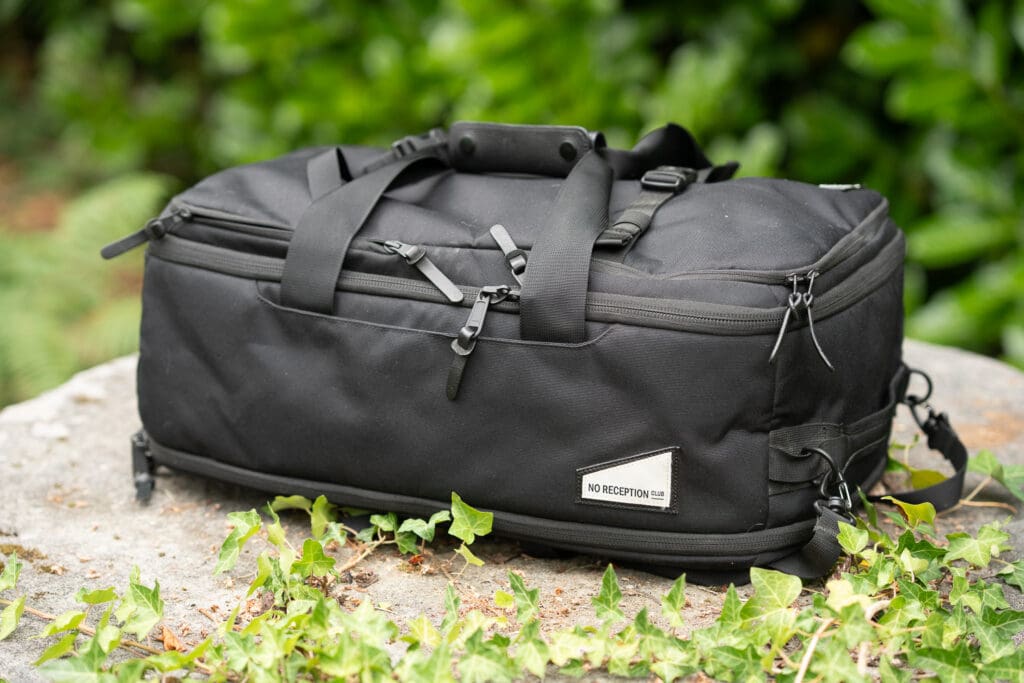
Not just the best bag for long haul flights, we bring this puppy everywhere, ready for all totally excellent adventures!
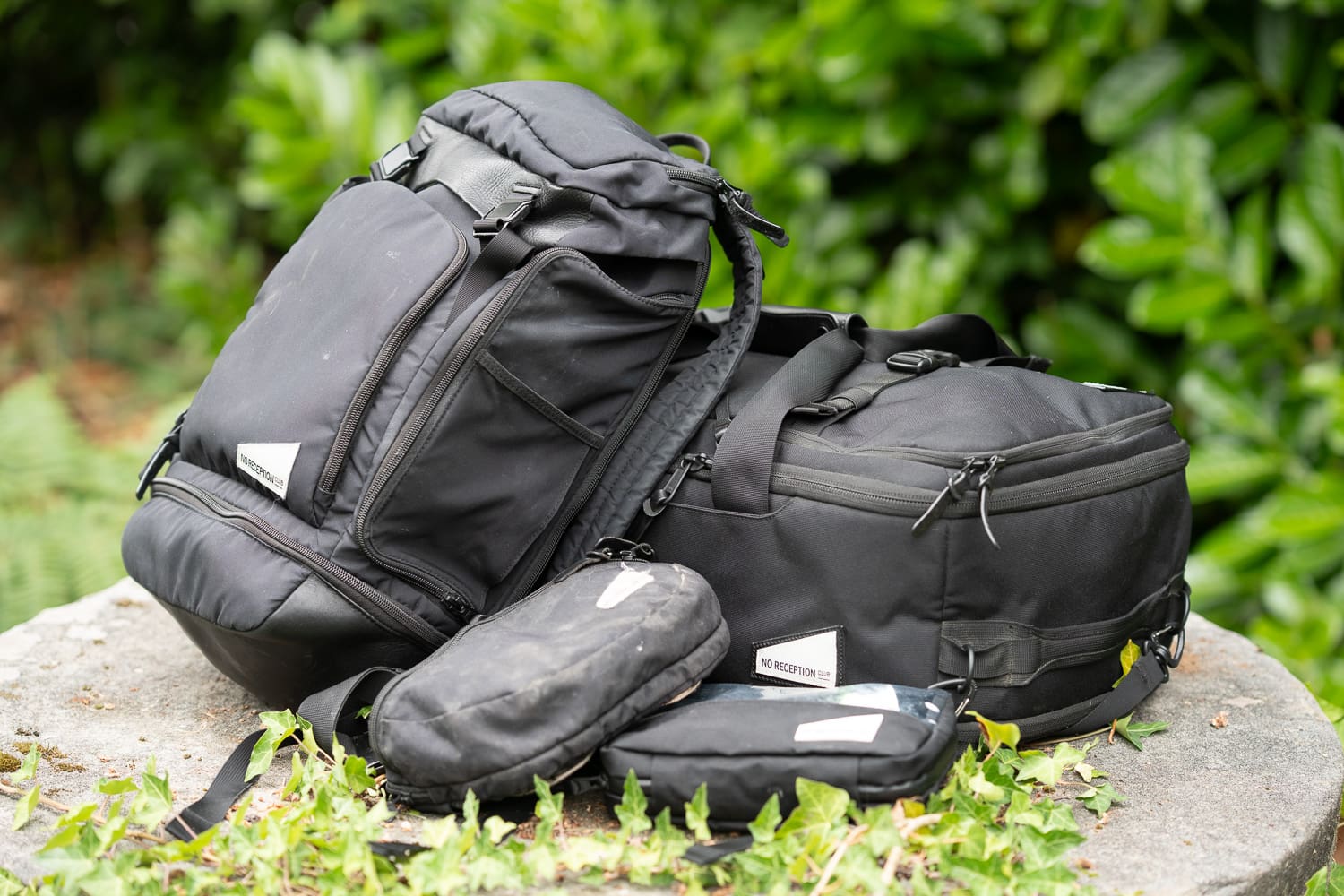
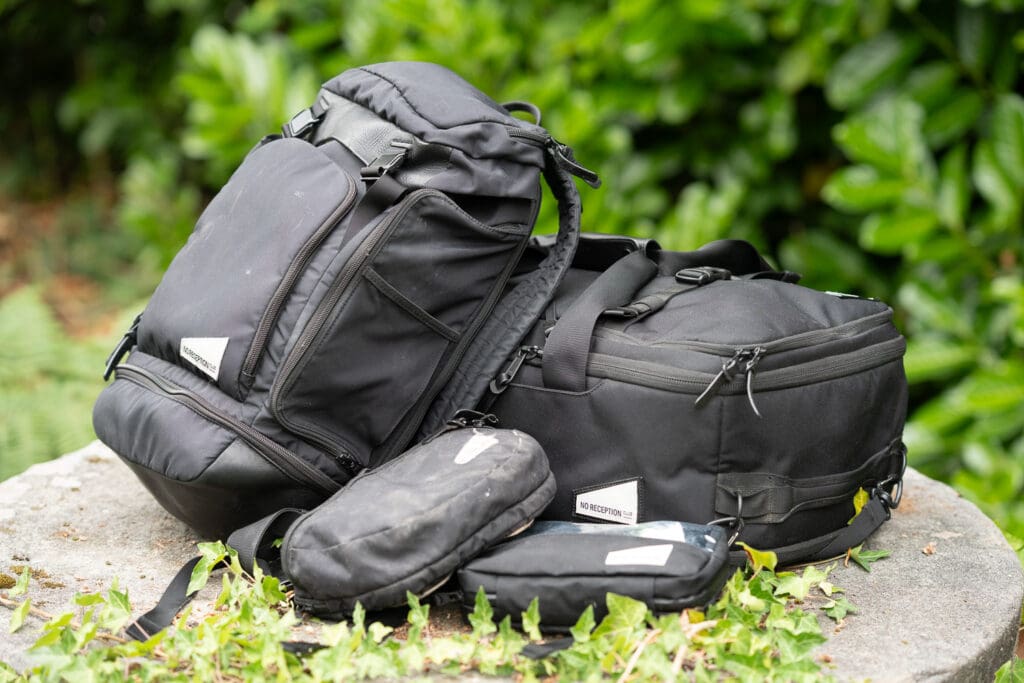
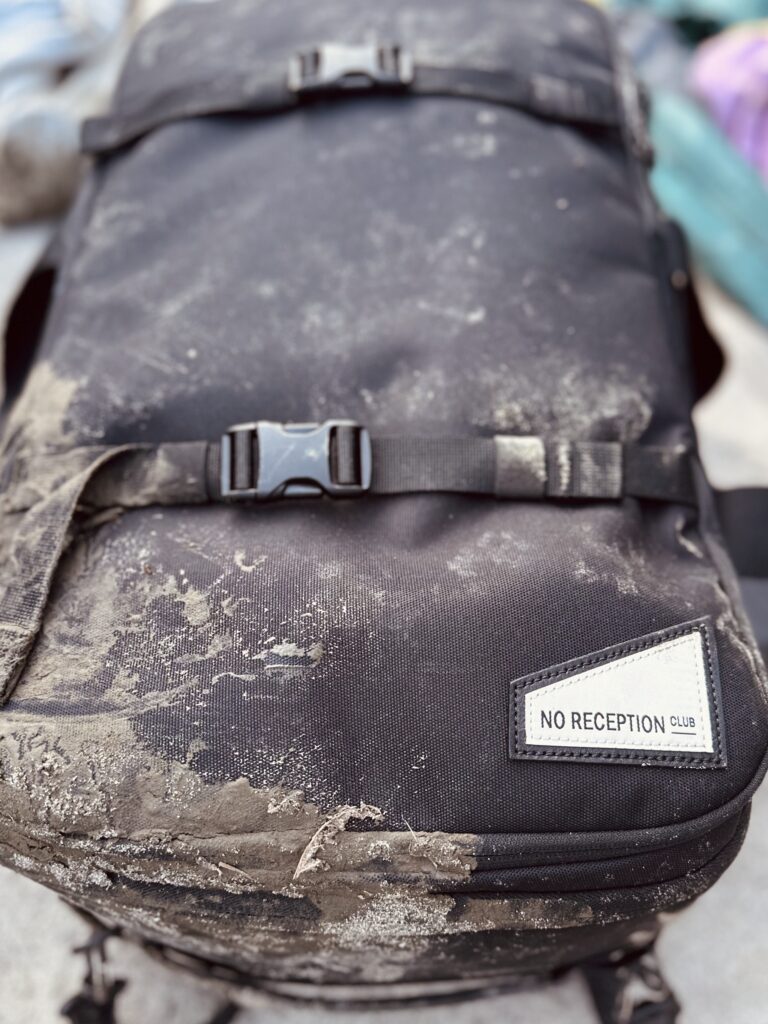
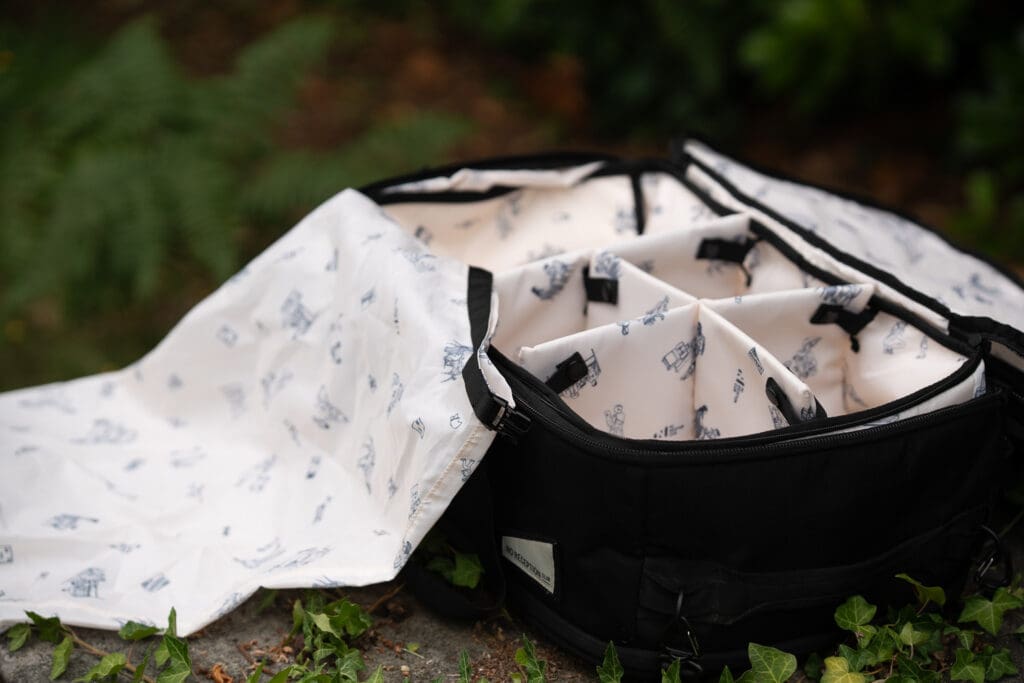
The real test came when I slipped in the mud while crossing a stream to get to our backcountry campsite. Although muddy and wet on the outside, the goods inside were intact, dry and clean. Once the mud dried, it easily wiped off, and now over a year later, looks brand new (see first image) thanks to the durable CORDURA® Eco 600D/1200D polyester shell.
This duffel is a narrow personal fave of all No Reception Club’s bags. Although each bag serves a different purpose, this one tames my ADHD sleepy travelling mind the most. I use this bag less while on the go/flights, but more once we arrive. With a customizable and removable organizer insert aka ‘the cubby’, I can keep my daughter’s clothes, jammies and toys separate from my son’s. It’s 42 litre capacity is perfect for 2 toddlers, also meeting the allowed carry-on dimensions. We may have to purchase another down the road to grow our bag space with our growing kids, or just get used to packing less.
Laundry bay on left, cubby installed to divide and conquer!
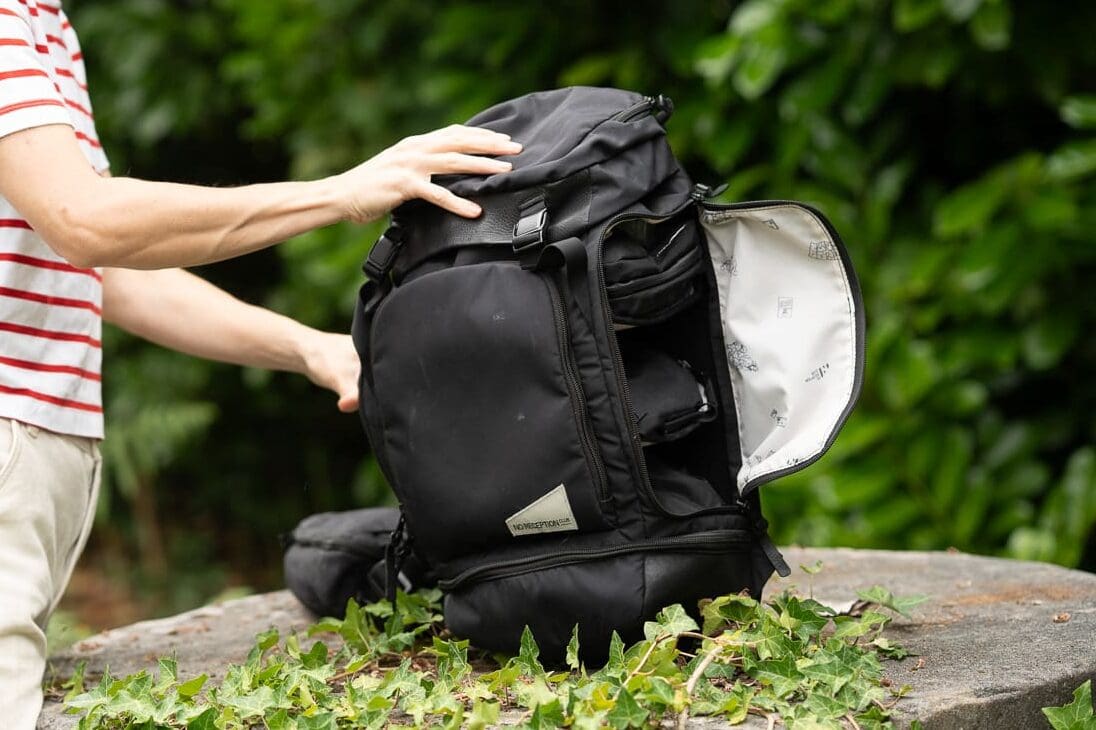
The added laundry bag is brilliant, as are the odour resistant compartments to keep your stinky socks and soiled shoes in. The handy stash pockets are created to fit easy access items, such as toys, books, and NRC’s accessories – the Dopp Kit, sliders and/or their insulated lunch kit.
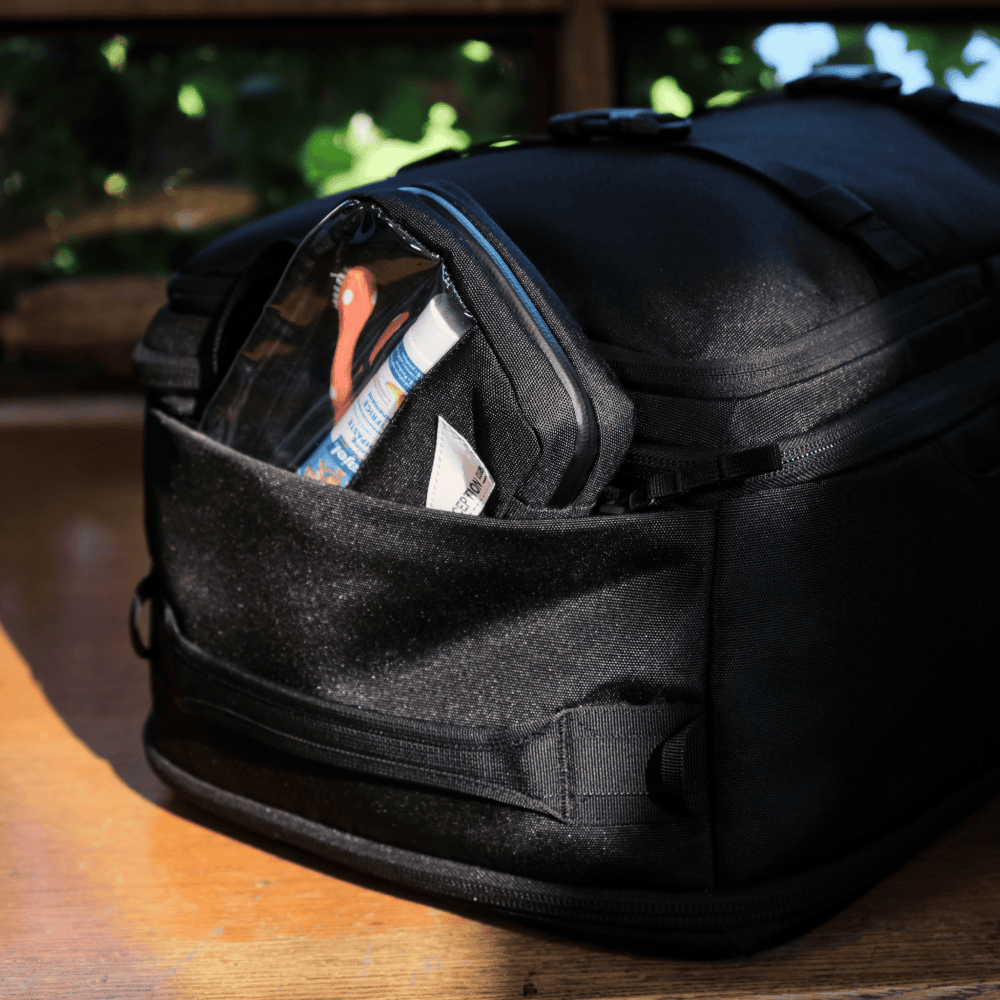
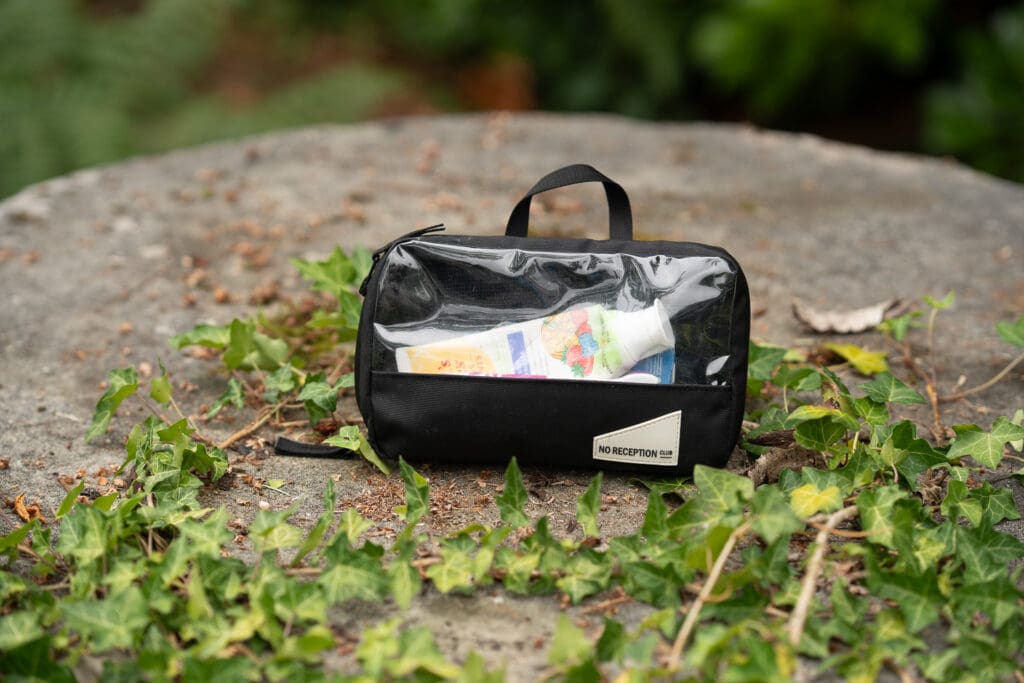
c/o No Reception Club. Their kids toiletry bag – The Dopp Kit- fitting perfectly into the top pocket of the Duffel.
The Hideaway Duffel can also conveniently be carried in various ways, with backpack straps, a single shoulder strap, many handles, and a back pocket to fit over your rolley bag.
The Dopp Kit
Small but mighty. No Reception Club really does make feeling organized, with kids, seem simple. This toiletry bag is made for littles to fit their little stash of bathroom stuffs. For us, there’s enough space on short adventures, to fit mom and dad’s things too. With see-through windows and mesh pockets on the inside, no more hide-and-seek in a dark oblivion to find where their things are.
Comparison
Although not comparable in their use, here’s a quick rundown of price and size.
Bag
SideKick Bag
The Getaway Bag
The Hideaway Duffel
The Dopp Kit
Price
$100 CAD
$275 CAD
$345 CAD
$66 CAD
Use
Diaper Fanny Pack
Travel Diaper Backpack
Carry-On Carry-All
Kids Toiletry Bag
Size
3 Litres
24 Litres
42 Litres
23cm x 14 x 4cm
Cons
Can’t think of many. Some fun colours could be nice, as the selection is pretty basic. I get the bags are made for the parents to lug around, but our kids are sparkly, I could see them getting more onboard with them if they looked totally excellent through their eyes.
The price is slightly steep. With their lifetime warranty, you can hope that they’ll stick with your kid for life. I know once our youngest is out of diapers, we can easily repurpose the Sidekick fanny pack as a convenient carry all, and the backpack and duffel are certainly age-less.
If you’re looking for lightweight and flexible bags to take on your next backcountry backpack trip, these may not be for you.
In Conclusion
We’ve been testing No Reception Clubs bag for three years now. We can attest that their product is durable, excellent quality and built to last. With their ethics of paying it forward to baby’s in need, using mostly recycled materials, and inspiring families to get out there and explore, they are creating a better world world for our children – one bag at a time.
👍👍
Stay tuned
This review comes as No Reception Club just released their latest version of their Getaway Bag (June 2026). Word on the street is they’ll also be coming out with a roller bag. So keep your eyes peeled for the latest drop in their delightfully designed family of bags.
This may be entirely unnecessary, pretty sure these slippers write their own review, but today, is (always) the day to give praise where praise is due.
As I arise from bed on this dreary, Tuesday morning, with a few pairs of slippers to choose from, without thought or hesitation, my feet gravitate towards these baby’s. Every. Single. Time.
Let’s take a look at why Glerups are my queen in the kingdom of slippers.
What makes them the best?
Comfort. Over a few wears, the felted wool shapes to the contours of your feet, it also keeps it’s shape, and doesn’t cave in or expand drastically over time. The wool is miraculously itch free, as my skin is usually super sensitive to all things that go ‘baaah’. The wool acts as a temperature regulator, keeping your toes toasty in winter and cool as a cuke in summer. And if you have stinky feet? No worries, these won’t absorb the smell, they’ll also work as a barrier, so your SO’s nose doesn’t need to fret when they see you coming close.
Not only do they fit like a glove, the felted wool worn in just so (on my feet), the company is one of the good ones. They make one product, and they make that one product, imo, perhaps better than anyone else. Hailing from Denmark, notoriously known for it’s great design, these slippers are Scandinavian simple, chic and practical.
Earth-First
In addition to their incredibly thoughtful design, these slippers are created with the environment at the forefront of the entire circular design process, from the sheep to your feet.
Utmost care goes into all the materials, the animals and plants these slippers hail from. They carry the highest standard for humane animal care with their leather souls and wool, using Certified Responsible Wool (traceable to the exact location and farm it originated from), Forest Stewardship Council Certified natural rubber souls (zero harm caused from it’s source – the Hevea tree), and chrome-free leather. The slippers are also meant to completely break down after their (long) lifespan on your feet, rather than (most) other slippers that use petroleum and synthetic elements. Through their Project Zero Waste, Glerups upcycle all their scraps to make other handy things. They also don’t outsource, having complete control of their energy usage (solar power) and employee treatment. Go Glerups!
“…It takes time to make a pair of glerups. We don’t rush the process, but rather, we take our time. My parents spent many years testing and developing our product. They put a lot of hard work and many hours into glerups. All the way from the sheep to your feet. We take extreme pride in the fact that we own our own factory, partner with honest and caring farmers, and have eyes on every step of our value chain… My parents started glerups this way and their legacy will never be forgotten.”
– Jesper Glerup
With all that said, I’ll share a few pros to why my unconscious and conscious both choose Glerups.
Glerups Slip-on: The Facts
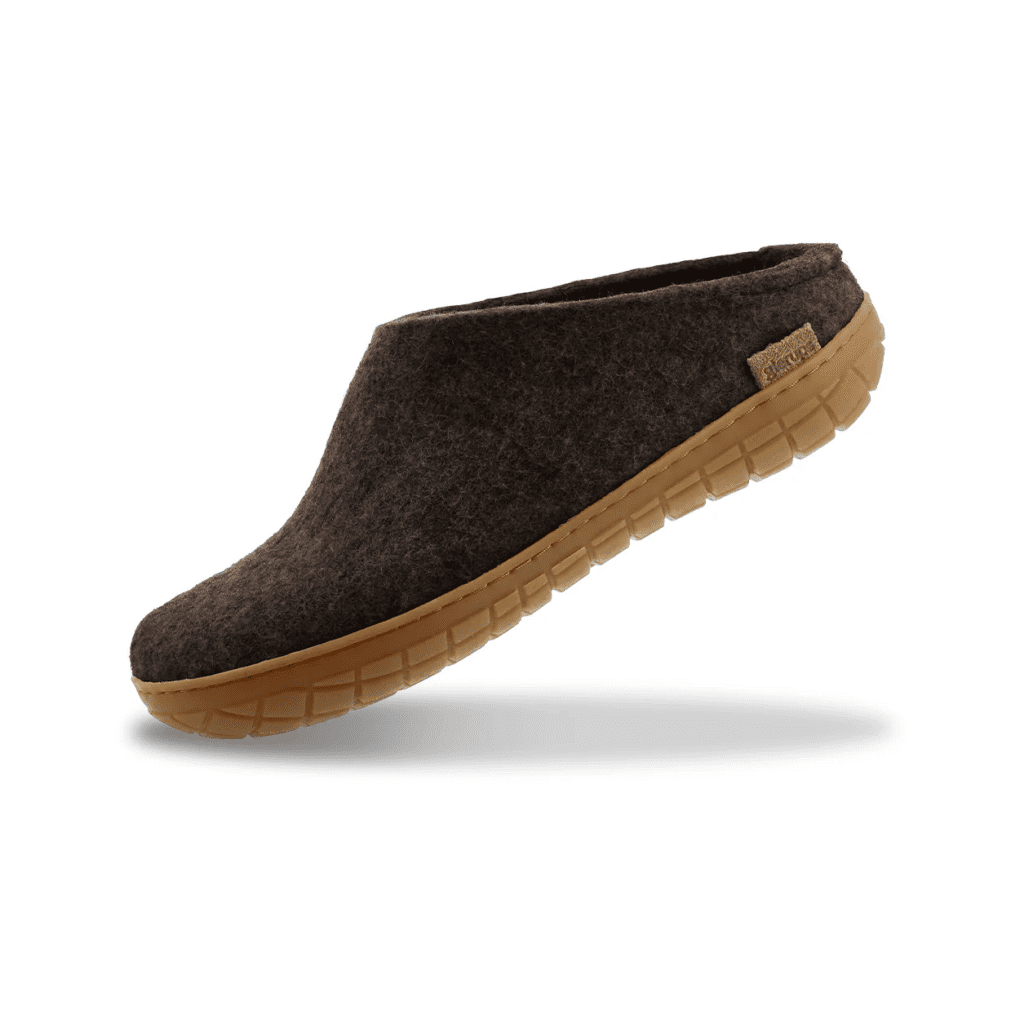
My go to, the Glerups Slip-on with natural rubber sole – honey – Chestnut
Price (as reviewed)
$119.95 (cdn)
Upper
100% pure, natural wool (available in 3 styles – slip on, shoe and boot)
Lining / footbed
100% pure, natural wool
Outsole
Natural rubber (also available in leather for less $$)
Fit
True to size
Warranty
Fully guaranteed against defects in materials and workmanship – without guarantee or expectation of service life
Specs verified June 11, 2026. Prices drift — check before you buy.
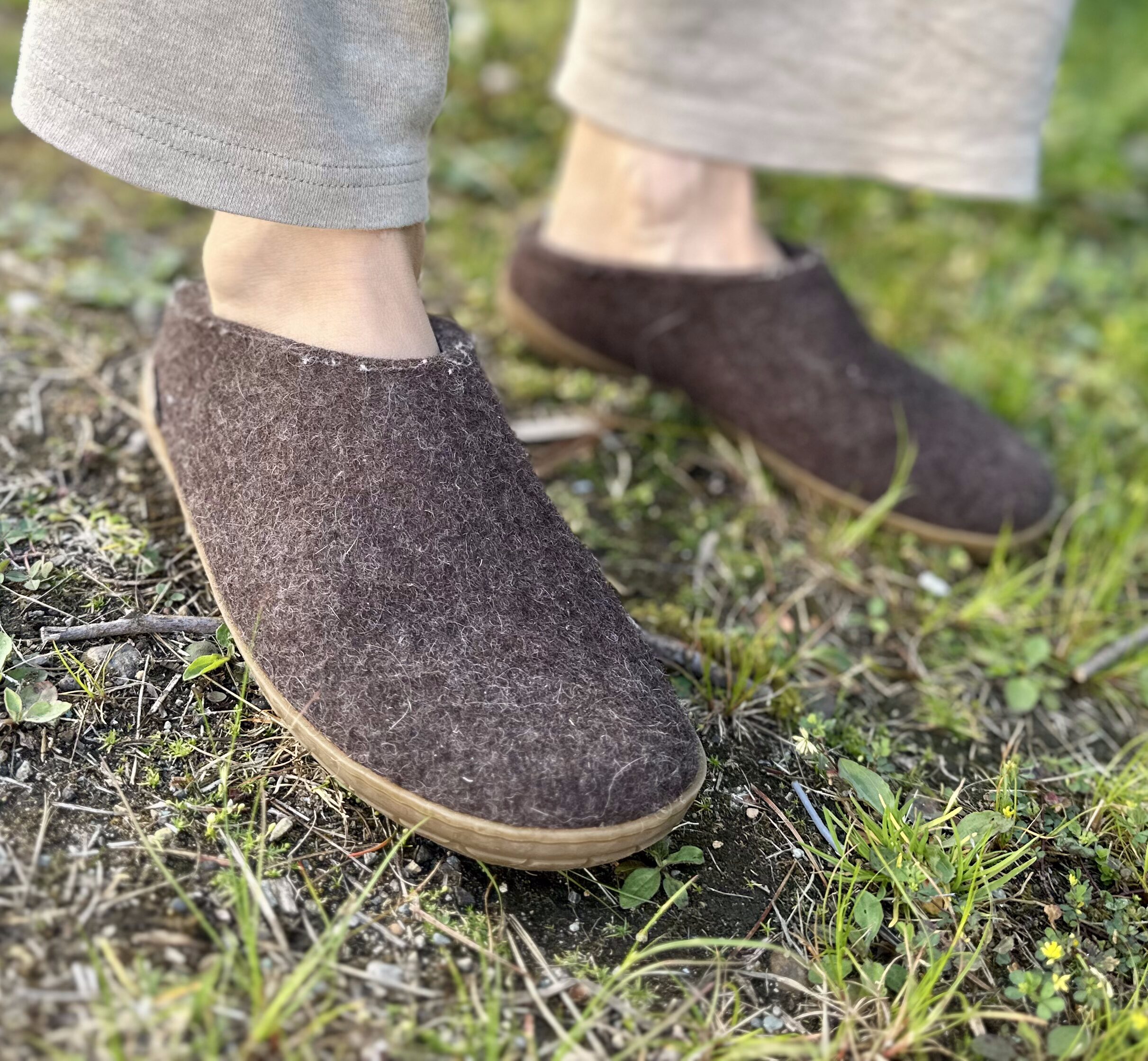
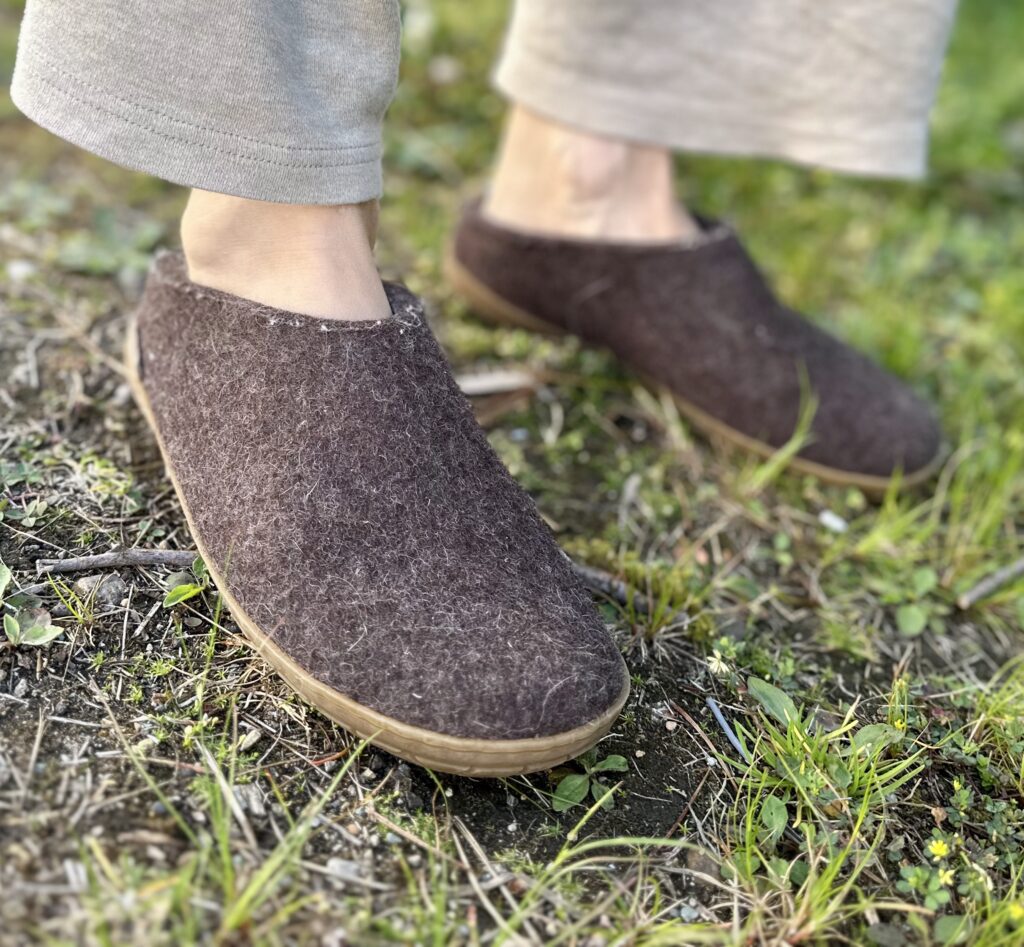
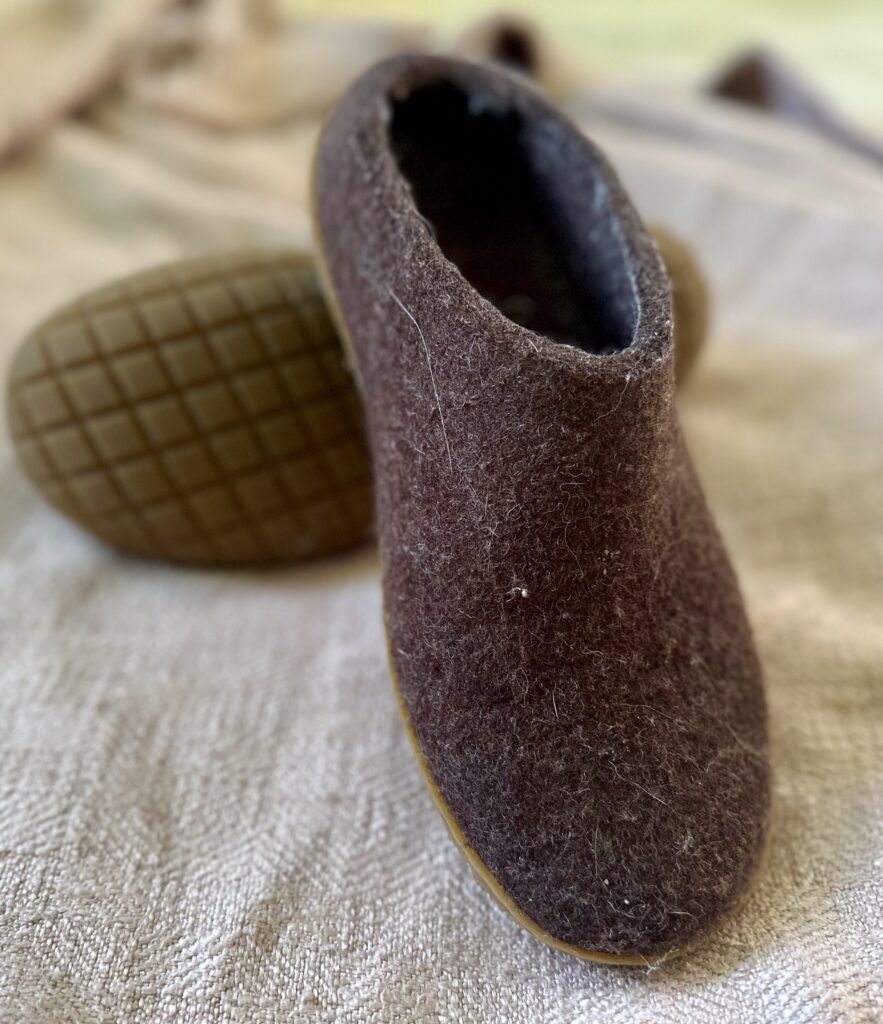
They’re beautiful, so pristine, so clean, slightly stiff. The rubber soul is rounded rather than flat, feeling off at first. But just wait, give it time, and soon, once the wool footbed molds to your feet, you’ll be pleasantly pleased.
Over Time
If these slippers could time travel in a time travellin’ phone booth, they would. Hailing from the current owner’s parent’s, they feel timeless. Nanny Glerup created her first booty for her husband, Ove, back in in 1970. In 1985 they moved to their own farm and reared their own lustrous Gotland Sheep, registering the company in 1993 to keep up with the demand of their friends and family. That’s 33 years the company has been going strong, and they’ll most likely be around for Nanny’s great great great grandchildren.
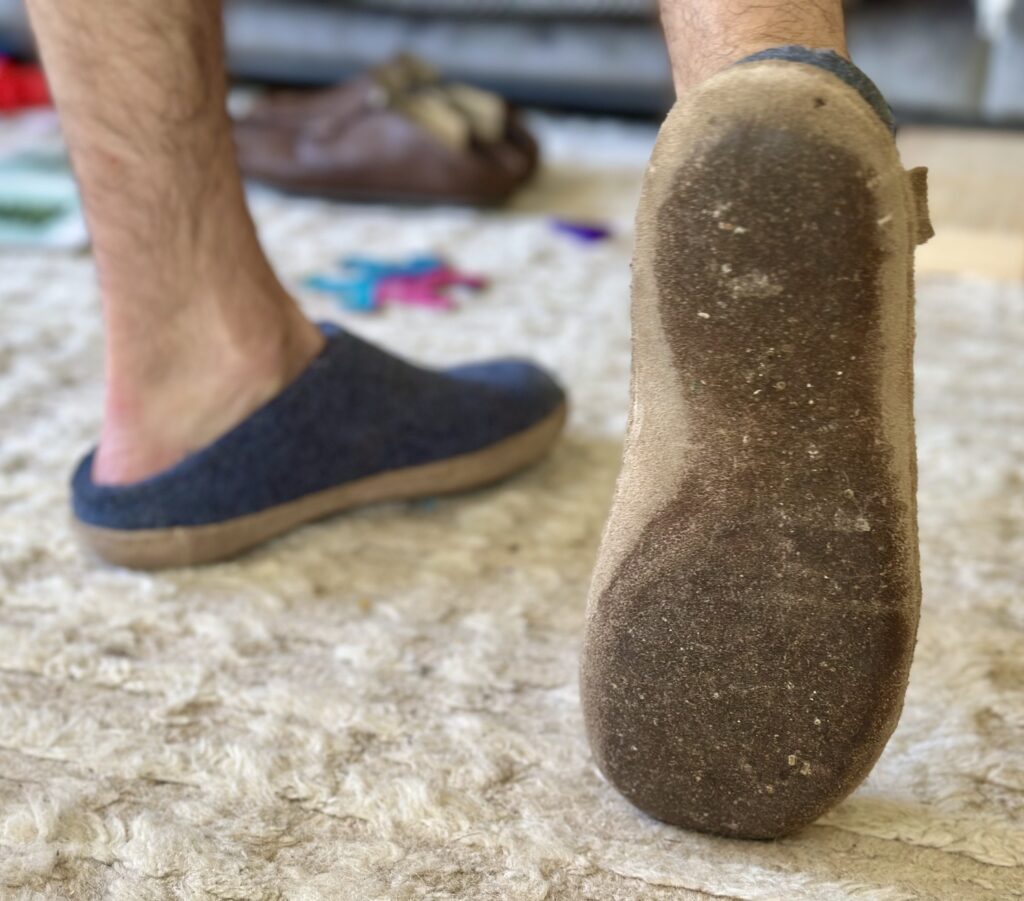
Now, over time through the life of my slippers? I’ve had them for over 8 months, they have formed to my feet, and are delicously comfortable. Sometimes I forget I’m wearing them and omit to change into shoes when going to do errands. There is a little pilling around the opening, and if you have fuzzy animals, the felt attracts fur. Both not a big deal imo, if you have spare time away from your toddlers or whatever beckons, both can easily be pulled away.
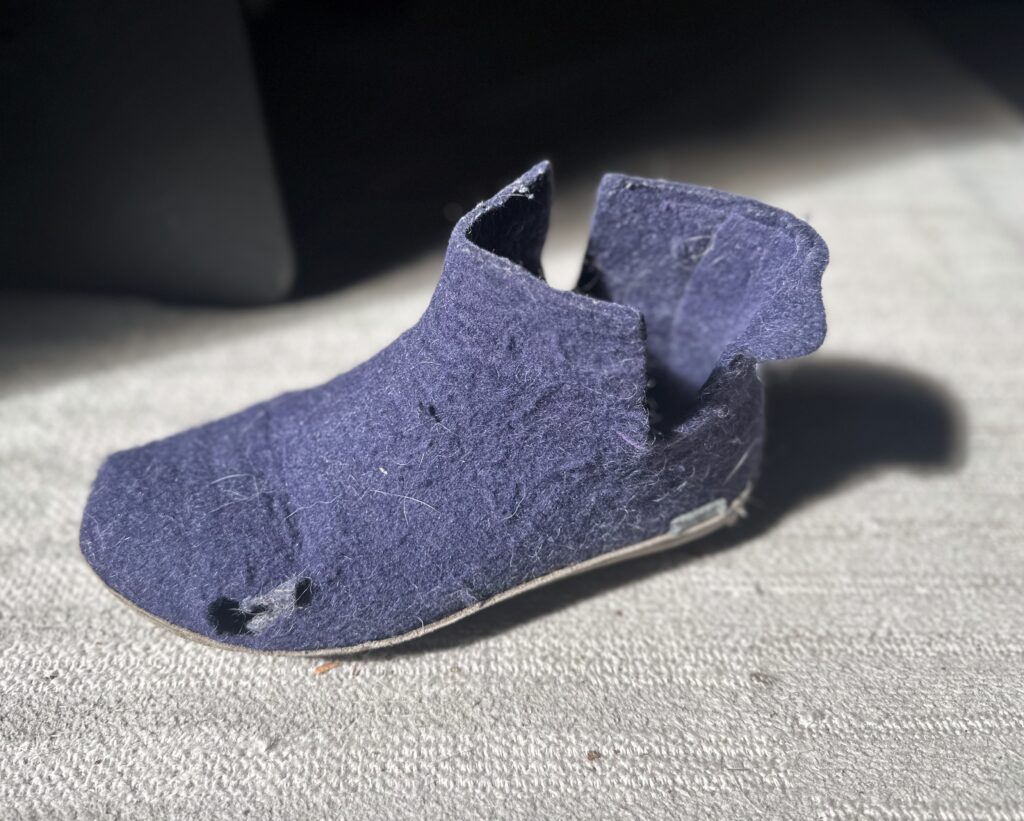
If you buy the leather soles, know that there is an awkward teenage break in phase where everything seems to stick to the bottom. With more wear and tear, this eventually hardens and smooths out. You can see this in the image below, nearing the end of their sticky adolescence.
I snuck a pic of my sister’s ride or die Glerups, and this is how they look after 8 years. She put these slippers on my radar, as she wore them nearly every single day for the first 5 years of their life. She holds onto them to wear during the cool and damp winter months. Here, you can see how they naturally break down and will eventually return to the earth they came.
A work of art, non? If you could describe what love looks like to an alien, maybe, it would be this.
Final Thoughts
We’ve got some good experience with Glerups and can report that these slippers hold up well over time. Steve (my co-creator in this lil’ family adventure) rated his Glerups as Best for Travel and Best Slippers for the Home in his review of the best slippers for camping, travel, and home. More reason to stand by my best slipper on the block testament. We simply love them, in our everyday and on our adventures. Perhaps now is the time to see for yourself, dude/dudette.
Party on Glerups!
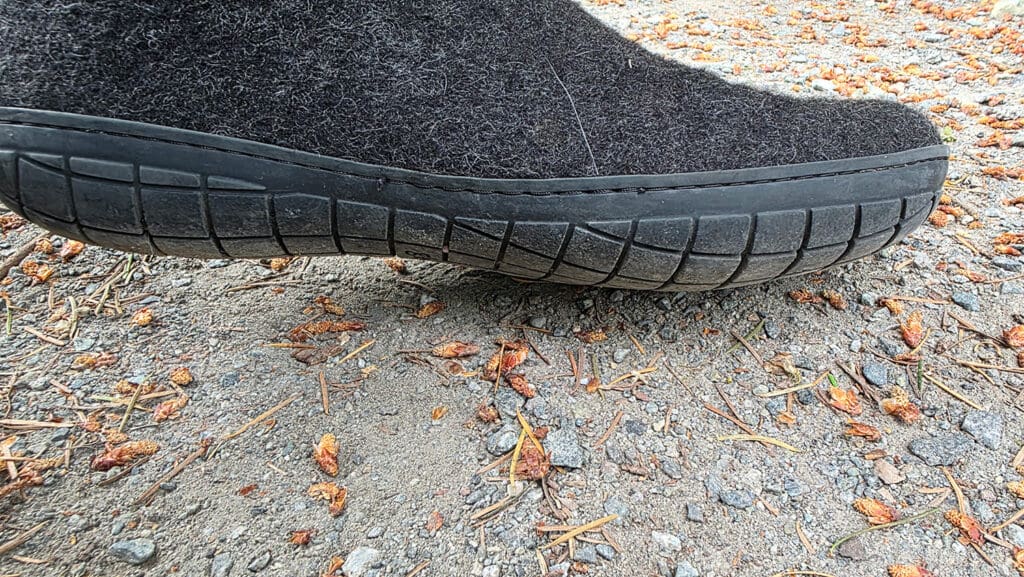
The rubber sole version makes outdoor adventures much more palatable.
Some things in life are worth paying a premium for. If you told me a few years ago as a dirtbag subleasing a basement in Whistler that I would find value in a pair of slippers that cost more than a fancy dinner, I would have thought you were crazy.
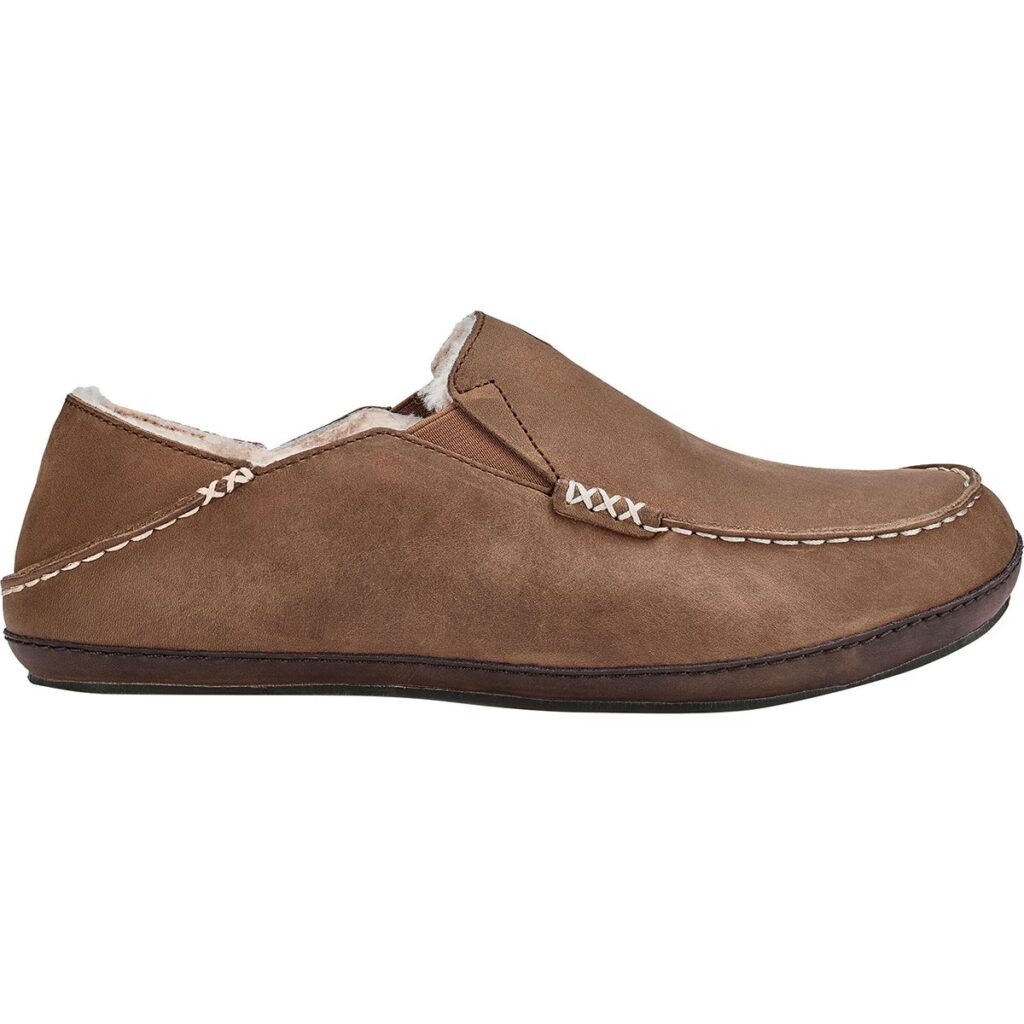
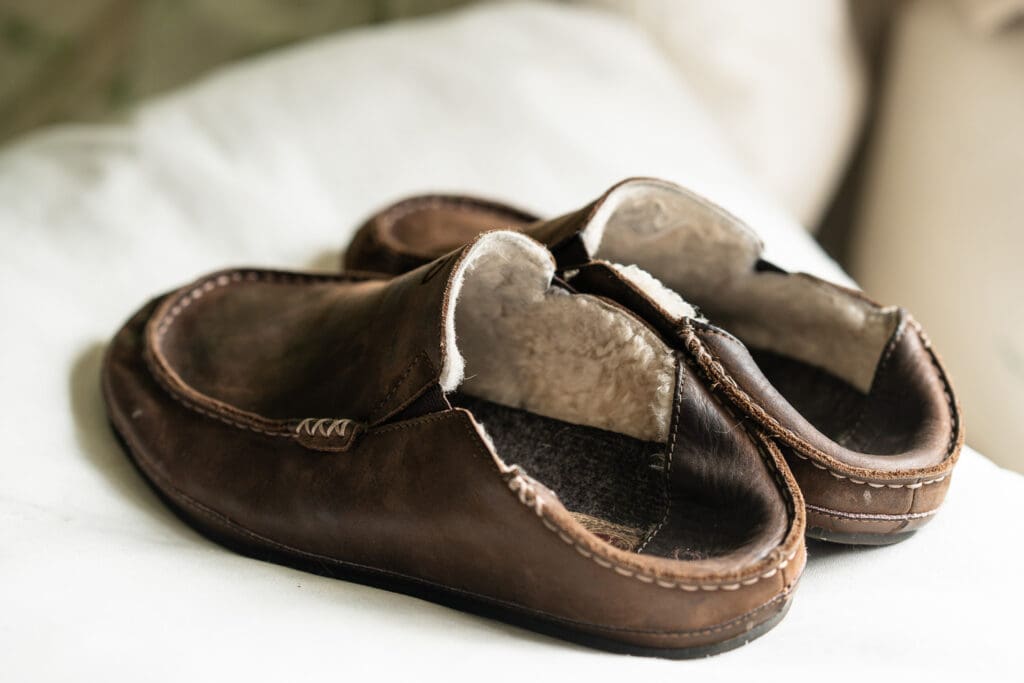
Well, two kids, two cats, and an upgrade to a house later, and here I am, telling the world about how much I enjoy OluKai’s Moloa slipper. I have been testing travel slippers for several years now, and these slippers quickly went to the top of the rotation for their packability, comfort, and the way the sole shapes to my foot. And the best part is, they seem to just get better with time.
Read on to see why I rated this the “Best Travel Slipper” after wearing out dozens over the past decade.
It was clear on the unboxing that these weren’t your run-of-the-mill travel slippers due to what stood out right away: The smell. I say that in the best way possible, as the leather denotes a sense of quality that one simply can’t get from polyester or cotton, or any other material that is used for slippers these days.
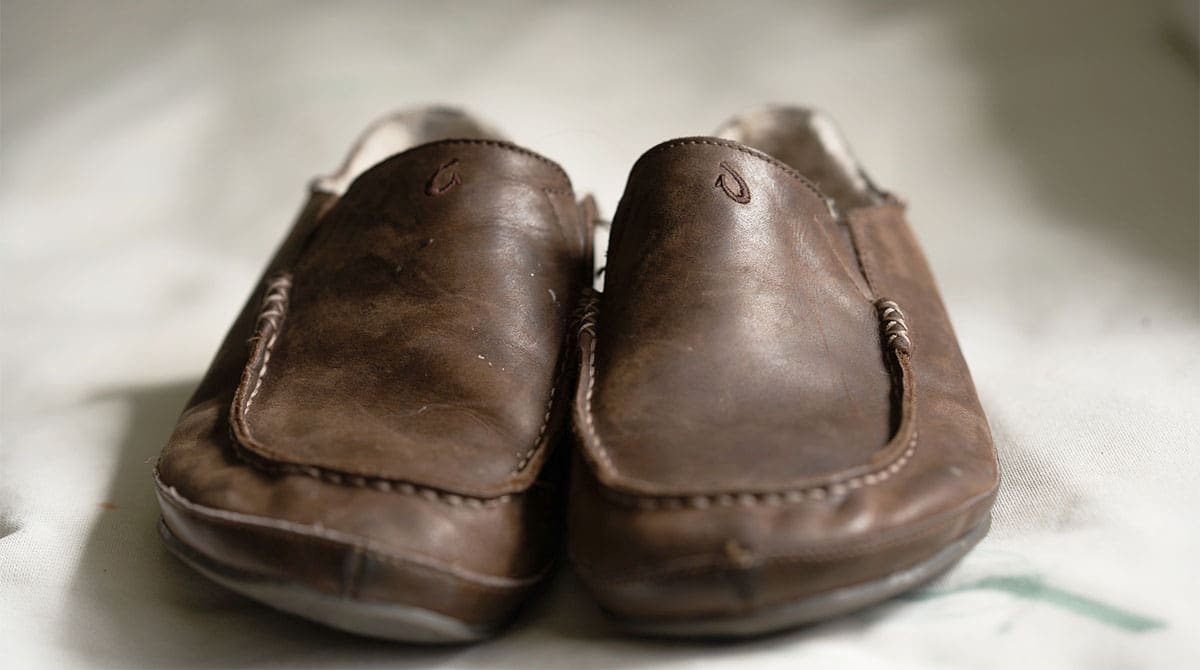
How the footbed breaks in over time
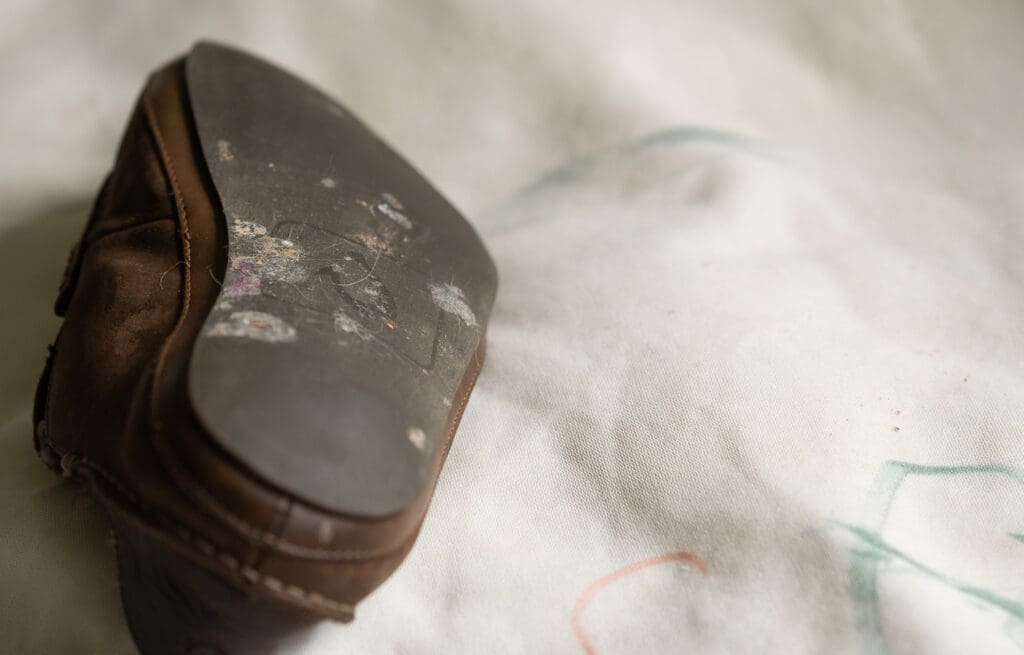
The gum rubber outsole is the unsung hero of the Moloa slippers. As comfortable as the inside is (and believe me, it really is), the way the outsole molds to the foot is unlike anything else I’ve tested. It’s a perfect balance of support and the ability to feel the ground underneath you.
It’s not without its drawbacks, though. If you have toddlers at home, the outsole will pick up anything on the floor, and stay there. Trying to scrape it off is a chore, and I’m yet to find the right solution to work with it. I might need to upgrade to an industrial solvent or something to get whatever my kids leave behind on the floor off of it. Better than stepping on it with bare feet, I guess.
If anyone knows a good way to scrape off the gunk without ruining the outsole, let us know!
The case for keeping them indoors
I wish these slippers were more acceptable to use out of the home because they are the pinnacle of at-home comfort. They would wear out too soon though and the wear is part of the journey to perfectly shaping your foot. It’s amazing how well it forms and how good it feels.
So keeping them inside will extend the life of them. The same gum rubber that shapes to the foot over time is also incredibly soft, and any gravel or foreign objects would definitely shorten the lifespan.
Buy them if you travel often and want a packable slipper that only gets better with time. It’s the pinnacle of comfort, and will soon become a must-pack item, whether for a weekend getaway or a
Skip them if You’re vegan. The whole thing is made from animals… the leather, the shearling lining, and the wool footbed. But millions of years of evolution kind of knows what it’s doing for comfort and warmth, so sorry to those who don’t use animal products… but synthetic material simply doesn’t mold to the foot the way leather can.
You probably also don’t want it if you spend the majority of your travels camping. There are plenty of camping slippers available that are more rugged, these slippers definitly work best when they are kept inside as much as possible.
Final Thoughts
I really don’t have enough good things to say about the Olukai Moloa slippers. I’m wearing them now at home, I pack them for flights and wear them on staycations to the Nita Lake Lodge, and they just get better with time. OluKai knocked these out of the park and if you value comfort and don’t mind paying a bit extra, these slippers are a fantastic choice.
We care about the recommendations we make. We sometimes (not all the time) use affiliate links to help keep the site running. Every item here has been hand-tested through years of professional outdoor work and surviving weekend trips with my own toddlers. Learn more about our Gear Review Policy here.
Being a dad is the greatest privilege I’ve had in life. There is no ifs, ands, or buts that could come close. But that said, it’s a hard, mostly thankless job that usually ends up being the one with all the dirty work: taking out trash, cleaning up the puke, and mastering the harmony in Moana’s “How Far I’ll Go”.
Well, aside from another octave, there is no limit to how far our love for our kids will go. And if the dad you’re shopping for is anything like me, we appreciate a little bit of thought and kindness to recognize just how much we are loved and valued through all the chaotic noisy moments.
As someone who tests gear for a living, I’ve been lucky to be able to take a look at some of the latest and greatest gear out there. A lot of it is same-old, same old, but once in a while I’m sent something that becomes part of the regular rotation. Here’s what I’ve been liking lately, and are some quality items for fathers to make the most of their time outside.
Bottom Line: Comfortable, warm, more breathable than most.
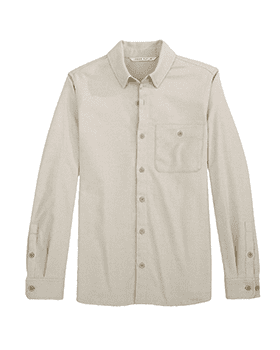
I have a few flannel shirts, yet nothing is really made of pure flannel these days. A lot is polyester and it gets hot and sweaty without the comfort. Cotton flannel is good but it’s both expensive and no good when wet.
Freefly is a great apparel company that is making a foray into a new type of yarn called Seawool, which mixes polyester with oyster shells to give a bit more circular type of material to the standard outdoor fare. Add in a majority of cotton, and the result is a fabric blend that feels soft but can handle the rigours of outdoor use. It’s my go-to when I’m wanting to have a bit of warmth while camping or hiking, but still have a classy look that keeps mom whistling.
Heads-up: Metal hardware can corrode near salt water
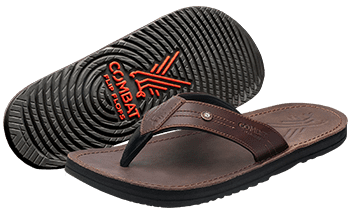
Bottom Line: The most comfortable flip-flops I’ve worn, that only get better.
I’ve been wearing these flip-flops for two years, pretty steadily. While other flip flops wear out pretty quickly, these have held up and only get better with time. The secret to them is in the midsole and outsole; and the cushioning is a step above any other premium flip-flop I’ve tried. The only issue is the small emblem on top corrodes in salt water, so if you’re going in the ocean a lot, keep that in mind. Otherwise, it’s as solid as they come for a premium flip-flop at a more-than-reasonable price.
Performance: Best for Sunday mornings and long-haul flights
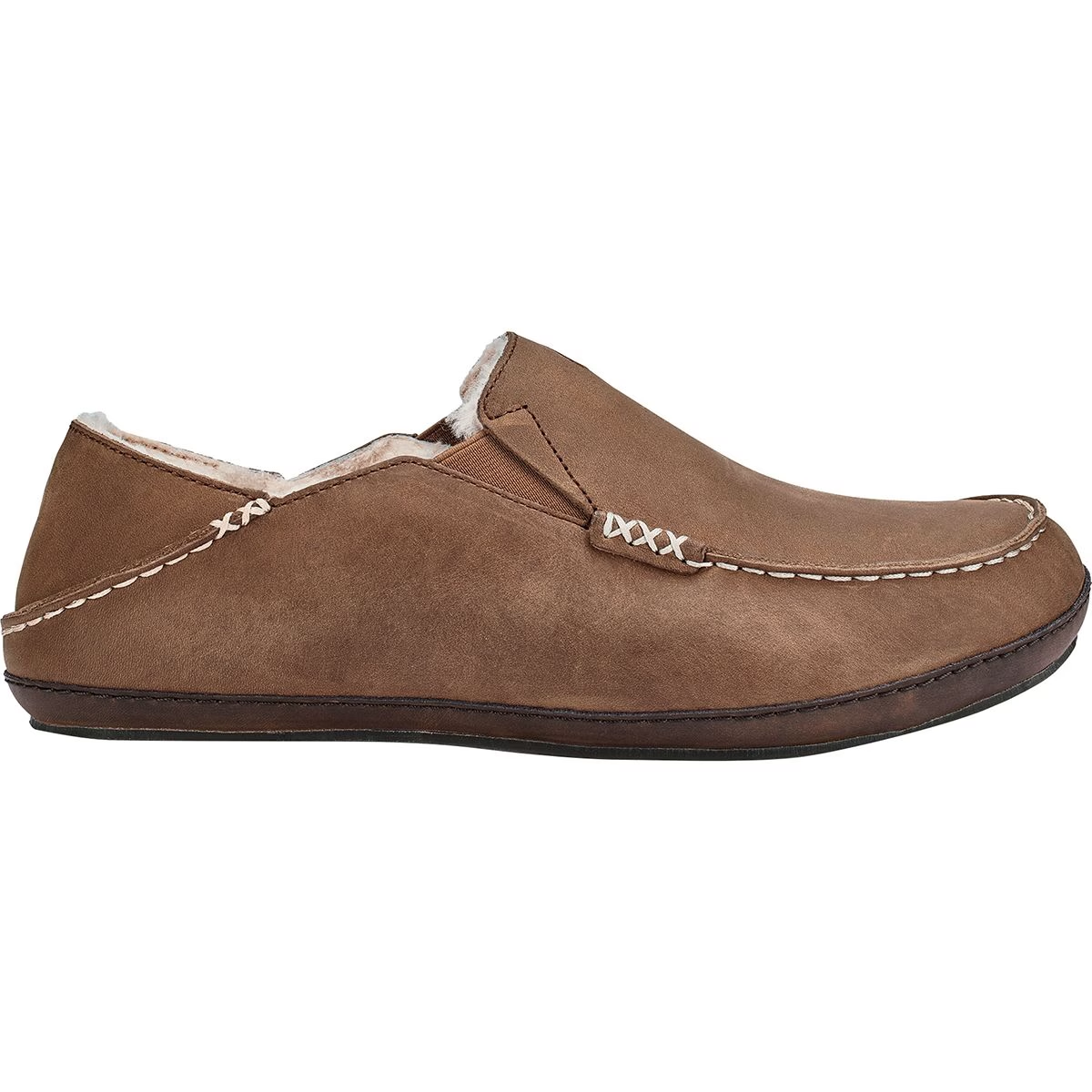
Bottom Line: Pricey for a pair of slippers… but totally worth it.
If you really need to give the dad in your life a gift that he will remember, this might be it. It has been hard to find anything else that has come close to the comfort my feet have when slipping the Moloa slippers by Olukai on. They really are that good.
The only downside is that the rubber on the outsole is so soft, they are best suited for indoors. If it were a bit sturdier, I’d probably take them everywhere…. but then it would lose some of the magic.
If there is anything bad to say about these it’s that the soft rubber attracts anything that it touches and for a dad of two toddlers, that’s quite a lot. So aside from scraping off thrown food and hair from the cat… I guess it’s better than stepping on it with bare feet.
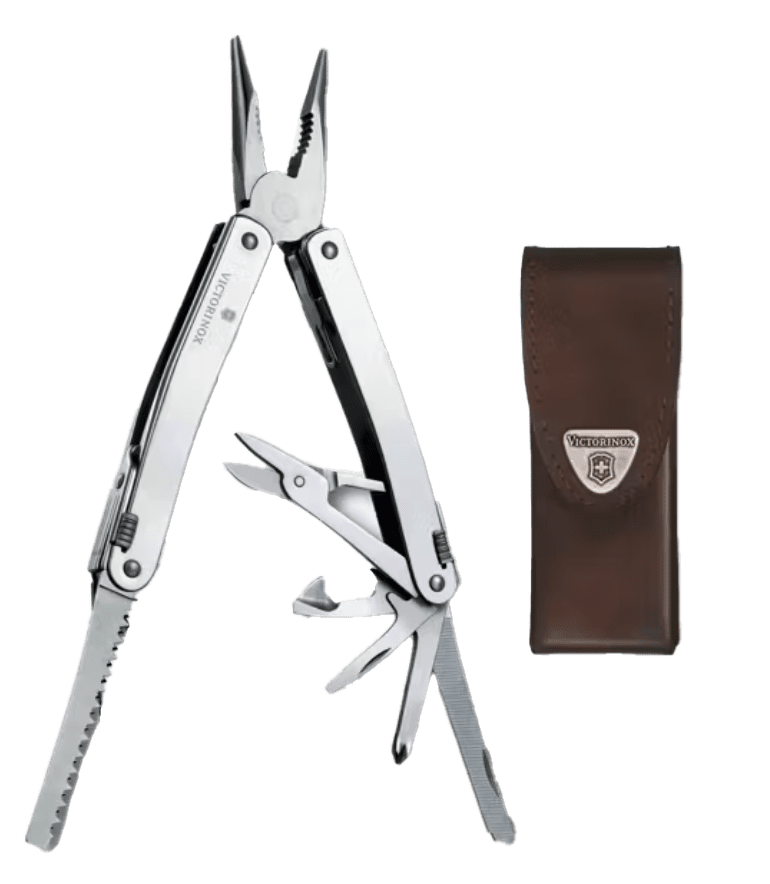
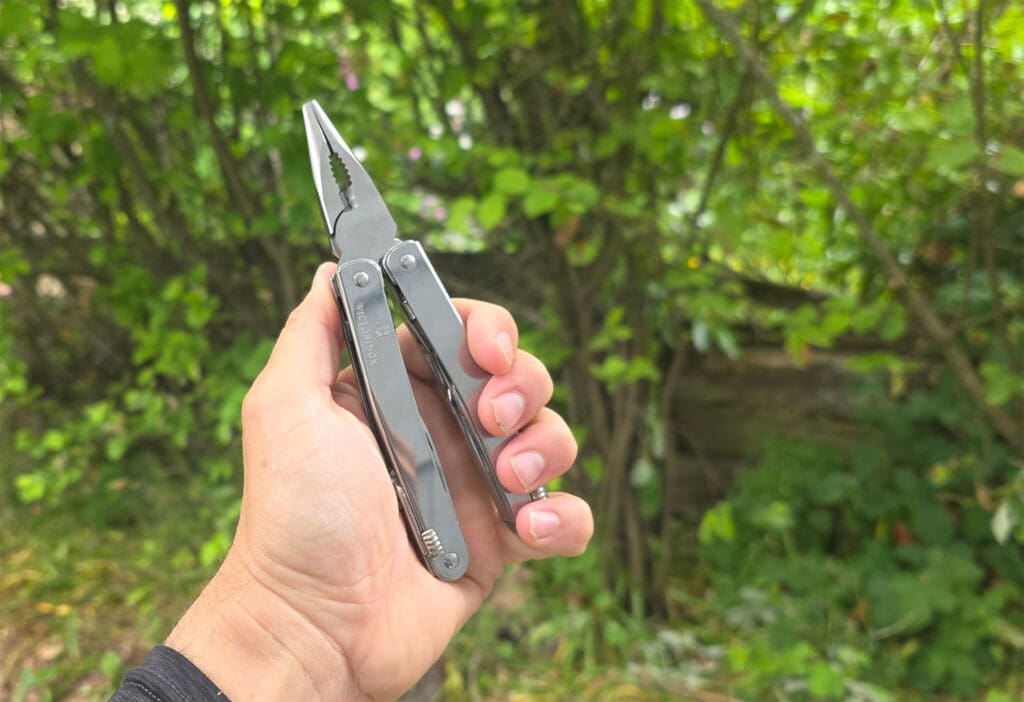
Bottom Line: It looks good, performs well, and stands the test of time.
Every dad should have a multitool. This one is a step up in detail, quality, and looks compared to your average Leatherman or Home Depot special. The swiss know how to do things right and Dad will feel the sophistication, whether or not he earns it. The bowed shape makes for extra leverage and all the knives are a premium quality. It also comes in a snazzy leather case.
Bottom Line: Lightweight, yet durable, and functional.
Ultralight gear is rad, but sometimes sacrifices functionality. This is the first pack that I’ve tried that is less than 2 lbs that actually feels like a normal pack. The carbon stays help keep the frame solid while not weighing you down.
While we may not be crushing major thru-hikes at this point in life, it’s still important to maximise the time you do have to get away, so getting lighter gear will help you go a bit deeper before needing to turn around. This pack checks so many boxes in convenience, ease, and well-thought out engineering to make it a great getaway pack. I wrote a deeper review on another site I write for, Alpine Islands, check it out if you’d like to learn more.
Bottom Line: The bag that makes anyone automatically become more organized.
I’m a throw-it-in-a-duffel type of guy, and that came at odds when having kids. When a kid’s snack from last week’s ends up sitting with an emergency change of clothes, you learn fast that bags like the No Reception Club Getaway Bag are worth their weight in gold. My life is significantly easier when this bag is well-packed for spontaneous road trips and missions to the beach or park.
The bag evolves with kid’s ages, and we’ve had this since the infant stage with no end in sight. The sidekick fanny pack fits into one of the side pockets and is used even more often due to how small it is. But the backpack makes any travel situation from road trips to overseas flights remarkably easier with enough compartmentalization to endure several days of chaos.
It’s not the prettiest photo, but hey, its proof that we actually use the bag to help us keep things neat while flying.
For the Dad Who Hates Texting But Loves Playing Spy Games
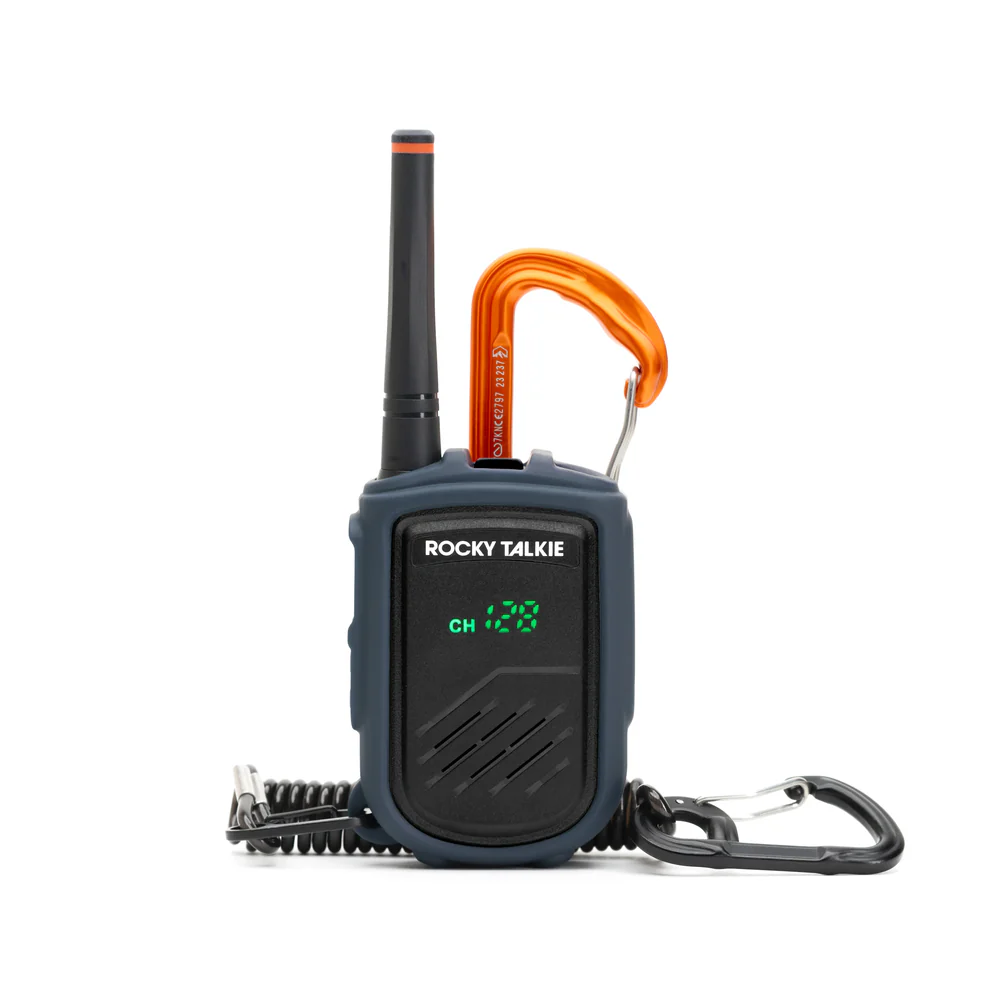
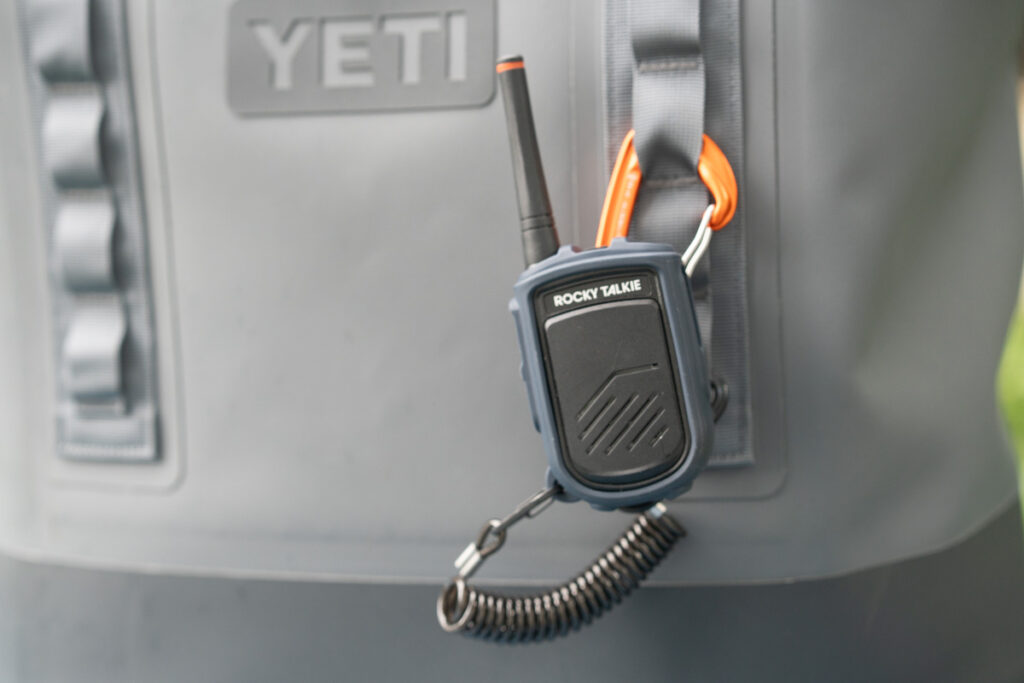
If you’re like me and want to leave the phone in your pocket whenever possible, communicating by radio when on adventures adds a whole other element of family fun.
Range: 35+ mi line-of-sight; 1–5 mi in mountains; ~1 mi in town
Battery: 3–5 days, USB-C rechargeable, cold-tolerant to −20°F
Waterproofing: IP56 (splash and snow, not submersible)
Heads-up: IP56 handles snow and splashes, not whitewater — if you’re packrafting or kayaking hard, the 5-Watt Expedition ($180) is the one
Bottom Line: These radios are reliable, can take a beating, and are some of the best performing 2-watt radios I tested over the years.
It’s endless fun with the kids while hiking or at the campsite, and they are fun to take on adult missions into the backcountry as well. You don’t get many useful tools that can work in both worlds very often.
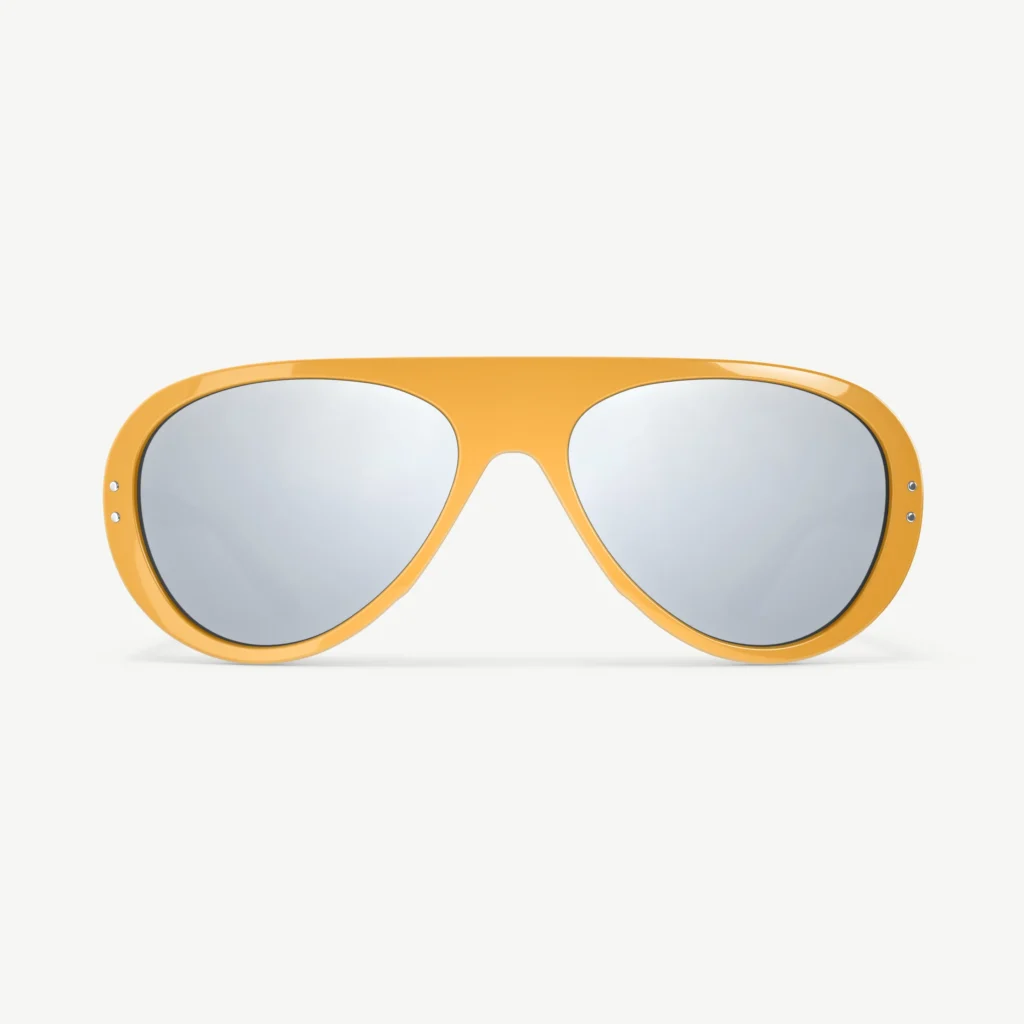
These glasses are so wildly impractical that it works. Designed for the retro aprés ski scene, they stand out like a radical relic in other circumstances. If the dad you’re buying for doesn’t give a damn what people think and sets their own standard of cool, these glasses are the ones to get. I love how they feel on the face, the optics, and the smiles people give me when I wear them in more square environments.
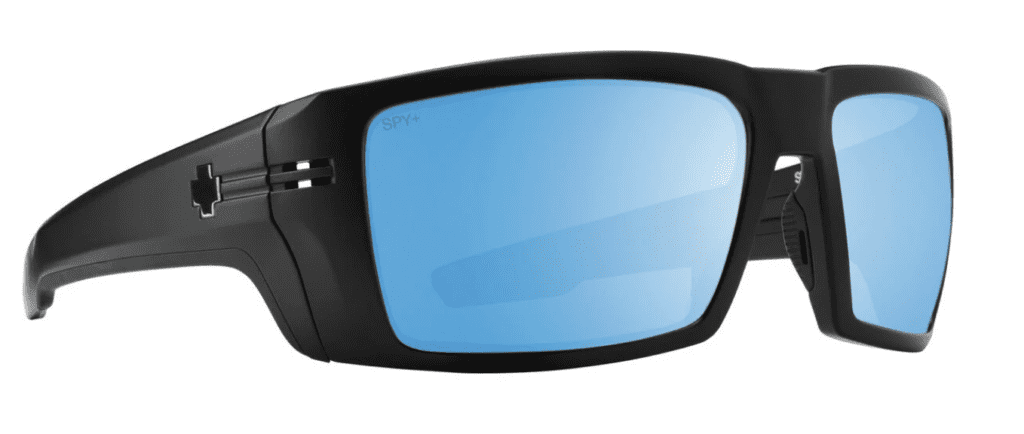
Bottom Line: Great wraparound protection for long summer days
It stays on your head, it’s polarized, and it protects you. What more do you want? These have quickly become a staple due to their reliability, good vision when it’s really bright out, and a timeless style that takes me back to before skateboarding and snowboarding went mainstream.
Spy optic just seems to give me the good nostalgia and if the father in your life grew up in the 90’s, this will be a good reminder of the counterculture part of the era in contrast to the mainstream pop. More Deftones than Ace of Base. So for that, it’s a good purchase.
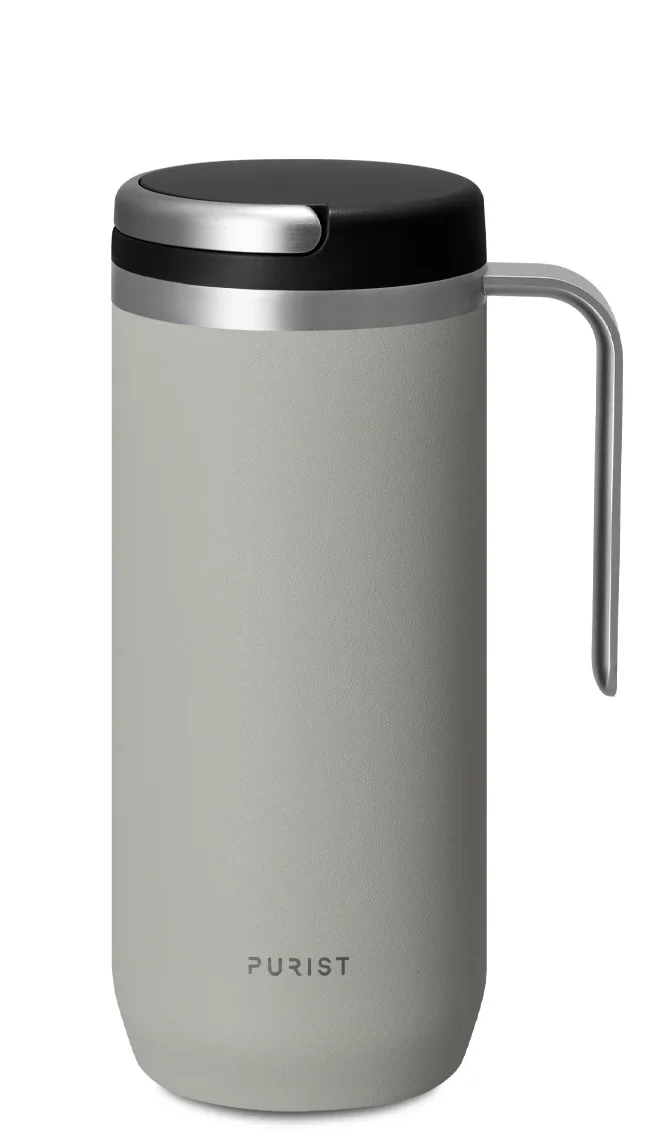
You go to the trouble of choosing better water, better coffee, better everything you put in your body. Then you store it in a bottle that leaches into it. The dads I know who care about this stuff have all eventually arrived at the same conclusion: the vessel matters too.
Insulation: 12 hr hot / 24 hr cold (lid-dependent)
Lid options: Element (carry handle, screw-off), Union or Scope (drinking lids)
Heads-up: Only the Scope lid is dishwasher safe
Bottom Line: Coffee tastes like coffee. Water tastes like water. The mug stays out of the way.
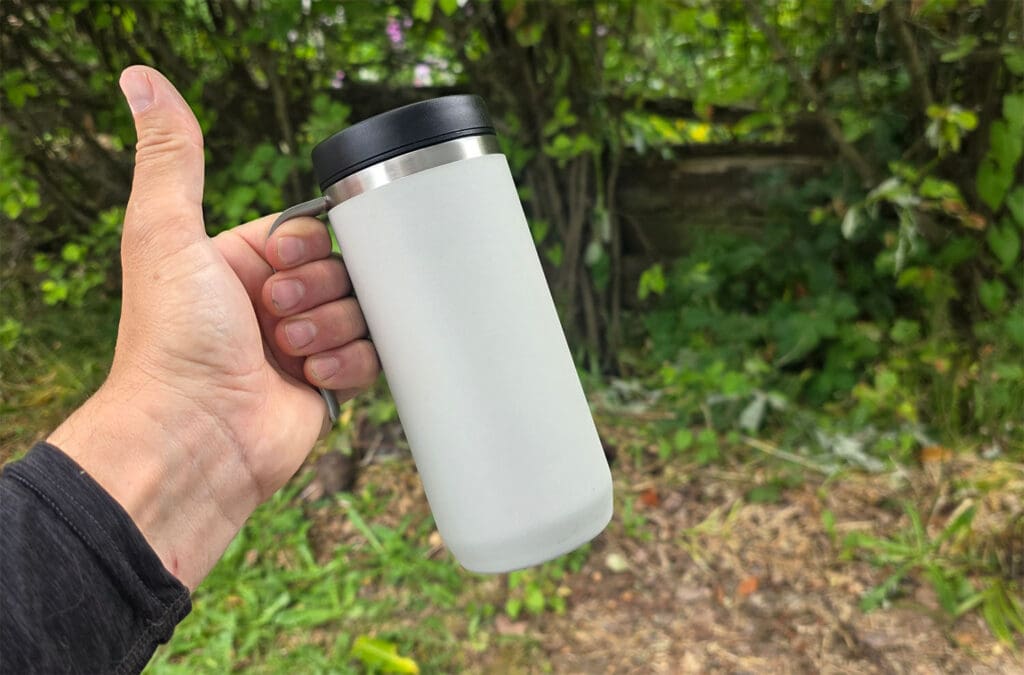
I just received this as a sample and am thoroughly impressed. I’m enjoying coffee from it right now. The spillproof lid doesn’t splash out all at once when you open it, and the external handle gives dad better ergonomics than holding the whole girth of the cylinder.
There’s a silicon dioxide coating on the inside that apparently blocks impurities from latching on, such as the dreaded coffee stain on most stainless coffee mugs. Time will tell if this is for real or just a gimmick, but they are standing behind their claim for now and even without that fact, It’s a handy upgrade from a coffee cup without a handle or spillproof lid.
Compact, spill-proof, and easy to hold. All signs of a great coffee mug.
This list comes from spending the better part of the decade as a journalist covering outdoor gear and getting all kinds of pitches; big and small. Everything here has been tested to its full extent as a dad who needs things to hold up to abuse by both myself and my toddlers. It’s all good stuff that I use daily.
I usually take more photos, but it’s been a busy time around the household. If you’re reading this far though, just know that I wish I could have had the time to take a bit more shots in the wild, but my M.O is to enjoy my time, not doing it for likes from strangers.
And although the father in your life doesn’t need anything fancy, it’s nice to give him something that lasts and serves its purpose well. A more relaxed dad means hitting those high notes for the big solo on the sing-alongs, so really a good gift for father’s day will just make for a better singing partner in the long run.
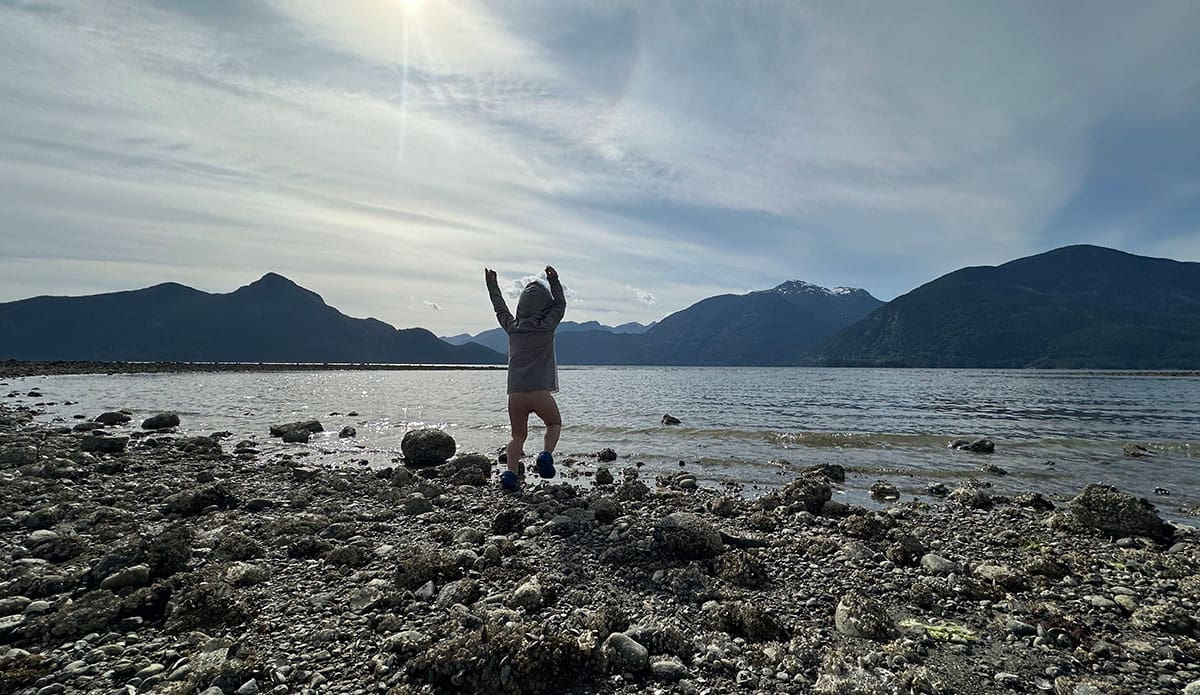
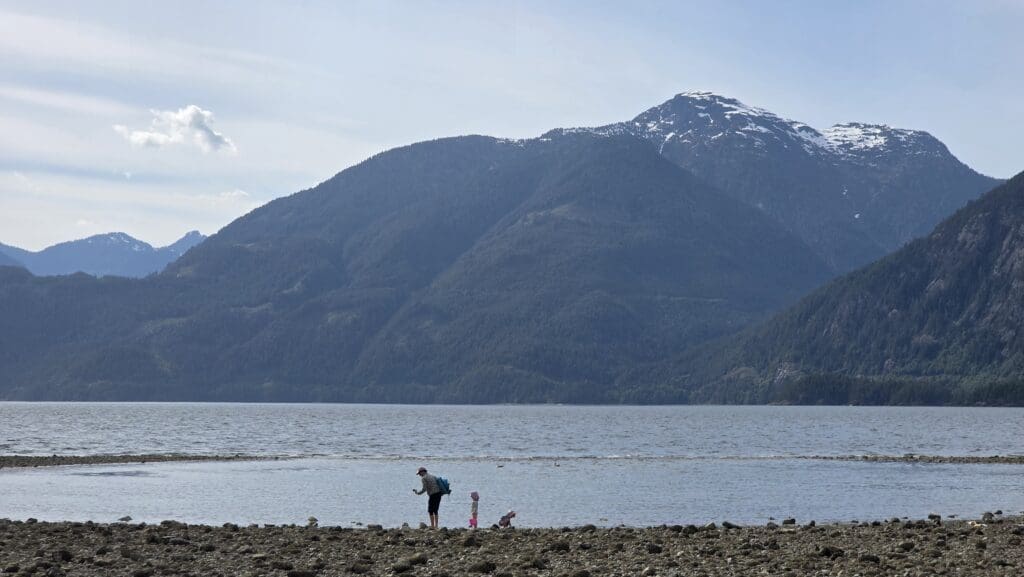
The reservation process can be stressful. Setting up is never easy. Weather can be hit-or-miss. But that first cup of coffee sitting by the water at low tide while watching the kids turn over rocks and view the life underneath makes every bit of work involved in coming to Porteau Cove worth the effort.
Where is Porteau Cove?
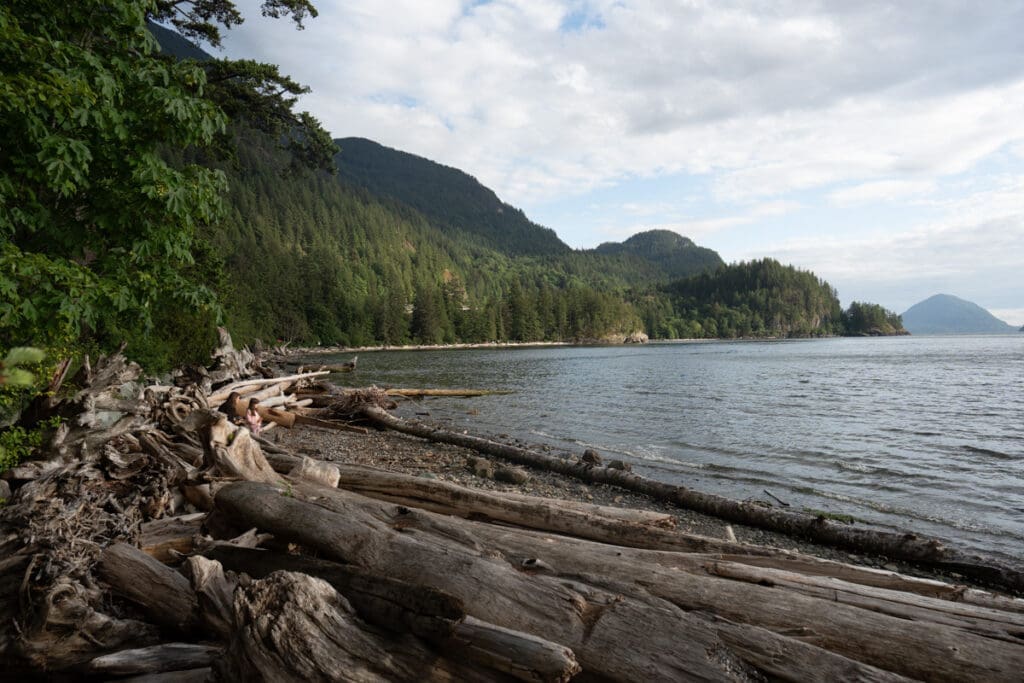
Porteau Cove is a popular stop along the Sea-to-Sky Highway 99 between Vancouver and Squamish. But most people just use it as a quick stopover on the way to other places, use the bathroom, maybe unpack a snack, and then move on.
Camping there, however, is another story altogether. It’s difficult to get a campsite if you don’t book three months in advance, sitting on your computer at 7AM hitting refresh until a spot comes up. This filters out most of the riff-raff, leaving those who know how special the place is to have one of the best waterfront campgrounds in British Columbia, and perhaps even the entire Pacific Northwest.
The Reservation System
Porteau Cove has exploded in popularity over recent years, and as a result, you can’t just waltz in there and expect to get a campsite. Most of the prime real estate gets gobbled up the moment it becomes available, three months in advance. Booking a site is a semi-stressful process, but thankfully everything else about the experience is pretty straightforward and simple.
The key is to know what dates you want to go, and be ready to reserve through the BC Parks online reservation system. Make sure you have an account set up before the system opens up to bookings at 7AM, three months before the intended date. Because once 7AM hits, you’ll be battling it out with everyone else trying to get the same spots.
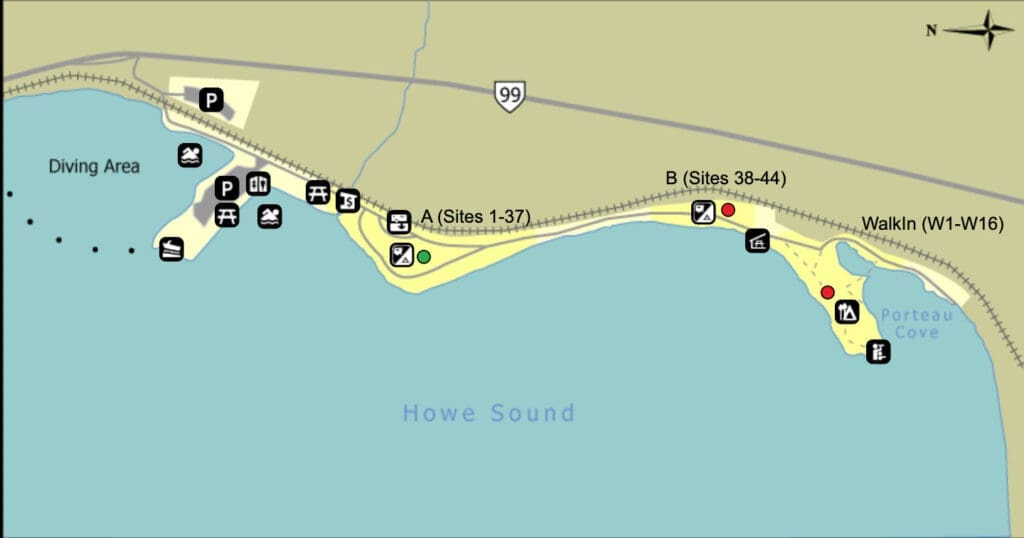
Not all campsites at Porteau Cove are created equal. The best sites are along the water’s edge, with south and southwest facing views across Howe Sound for ideal evening light. This makes it even more limited for getting the site you want. Summer months are obviously more competitive; as are the weekends. So our tactic is to book for Sundays or the Monday of a long weekend where the highest chances of people leaving are.
The Best Campsites at Porteau Cove
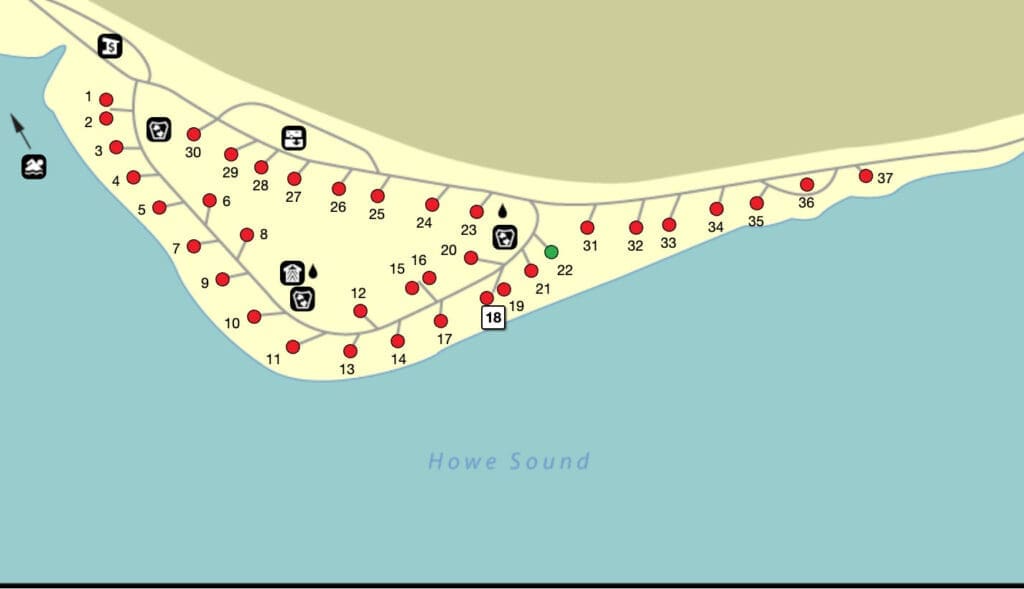
Don’t always trust the green circle…
Once you have settled on dates, the hard (and perhaps most stressful) part of the booking process begins: finding the right campsite at 7AM online. You first need to choose which zone you’d like: A has the nicest sites by far, but are also the most popular. B has good drive-up views for RV’s. The Walk-in area is pretty good all around but there is a waterfront row, and a non-waterfront row. So if you want the best of the best, go for section A.
The one green circle for the entire zone is only available for one night.
Then, you have to hope that the site you want is the one you’re choosing. Each campsite also has an availability calendar so that you can see if someone is checking out the day you want to check in. Then it’s a game of chance if you can beat someone else to booking at the right moment.
Campsites #13-22 are probably the best due to their southerly exposure and size. 18 and 19 are double campsites, so larger parties will want to book there for a quality setup. But really, it’s hard to go wrong with anything near the water.
We are partial to campsite #31 because it has waterfront access, but is also shaded with a nice large spruce tree, which also acts as a wind buffer. And it’s worth noting the wind here, which picks up like clockwork every day around midday. While the oceanfront campsites are nice, they are also exposed to the wind, which is important to keep in mind if you’re staying in a tent.
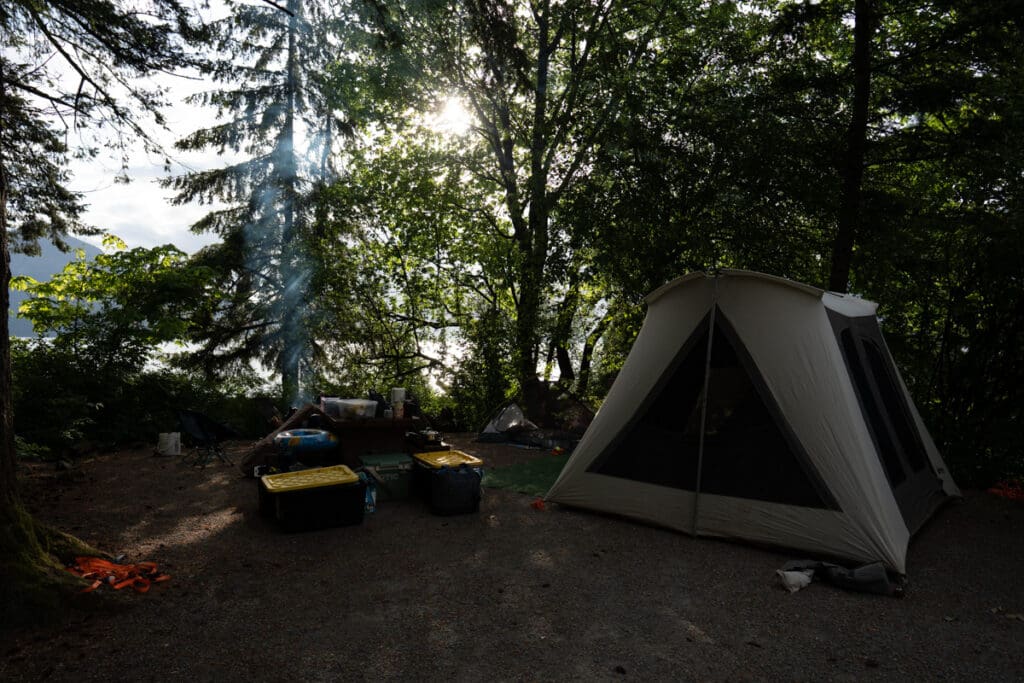
Speaking of tents – if you have a large tent that needs staking, the ground in the powered campsites can be incredibly hard. It was a chore staking in our Kodiak 10×10 tent in the hard ground with a heavy mallet. But well worth it once it was in!
Campsite #31 with the shade and beach access.
The Water
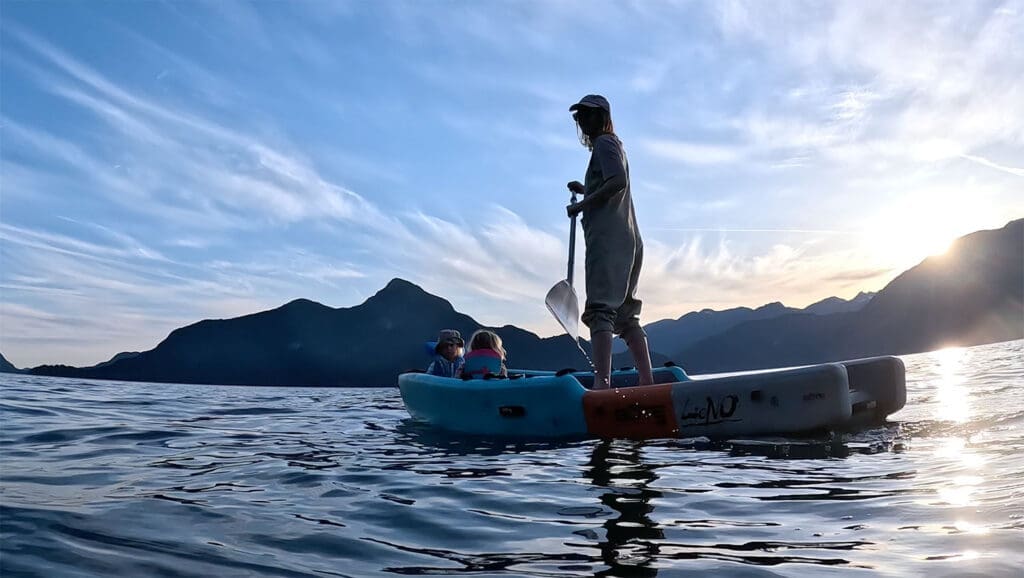
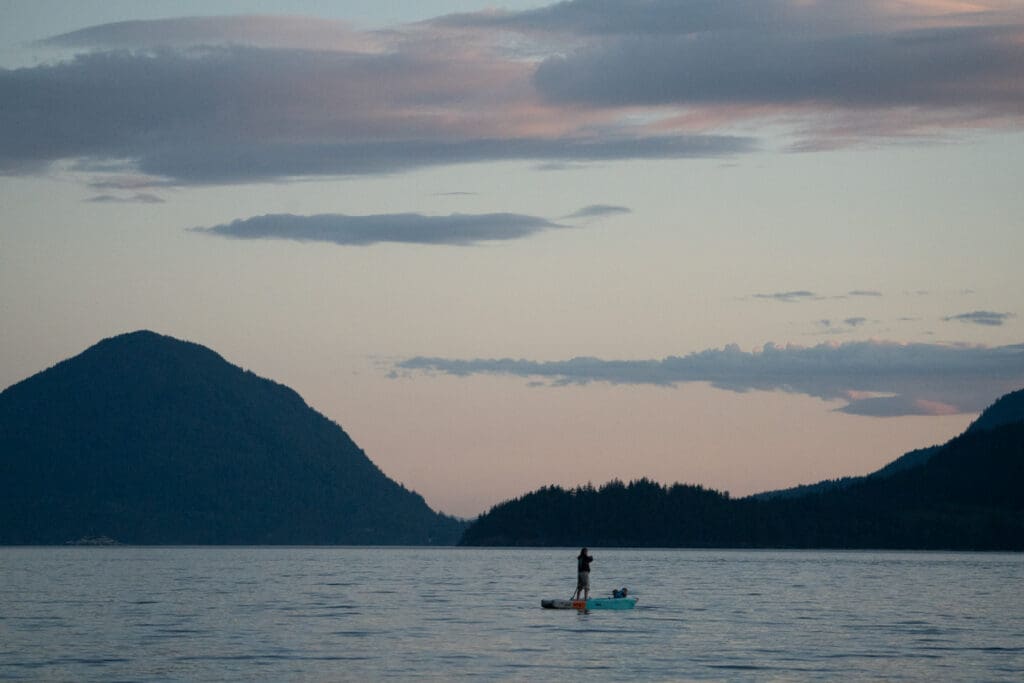
You don’t get many chances to have a fully serviced campsite next to the ocean, so it’s wise to make the most of it by investing in some sort of watercraft. People bring everything from fishing boats (there’s a boat launch in the public lot) to inflatable paddleboards. Whatever the vessel, it’s worth it to spend some time out on the water.
We went in springtime where there are massive schools of herring shimmering right beneath the surface. The kids loved seeing them sparkle and move en masse. With the herring comes other species that like to feast on them, so the wildlife viewing while out on the water is quite unmatched.
Porteau Cove also has a big yin and yang aspect to it with the water conditions. Mornings are generally calm; but by the afternoon the wind can pick up and make smaller boats unenjoyable. So we recommend getting up early and making sure you have some time on the water before it gets too choppy. When it does, there’s the namesake cove at the far end of the walk-in campsites that make it a bit easier to manage with children.
The biggest thing you’ll realize when you touch the water—but is worth a fair warning before you do so—is that it’s cold. Summer can be a bit better, especially from the cove where its a bit more shallow. But with the tide constantly moving and glacier runoff coming from the Squamish River, it’s not a pool in Vegas. It’s more one where you’d want to get in and get out fairly quick.
The other important fact about the “beach” at Porteau Cove is that its rocky, and in some spots peppered with barnacles. So a good pair of water shoes will go a long way to increasing enjoyment both above and below the tide line.
Speaking of tides—it can fluctuate quite a bit here. While it may be tempting to set up shop at low tide close to the water, make sure you can be light and able to move quickly. It’s not so quick that you’ll have to panic, but enough where if you leave the gear unattended for a few minutes, there’s a chance it’ll be floating by the time you get back.
The Vibe
If I had to give the camping experience at Porteau Cove a tagline it would probably be something like “The Most Accessible Nature Experience Near Vancouver”. It really is something special to be only a half hour from the city and feel like a world away. Aside from the highway sounds (which isn’t totally negligible, but the mind does begin to filter it out), you feel pretty remote despite being along a major thoroughfare.
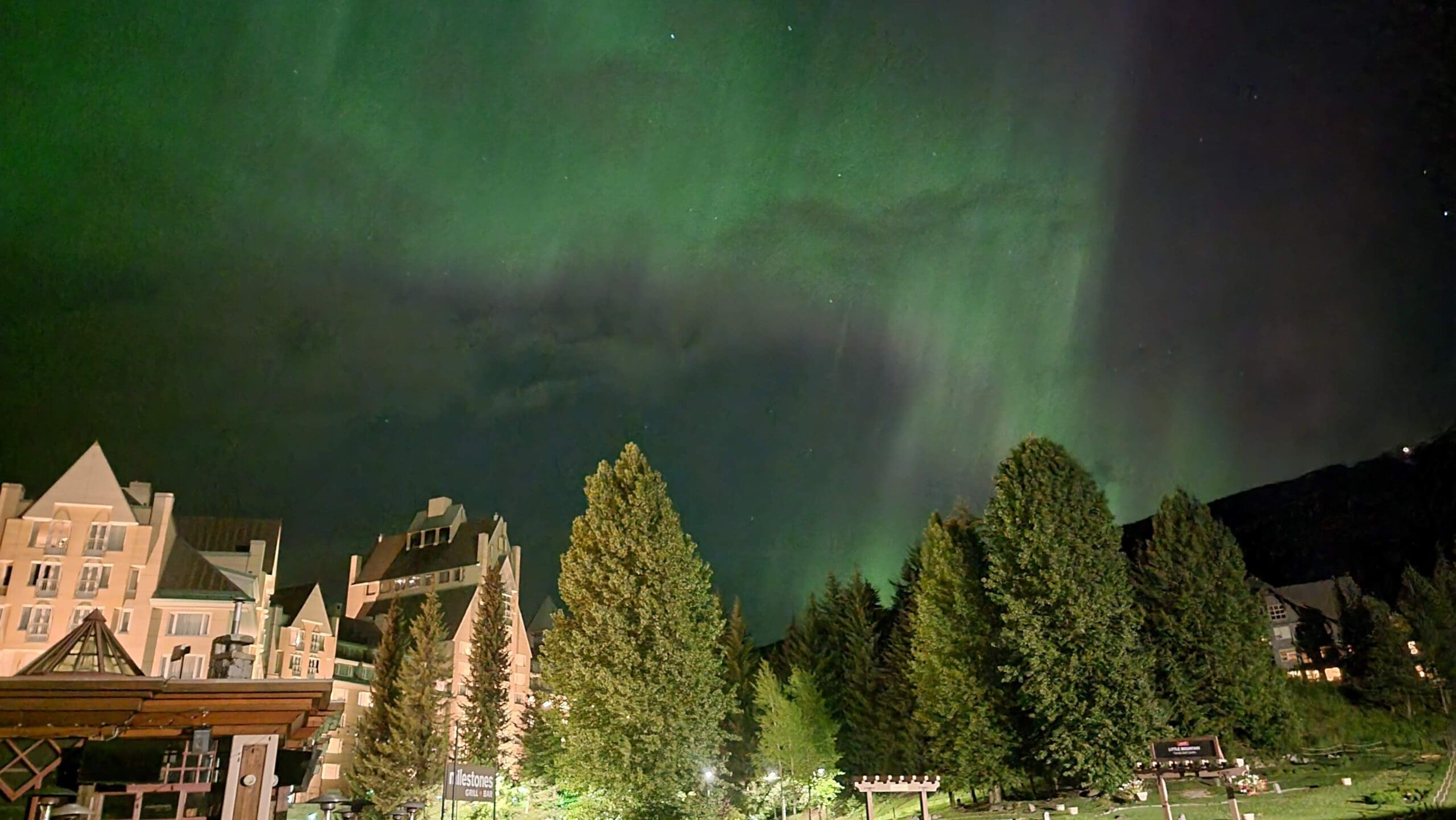
At night is where it really stands out as a special place to visit. When the ocean is calm and the starlight flickers on the surface, you almost feel like you can touch the sky. The light pollution is minimal, especially when looking north. And speaking of looking north—it’s a fantastic spot to view the northern lights with the coast mountains silhouetted along the jagged horizon.
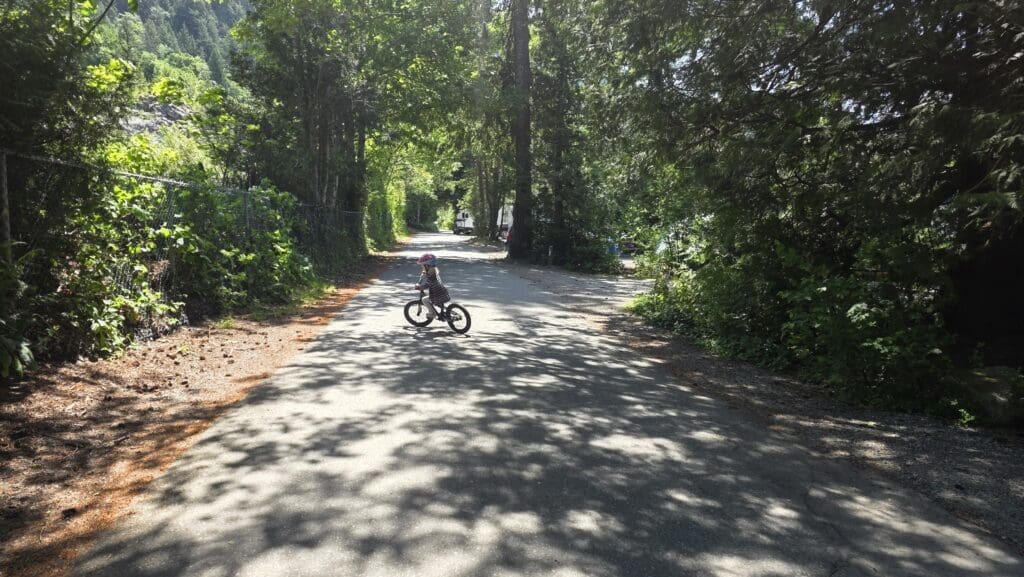
But daytime has its own special feeling to it, especially with kids as they explore the campground in relative safety. Our little ones love the flat grade of the road where they can zip up and down without fear of getting run over. Cars do still go along the road, but it’s so infrequent (especially in the afternoon) that we give our kids a bit more leeway to explore than when at home in the neighbourhood.
A Luxurious Bonus: Renting a Sauna
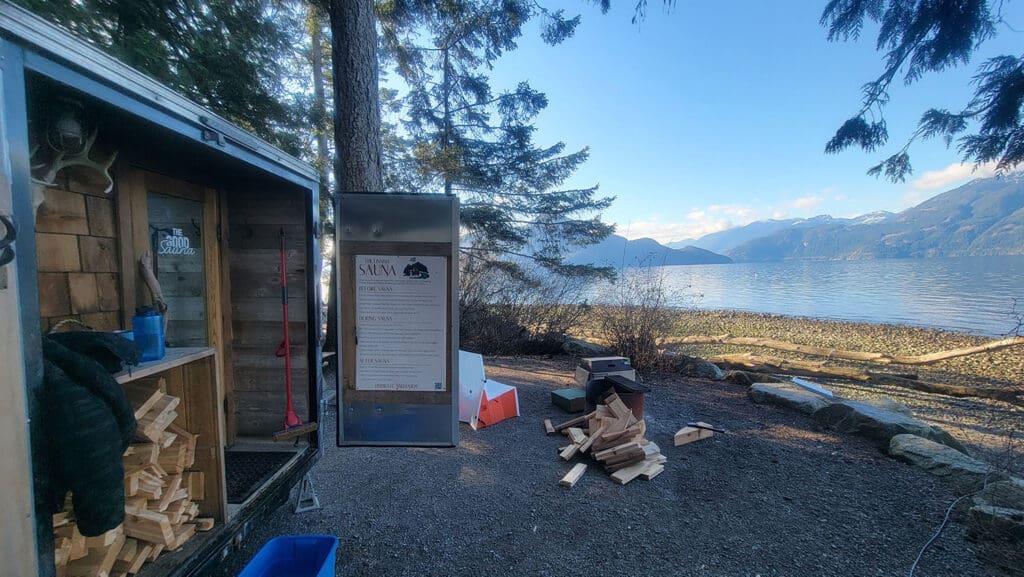
And if you really want to improve the vibe for the campsite (and make friends with your neighbours) we recommend a bit of a splurge and getting a sauna delivered. This is dependent on if there’s a fire ban, but if not, there is nothing like stepping out of a hot sauna and into the ocean… and then rinse and repeat. Our friends as The Finnish Sauna Co. would be happy to get you sorted. This is also something you should book ahead for, especially over the weekend. But it’s well worth the effort, especially if you have a few people to pitch in for the costs.
Important Facts About Porteau Cove
There are a few things to know if you do end up having the luck to get a campsite:
As of now, the water is unsafe for drinking/cooking, so pack in your own water.
There are showers available but they get busy in the morning, so plan on a shower in the early morning or late afternoon.
Campfire bans do go into effect when it’s dry. Be sure you check ahead of time to avoid disappointment, or bring a propane fire pit along if you can’t go without a campfire.
You can buy firewood and ice at the welcome station, but you’ll have to drive to Britannia Beach (only 5-7 minutes north) to get anything else, or further to Squamish if you really need to stock up properly.
The animals here love human food, so be sure to stash any unattended food in the car. Racoons are particularly daring at night and will wait for the right opportunity. Birds and squirrels will hover around during the day. The staff will give you a warning if you leave food out, and reserve the right to kick you out if you don’t follow the rules.
The classic Trash Panda
To Sum it Up…
There aren’t many places where you can camp so close to the ocean where you have 3 million people only a half-hour away. It’s easy to see why it’s so popular. Although it can be a bit of effort to reserve a campsite, I promise it’s worth it.
Porteau Cove is well worth the journey, no matter if you’re coming from just down the road (like us) or are an international visitor renting an RV and touring around BC. It’s well worth the advance planning and hopefully you’ve found this guide in enough time for you to play campsite roulette at 7AM, 3 months before your stay.
There is much more to see and do along the Sea to Sky Highway, and we’ve got more great guides for you to check out. First thing you should do is check out our Sea to Sky Family Navigator web app which can get you the lowdown and help you plan a trip a bit more easily. Then maybe check out all the wonderful hikes for toddlers available in the Sea to Sky. We also have a free Wildlife Bingo for the kids if you would like to keep them occupied while travelling.
We will see you out there!
Want to Find More Great Spots? Check Out Our Free App
We made an app to help families navigate the Sea to Sky corridor a bit better. Check out the Sea to Sky Family Navigator app to plan your trip and find spots based on map, activity, location, and more! The best part, it’s free!