The first time I saw a Strider Balance Bike I had to do a double-take. It was several years ago but the memory is still vivid. Here was this little kid cruising the bike path as if they owned the place. The amount of confidence and joy on this kid’s face was contagious. I had to cheer him on.
I immediately got jealous. Why weren’t these things invented 20 years earlier? I first learned how to bike without training wheels at five years old. But the balance bike is a whole new level of progression—far better than what training wheels can accomplish.
As soon as we had kids, I knew that a balance bike was in their future. We got our daughter a well-loved one off of Marketplace. The learning curve was gradual at first, until it clicked for her. Once she figured it out, she was off to the races.
What Makes Strider Balance Bikes So Special?
Being the first in the game has a ton of advantages. Since 2007, Strider has sold over 2 million balance bikes, meaning they have had many years and opportunities to get the design down. The result is a durable, reliable balance bike that can withstand the abuse that a toddler will give it.
Being an independent company also has its benefits. Ryan McFarland started the company with the simple goal of trying to get his son on a bike as soon as possible, but not finding anything adequate in the market. As the company grew and countless children caught the riding bug, the core mission to help young riders never wavered. Nowadays Strider has programs around the world that help riders of all ages learn how to ride a bike.
Strider also provides a ton of free learning resources to help make the experience as smooth as possible. Some of the tips like “support the child, not the bike” went a long way toward a smooth progression for your youngest. After reading through some of the tips, it became clear that this company truly did care about helping children ride a bike as soon as possible.
Our Kids’ Journey With Strider
First Strides
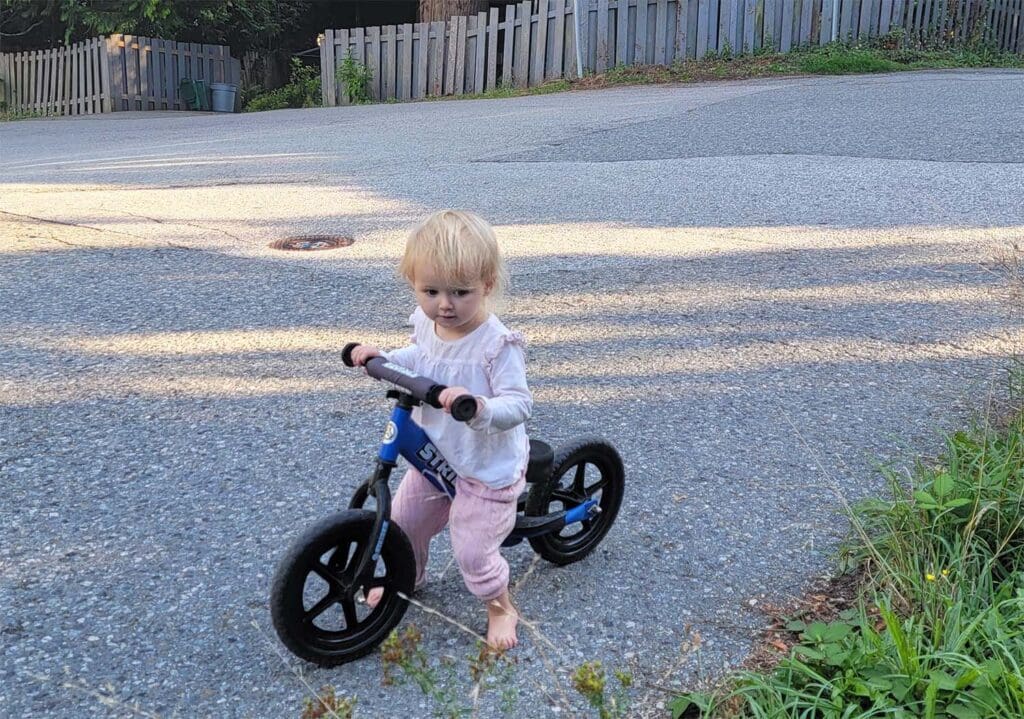
Our daughter got her first Strider balance bike from Marketplace. The tire treads were nearly worn down but the bike still worked like a charm. In retrospect we could have gotten her some new wheels but she didn’t seem to mind—one great advantage of the plastic wheels over rubber tires is their longevity. Being just under two years old, she didn’t seem to mind that the bike had been well-loved by a few other kids and passed down the line.
yes we know, no shoes or helmet… but she was taking it super easy, I promise!
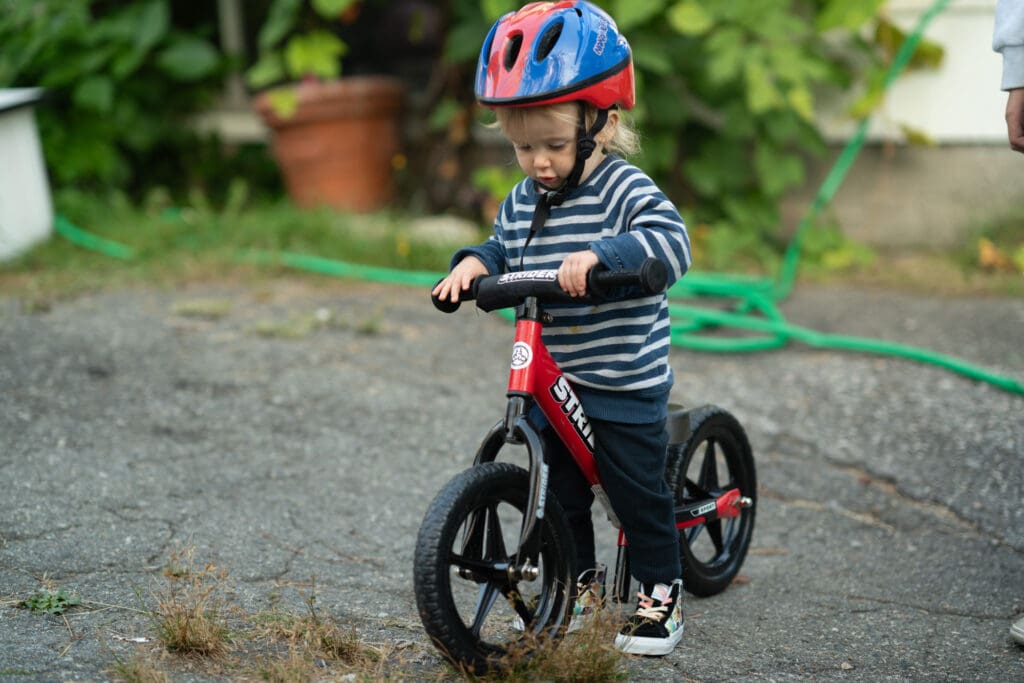
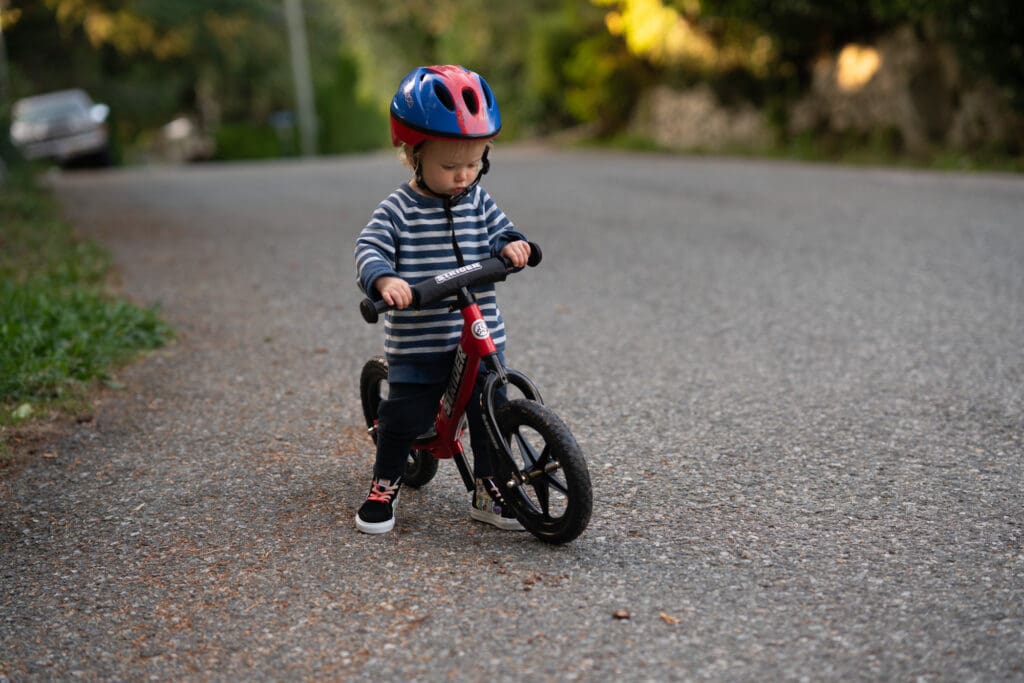
At first she was hesitant, and would only pick up the bike for a minute or two. Then I began to push her uphill and guide her around some corners, which may have instilled some bad habits to rely on me. But eventually, her time on the bike unassisted got longer. The next spring she got a new Strider Pro, and well… the story is still being written but so far, it’s safe to say that she loves it.
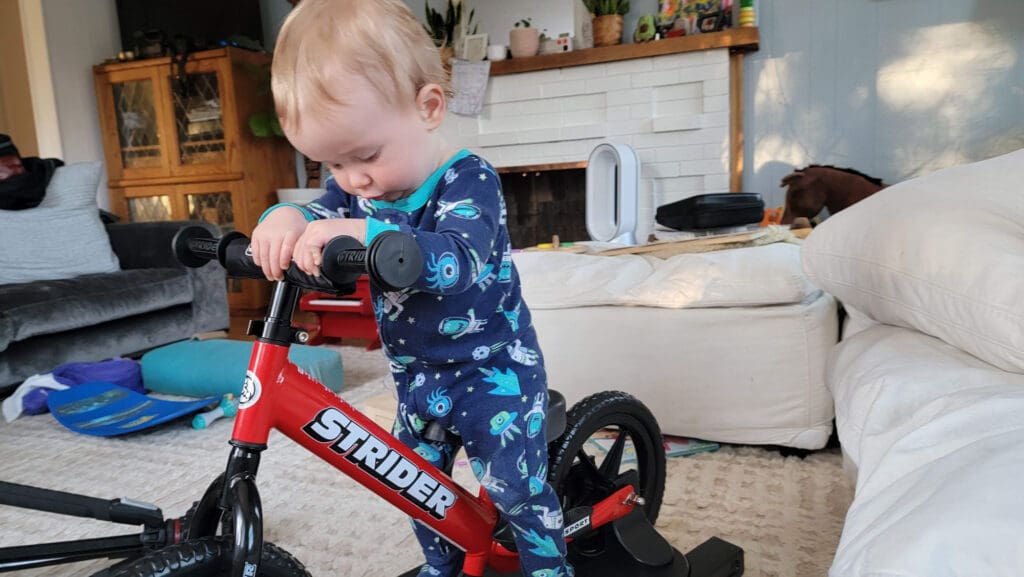
Our son got his bike at around 9 months. The rocking base attachment is the perfect tool to acclimate a child to riding a bike in a safe yet fun manner. It was wild how quickly he caught onto the usage, but perhaps that’s why rocking horses have been a staple of any playroom for at least two centuries. It was the perfect introduction to mounting the bike unassisted, which noticeably happened much faster than our daughter who learned without the rocking base.
Gaining Confidence (Learning to Stride)
For our daughter, the big breakthrough came when I would walk her to daycare while she rode the bike. We live on a large hill with a steady grade all the way down to daycare, a distance of about 600m. At first I was hesitant to set my daughter loose on such a long descent until realizing that it was actually perfect.
She instinctively knew her limits. She also knew that at any time, she could put her feet down to stop. Never once did I see her lift her feet long enough to lose control. Maybe she’s an anomaly and it goes without saying, every kid is different—don’t set your child loose on a long hill on this advice alone. But for her, in this circumstance… she nailed it.
The incline allows for momentum without the child needing to push themselves forward. It gave our daughter the ability to coast without supplying the power. It soon became obvious that it was the major difference compared to a flat surface, which all of us parents gravitate to—or I suppose I can only speak for myself, but that was certainly my instinct.
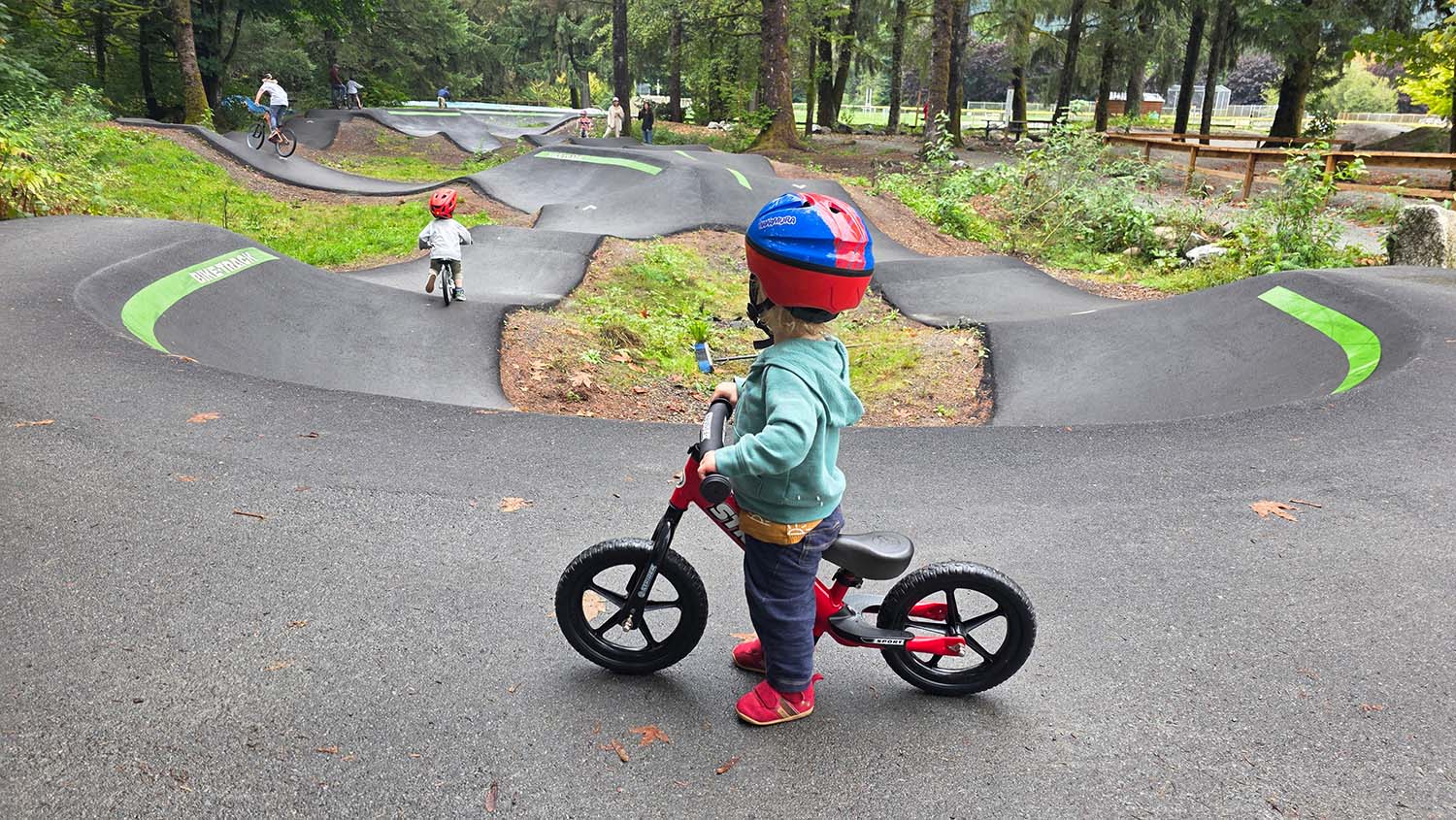
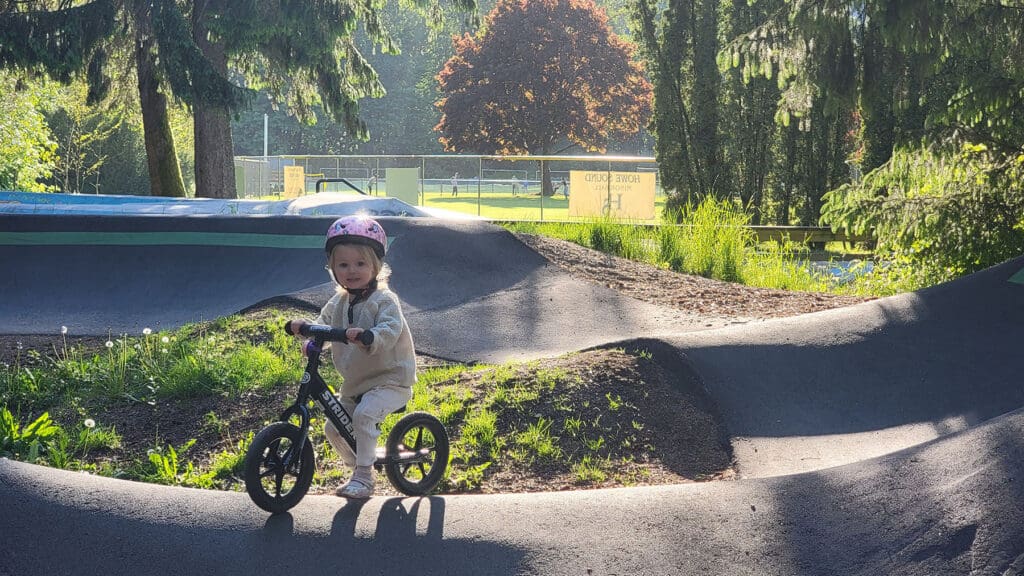
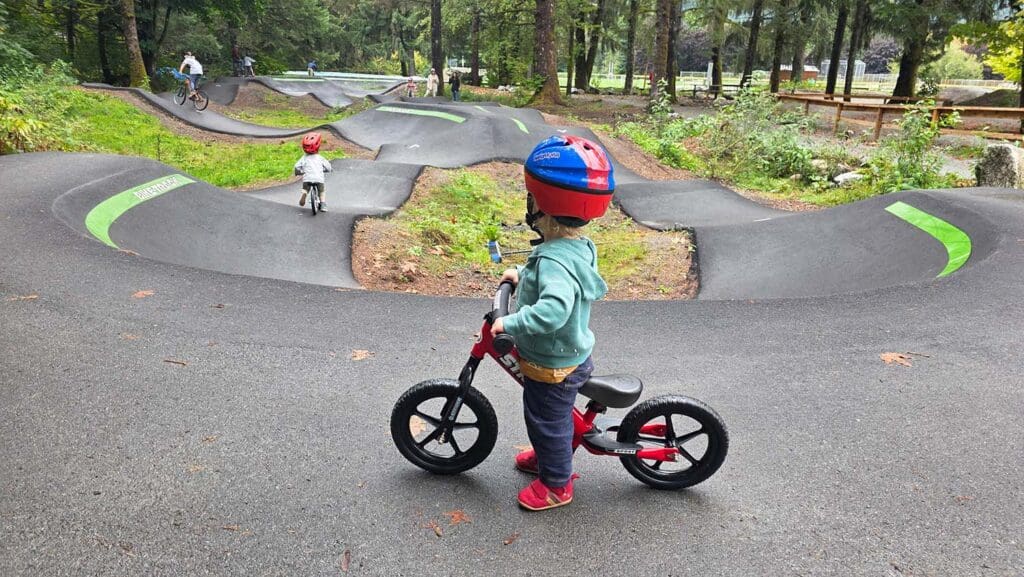
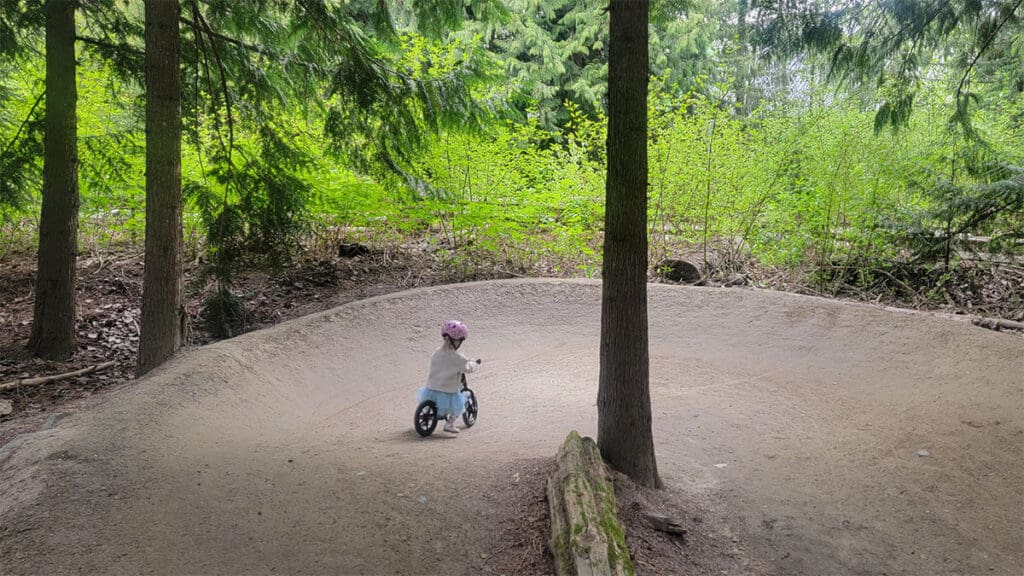
Now the pump track is where she asks to go when we have a free afternoon. It felt intimidating as a parent to set her loose around bigger kids and undulating terrain, but she never seemed scared. I have to remind myself that at that age, fear is not as prevalent as we adults allow into our lives. And in all reality, it’s one of the safest places for a kid to learn. The downslope is never too long, so the speed she carries with gravity ends pretty quick. It also gives her a more 3D balance profile than simply riding on flat ground. And the results speak for themselves:
Our Son’s Introduction To Strider
Our son was 9 months when his Strider Sport arrived at the door. Initially I was thinking we might hold off for a bit until he started walking. But with the removable rocking base that came with the bike, he had a new toy for the living room—one that allowed him a soft introduction to learning how to mount a bike.
First time on the bike was a bit of an investigation… patience is key for the first few months.
The progression was slow, at first. He would size up the bike for a moment, maybe rock it around, and then move on to the next shiny object. But then he began to mount it. Eventually he started rocking back and forth, and I could see he was starting to get it with regards to staying upright. By the time he could walk, he was already really comfortable on the bike.
Once we removed the base, he had enough familiarity to take some steps with the bike. And that’s where he is now. He will take a few steps, but is yet to use his momentum to go forward. But he’s a million times better than if he didn’t have the base to start with. Now he’s gaining confidence each time he goes out. Having a big sister show him the way is a big bonus, and one I don’t take for granted. I’m already seeing how much faster his learning curve is with
Starting earlier than his sister
Having the rocking base
Having a sibling to look up to
Now, he’s not even two and gets excited each time we go out. His coordination is spotty even just walking, but with the bike between his legs he’s figuring it out better than I could ever have imagined.
The Durability of Strider Balance Bikes
Not having tested other balance bike brands (yet), I can’t speak to the durability of others and whether or not the Strider is better or worse than others. What I can say, though, is that Strider bikes are pretty bomb-proof (Disclaimer: not literally, of course).
Our daughter has put her two bikes through the paces and it still rides perfect. It’s what you need in a bike for a toddler, and something I wish was present in other aspects of raising little ones! But through all the drags, hops, drops, crashes, and scrapes, the bikes have performed well. Who knows how long the secondhand bike had been going before she had it (and subsequently passed on to a neighbour) but the bike always performed well, despite some well-loved wear present.
The only real wear and tear was the tread on the tires. But since they are made of a solid plastic and not soft rubber… no inflation/deflation issues! Even when the tread is worn down there is plenty of wheel left for someone who is just getting started.
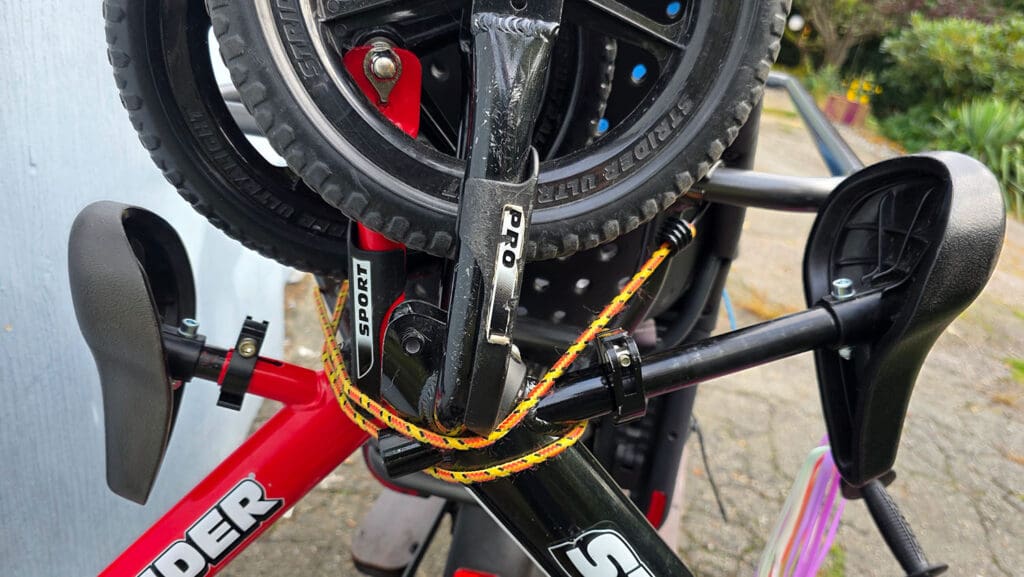
A little bit of scratching, but no worse for wear! P.S. These bikes tie to the back of a cargo bike really well.
Strider Bike as a Hand-Me-Down
The durability of these Strider bikes means they can be passed down for many years to come. Whether you sell it online for someone who can’t afford it new, or simply donate it to someone deserving, the fact that the bikes have parts that last. So many kids will get to learn how to ride a bike before a Strider reaches the end of its life. When you think of it that way, it’s exciting to realize how many kids’ lives will be impacted with a single purchase.
Final Thoughts
Balance bikes truly are a game changer for how soon a kid can learn how to ride a bike. Balance is the hard part in learning, momentum comes second and for the first time someone figured it out. Strider has been leading the way for nearly 20 years and both us parents and our kids are thrilled with the results so far. With the bikes about to enter their second year in our family, they show no signs of needing replacement, and I’m so stoked to see a passion of mine transition to the next generation.
I’ve dealt with a lot of companies over the years of reviewing gear for this site and others, and in all the interactions I’ve had with employees and what I’ve heard from others online is that they are one of the good guys when it comes to developing a product and bringing it to the market.
What has resulted is nothing short of revolutionary, adding years of bike riding to a childhood and some early core memories on a bike. True it may not be for everyone. But since kids are a product of their environment, if you’re stoked on riding bikes, chances are that they will be too. This year we take our oldest to the trails and the youngest on his way to following his sister around as quickly as possible. It will be a fun journey, and I’m sure there will be an update in here at some point!
Until then, you can consider this our whole-hearted recommendation for your toddler shredder-to-be.
One step at a time… but please stop growing so fast!
Thanks for reading! We hope you enjoyed this review. Check out more Gear Reviews, and more on our homepage. This review uses affiliate links to pay the bills. Learn more about our gear review policy and our ethics behind it.
When I was approached to write this guest post, I wondered for a good while what perspective I could add to this wonderful site.
Any organisation with the mission ‘Our goal is to raise the next generation to be mindful of our natural world and to preserve wild spaces’ is something I can get behind. But you seem to have it all covered: fantastic gear and activity reviews, beautiful photography of a stunning landscape, and a powerful, honest philosophy of making the world a better place.
I usually write on Substack, where my goal is to start a conversation around our relationship with the natural world, spread knowledge about the science behind nature connection, inspire people to reconnect with nature, and, perhaps most importantly, to get more nature into kids lives.
But as I browsed through the Excellent Family Adventures site, I found myself thinking, ‘These people get it. There’s no convincing to be done here.’
Outdoor adventures in nature are exactly what we need to be prioritizing when we have kids, not putting off until they are old enough or big enough. The natural world is far safer than our human, urbanized world, when we take the time to show our children how to take joy in it.
Finding joy in nature can take many forms.
But you know this.
Then it clicked. I want to talk to you about why we think of outdoor gear as ‘gear’ at all.
Stick with me.
It makes me so happy that this site exists—that a collection of families has got together to build a resource-sharing project and share their love of the outdoors with other families.
On the other hand, there’s a part of me that feels sad it has to exist. Let me explain why.
My partner and I are trying for our first child at the moment. One of the things we are most excited about is showing them nature—getting to see them experience the first time their little feet touch grass or they dip their hands into a clear mountain stream.
But before being introduced to Excellent Family Adventures, I would have felt quite at a loss to know where to find good information about outdoor gear or activities for kids. I’m sure I would have dug some up, but it would have taken some digging.
Contrast this with information on other kinds of kids’ stuff—toys, TV shows, sports equipment, cute clothes. There’s no shortage of this.
This difference is reflective of what our society values for children and young families. Time out in nature is thought of as an extra, a luxury, a bit of a niche hobby.
This couldn’t be further from the truth. Time in nature is essential for our wellbeing, mood, physical and mental health, and our life satisfaction. It’s even been shown that more nature leads children to be more active and social at school, and improves their academic performance.
It doesn’t have to be the wilderness to enjoy time outside.
I spent five years researching children’s relationship with nature for my PhD. I worked with many primary schools across the UK, which I visited to survey the nature living in their grounds. As well as a niche knowledge of school playground-specific wildlife, this gave me a unique perspective on the sheer range of attitudes different schools hold towards nature.
Some are lucky enough to have sufficient space for a sports playing field, a tarmacked playground (maybe with a climbing frame), and a wilder outdoor area with trees. These schools aren’t forced to make a choice between these activities.
Most, however, are quite pushed for space. This means they are forced to choose between using the outside for sports or free play.
Many schools I visited poured their limited budgets into maintaining the playing field—keeping the grass short, painting the pitch lines, paying for goalposts—that kind of thing. In large part, they have to, since sports is mandated—it has to be provided.
Access to nature, on the other hand, is not necessary at all. The curriculum doesn’t place any kind of focus on learning about the natural world or ecology, and there is no requirement for outdoor learning, which is beneficial for all subjects and wellbeing.
In fact, many teachers I spoke to viewed trees or other aspects of nature as a pain. In the bureaucratic world of education, trees or grass represent hazards—things children could fall off or slip on. So it makes better sense to use their limited budget to cut the trees down or tarmac over the grass.
Who Defines Essential?
Let me bring you back to my point about outdoor gear.
My memory of the required kit list for school is a little hazy since it’s about 20+ years old. I am certain, though, that it included an extensive list of sports kit—trainers, football boots, tracksuits, maybe a tennis racket—but zero requirement to provide wellies or a puddle suit.
What does this say about the activities we, as a society, prioritise for our kids?
Yes, I know, instilling the importance of exercise is important for long-term health.
But exercise doesn’t have to be playing football or hockey. Exercise can be climbing a tree, running around with your friends or, outside of school, hiking or camping.
Let’s face it. How many of us have fond memories of school sports? Most of us do not get our exercise as adults by being a member of a sports team. Most of us are active adults because we walk outside.
Why, then, is it perfectly acceptable to ask parents to fork out a lot of money for sports kit but not for outdoor kit? Why is what you do here—reviewing kit for outdoor adventures with kids—niche and hard to find?
I don’t know what schools are like in British Columbia. But in the UK, the vast majority of those I visited found space for their children’s sports kit bags but not for wellies. Then, they proceed to ban outdoor breaktime when it’s raining because the kids will bring mud back inside with them.
What I’m saying is I think we have our priorities backwards, and you, being parents who value the outdoors, get this.
The School That Got It
I’d like to tell you about one school that gave me great hope. It was only small. It was not rich. But every classroom had a door to a little outdoor patio where there was a wooden rack for wellies and overalls. Every class was responsible for a line of crops in the school’s small vegetable patch.
We don’t need to teach children to care for the natural world. They do this instinctively. But we do need to stop squashing this instinct. How can we expect the next generation to grow into adults who value, respect and care for the natural world if they have always been separate from it, if it is full of danger, if they don’t have the right kit to be able to enjoy being outside in all weathers?
I think nurturing these values at school should be of the highest priority. And research agrees.
Learning To Love Nature
One of my favourite studies on the importance of childhood relationships with nature was done way back in 2006. Researchers interviewed 2,000 adults living in urban areas across the US. Unsurprisingly, childhood experiences in nature were the most important thing in determining whether someone cares about the environment or takes action to protect it as an adult.
This study separated childhood nature experiences into ‘wild’ ones—like hiking or camping, ‘domesticated’ ones—like picking flowers or growing produce, and environmental education, either inside or outside of school. They found that both wild and domesticated nature experiences during childhood were positively associated with pro-environmental attitudes and behaviours as adults.
This means that, if we want people to care about our natural world and value it at the ballot box, we need kids to spend time in nature. They can’t do this without a raincoat, a warm hat and good shoes.
But your average kid, whose parents aren’t necessarily outdoor lovers, is much more likely to own trainers and a tennis racket than they are some good outdoor gear.
All this to say, I’m feel so uplifted that this community and website exist. It lifts my heart that a collection of families values this philosophy enough to start a project like this. It is the most important work.
Buying your children the right kit, taking them for a hike or just toasting some marshmallows with them around a campfire are some of the most important things you can be doing for your children’s love of the natural world and the future of the planet.
Next stop—let’s convince our respective education systems either side of the Atlantic of the same!
Kate Howlett holds a PhD from the University of Cambridge on children’s relationship with nature. You can read more from Kate on her Substack, “Natural Connection“.
Organizing gear is a necessary step for successful family adventures. The problem is, if you’re like us, available time to actually organize anything is pretty much close to nonexistent.
Sure, we make time to pack for a big vacation, as tedious as it may be. But what about all the times when we want to get up and go on a moment’s notice? Without a system, the idea of packing for a spontaneous mission feels overwhelming. In the past we let the overwhelm take over and prevent us from those quick trips. But now, thanks to better flow after learning from experience, our system includes some gear that helps us leave as soon as the storm breaks or plans change where we are able to GTFO of town.
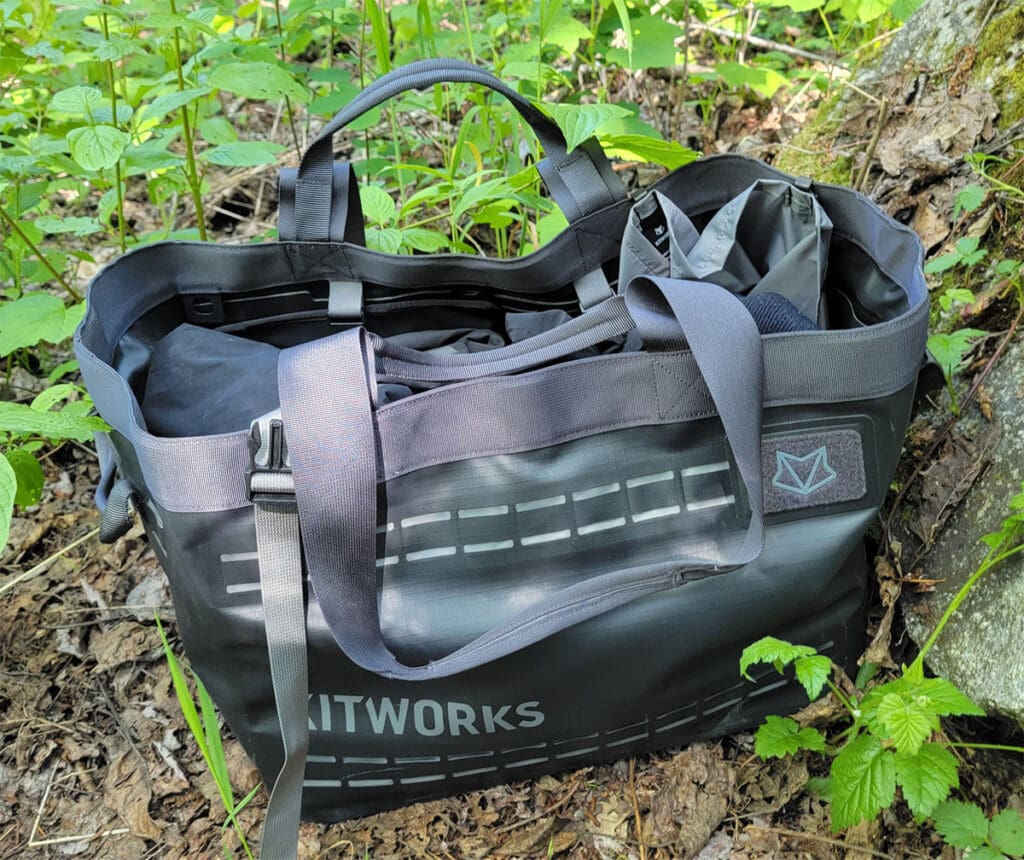
Tote Bags are nothing new; but lately some companies have been stepping up to provide options that are durable, easy to pack, and help people organize to minimize the overwhelm. One company we were just introduced to is Kitworks. This brand started with the simple goal to help make people organize their gear better. That’s something we can get behind.
We have been using their 55L Gear Tote this year, and can say with confidence that it will make life easier when packing and trying to get out the door. Keep reading to hear a bit more about this bag and why we have incorporated it into our adventure routine.
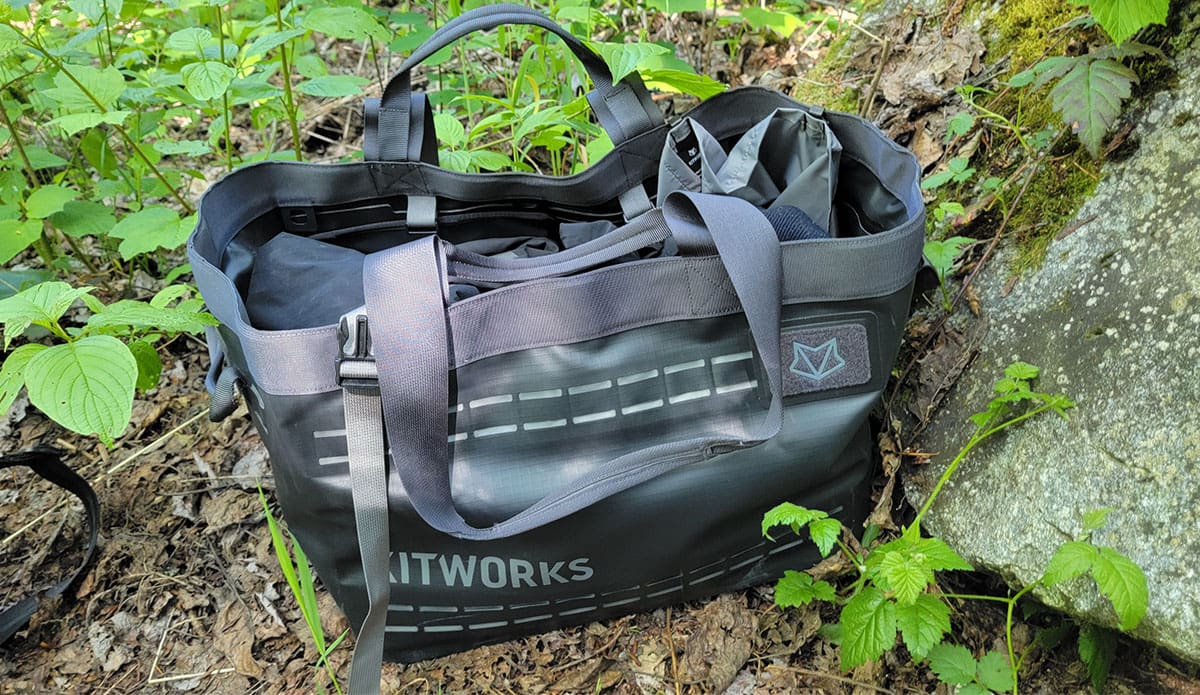
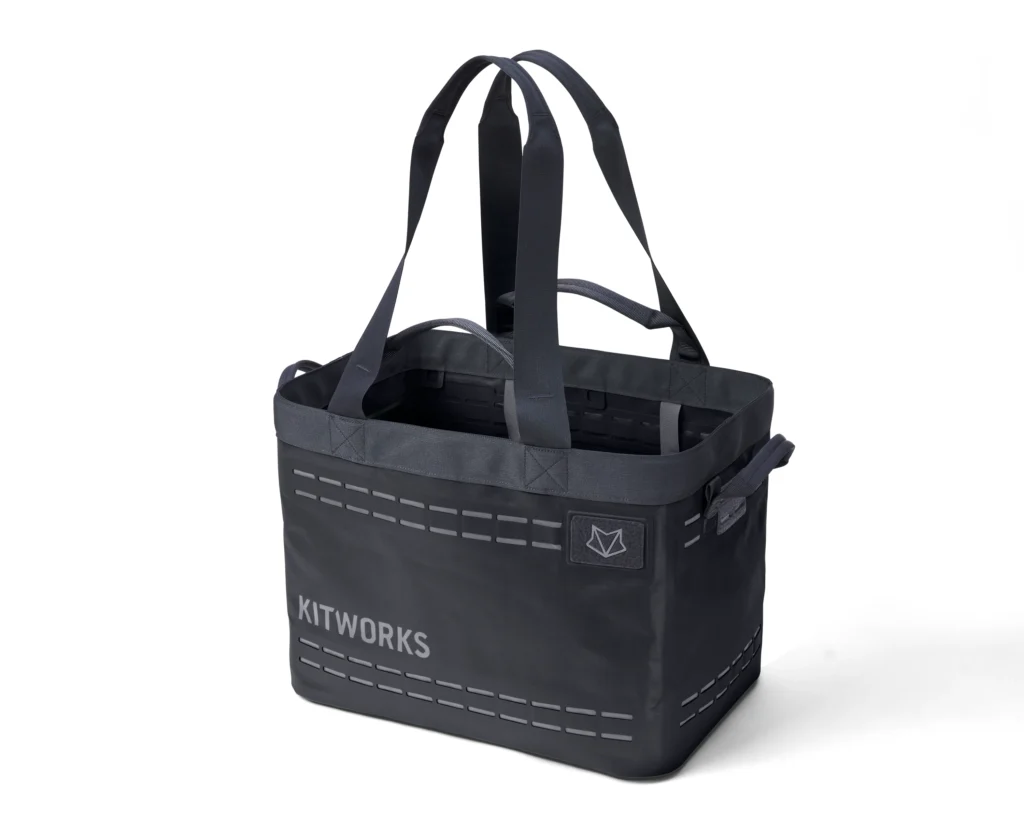
The main thing that stood out when first pulling this bag out was the durability. Indeed, it’s a step above other tote bags for its exterior shell. The 900D ripstop shell is incredibly strong, as is the heavy duty straps and handles that give a variety of ways to carry/unload the bag.
The other big standout feature of this tote is the shape. Most tote bags have a round opening, but the Kitworks bag is rectangular. It’s a subtle difference but a big one, allowing for you to toss gear in much more quickly than other bags. It also stays open and is self-standing, which further adds to the efficiency of tossing gear in with ease.
Notable Features of the Kitworks 55L Gear Tote
The big standout feature is in the modular design. The bag has a whole host of accessories that can be mixed and matched to design the system that works best for you and your family. Thanks to a multitude of attachment points on both the inside and outside, the bag can become a base camp for even the smallest of accessories, tucked away neatly until it’s needed, whenever that may be.
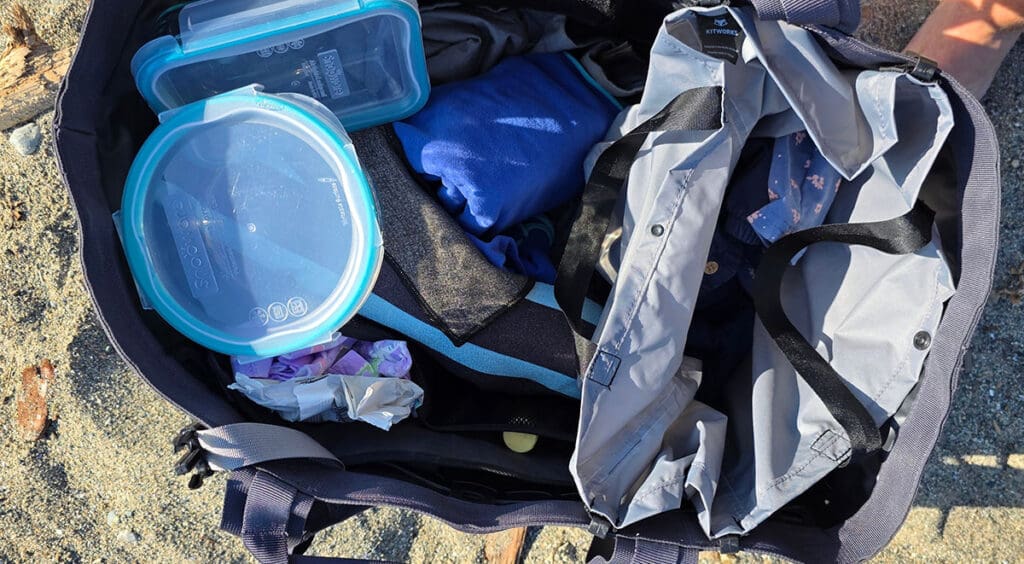
I found the wet storage bag, as simple as it is, to be one of the best features of all. The hooks allow you to attach it quickly to the tote, toss in wet (or soiled) clothes, and tuck it out of the way on the side. Since it’s removable it’s easy to pull off and toss straight into the wash without mixing with anything else. It’s a simple idea that has led to a much cleaner beach and pool experience.
The other optional attachments are equally as good for their own reasons, and I don’t really want to get into the semantics of how to organize. That is the beauty of it, after all: each person/family will have their own configuration that will best suit their needs. For us, we like having the space for some spare diapers, sunscreen, and snacks, all within easy reach of the perimeter without needing to waste time digging around.
The wet storage bag clips on and can easily be removed.
Drawbacks To The Kitworks Gear Tote
Being such a heavy duty unit, the main drawback is the bulk. Although it can fold down, it still takes up a bit of space when packed away. So for that reason it might not be the best if you have a small closet or car.
There are also very few colour options, which personally, isn’t a big deal. My partner will be the first to tell you that I don’t really score style points. But, I do know that it’s important to many people… although likely not the market who want a heavy duty tote bag anyway. This bag is for those who see mud as a badge of honour rather than something that would ruin their day.
Final Thoughts
The Kitworks Gear Tote is well-made, well-designed, and will help you and your family become more organized. This will lead to more spontaneous adventures if it’s already packed and organized—bonus points if it’s already in the car, ready to go.
Yes, its pricey for a tote bag, but really when you consider the durability it’s a good investment that will last. And with the customizability you can morph it from a summer kit to a winter kit with ease, and know where all the bits and pieces go. Less time searching for gear is always a win.
There are very few activities around Vancouver, BC that offer real outdoor adventure with a few local comforts. Sure, there are pretty parks such as Stanley Park and Lighthouse Park, or activities such as Grouse Mountain or the Capilano Suspension Bridge, but our favourite spot to take our little ones is the Sea to Sky Gondola, just outside Squamish, BC.
About 45 minutes from downtown Vancouver, the Sea to Sky Gondola offers people of all ages and abilities the chance to experience the beauty of the BC coast mountains without the usual heavy effort to get there. Within 10 minutes the gondola whisks visitors up the mountain to over 800m above sea level, offering views of Howe Sound, the Squamish Valley, and a beautiful panorama of the Coast Mountains.
At the top of the Gondola is the Summit Lodge. In actuality it’s nowhere near the summit; but those semantics are for another day. The lodge is beautifully crafted, with everything you’d expect in a tourist destination: A cafe, bar, and of course, a gift shop. Everything is kept pretty clean and the staff are friendly. It’s a great start and finish point for some fun on the mountain.
The star of the Summit Lodge is the patio that offers sweeping views of Howe Sound and Sky Pilot mountain. Fridays in the summer become a ton of fun with live music and the sea to sky community getting out to enjoy the late afternoon/evening.
Sky Pilot Suspension Bridge
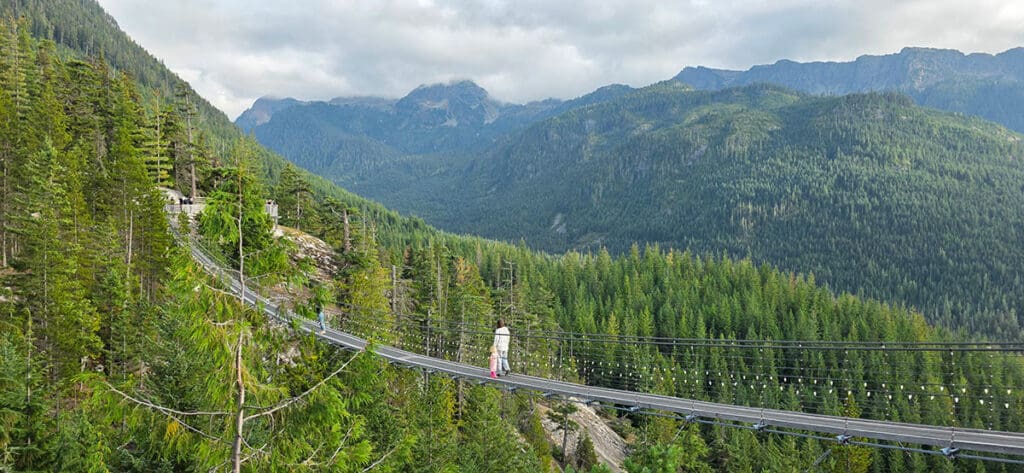
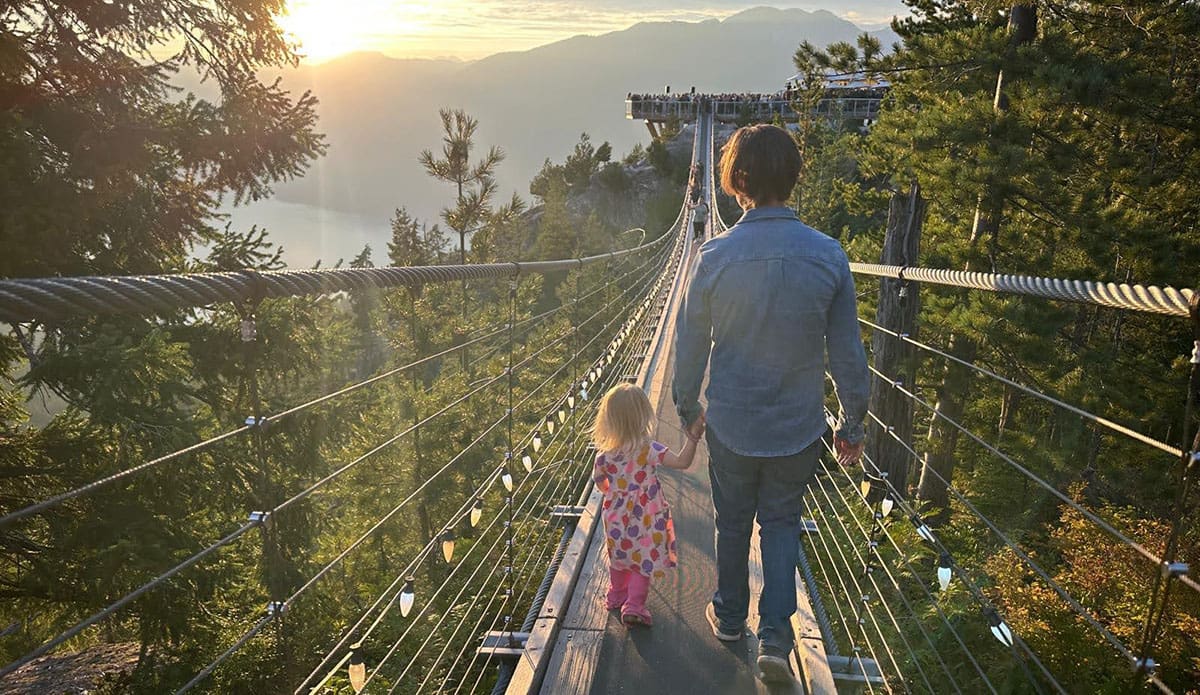
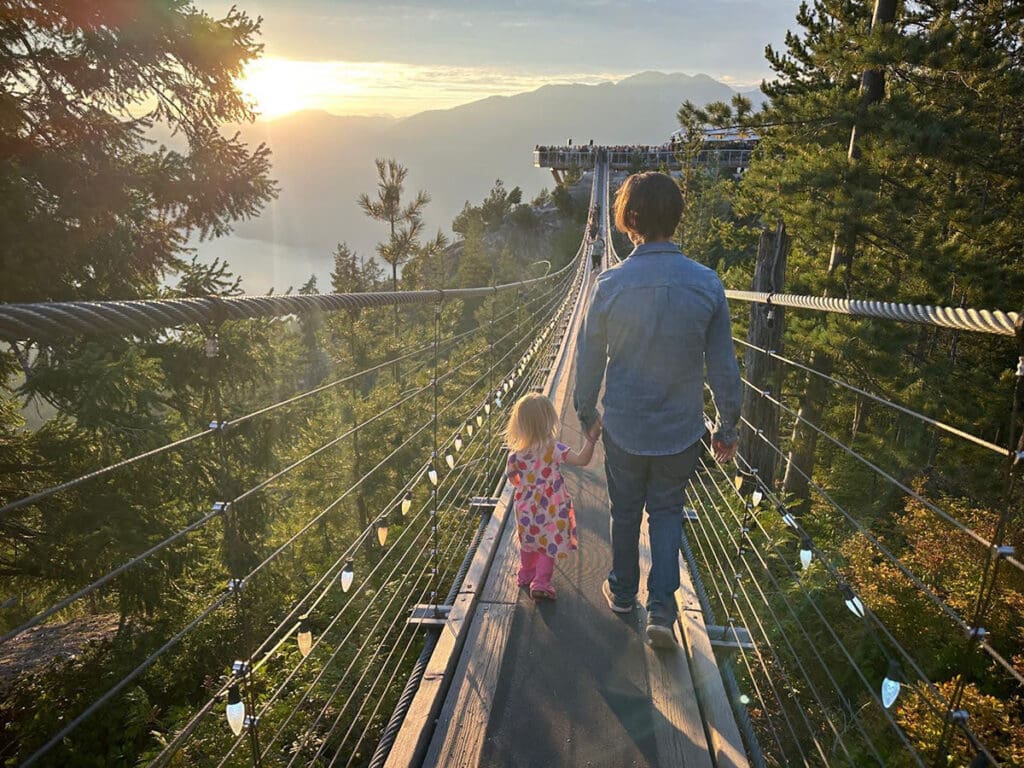
Right at the patio is the suspension bridge offering a beautiful view of sky pilot mountain. It’s nowhere near the vertical drop of the Capilano suspension bridge, but it still offers enough to look down upon as you walk over the tree tops. But the views in the distance are the real treat, especially late in the afternoon as the sun begins to hide behind the mountains.
The suspension bridge with Sky Pilot mountain in the background.It’s worth it to wait for the right time to go across the bridge.
From there, it’s a short loop to get back to the base, where a variety of other hiking trails are available. There are also a few play structures for kids to play on; as well as a picnic area. As I’m sure you all know, when you have kids, it’s important to break up an outing with snacks, and the folks here have designed a great zone to break up each hiking loop with some other activities—including eating.
Front Country Hiking Trails
There are several trails within the patrolled boundary of the Sea to Sky gondola that all loop back to the gondola. They are much more mellow and suit the more casual crowd who isn’t a hardcore hiker.
Alpine Alley
This is the best hiking trail for kids is Alpine Alley, which is a simple loop trail with a few (fake) furry surprises. The trail starts and ends right next to the gondola, allowing for an easy exit if emotions get the best of a little one (or their adult). There are a few challenging sections for the bigger kids, but all the steep bits have a walkaround section if it’s a bit too much.
You can get a specialized map for Alpine Alley at the entrance to the trail, which also offers clues to all the different items you can find along the way. If you have only one trail to do with the kids, this is the one.
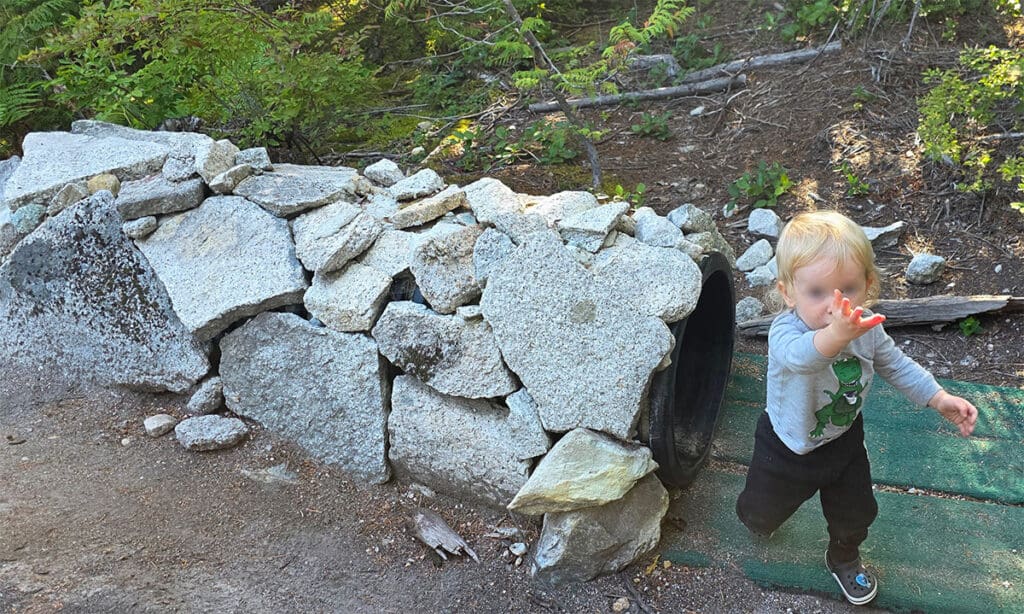
This tunnel was a hit with our 1 year old.
Panorama Trail
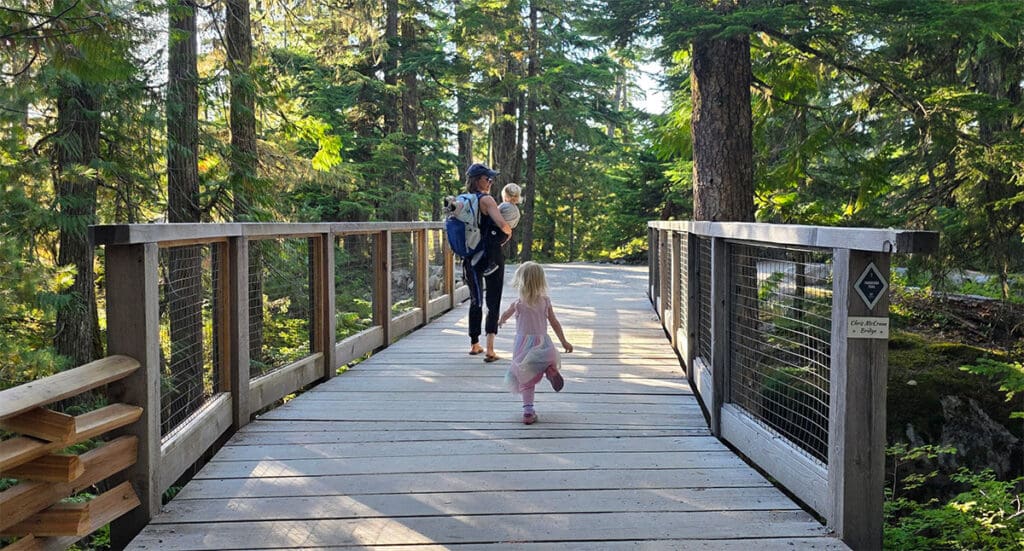
This trail is a bit longer, so smaller children might get bored, but it’s doable. It’s well graded and has nice construction along the bridges, offering a beautiful lookout before returning back. It’s still more of a walk thank a hike, but perfect for bringing little ones along without too much fuss.
Cruising along at the Panorama trail
Backcountry Hiking Trails
While I don’t have any official statistics, I’d guess that at least 90% of the guests at the Sea to Sky Gondola don’t venture beyond the main area and manicured front country trails. Those trails are nice and will suit an outing very well, with most people being more than satisfied for a day trip.
BUT… if you’re the type who wants to venture a bit further, then it’s well worth a bit of extra effort to go up the backcountry trails to make a whole day (or longer) out of it.
There are two mountains within a short jaunt of the top of the Sea to Sky gondola: Mt. Habrich and Sky Pilot. Habrich is very similar to what you find on The Chief: big granite cliffs that point straight upward. Sky Pilot, on the other hand, has much more jagged rock and is a different landscape altogether. It’s pretty remarkable that these mountains are so different and coexist right next to one another. But that’s the amazing varied geology of Squamish. You get a lot in a relatively short amount of space.
Mt. Habrich
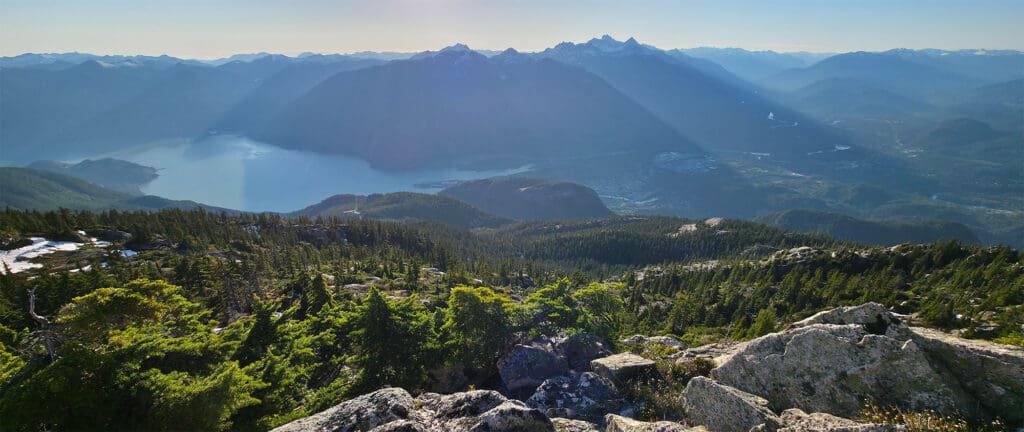
Al’s Habrich trail is a fantastic loop that is similar to the Chief, only much larger in scale. The loop to the subalpine meadows takes about 5-6 hours at an intermediate pace, but you can go much higher than that. The peak is another story altogether and we wouldn’t recommend that for a family adventure. But you can get a bit further up from the “Neverland Loop” which is well worth the extra effort for the views.
This is only one angle but there are many more worth seeing from high up on Habrich.
Sky Pilot Mountain
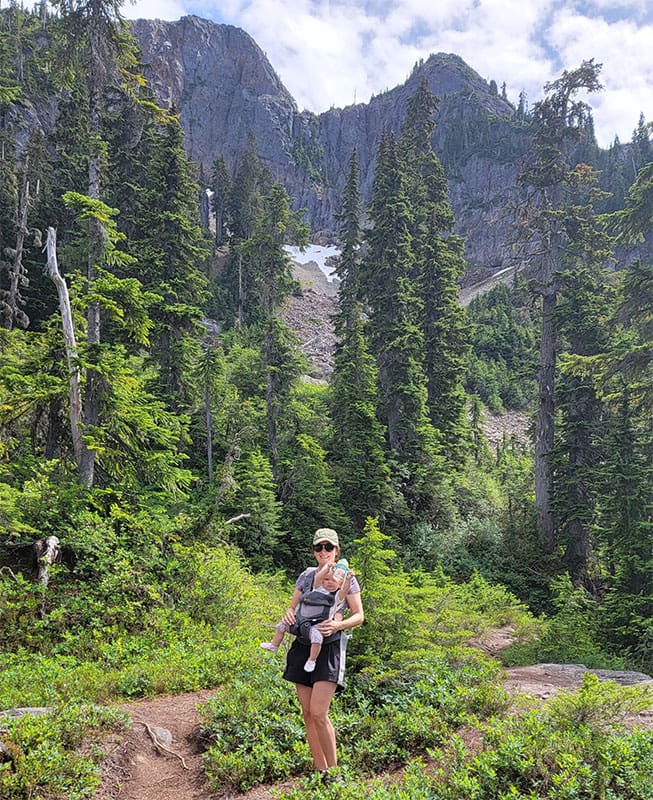
This hike is definitely a bit more technical, and one we don’t recommend taking young kids on. That said, we took our daughter here when she was about 10 months old. Smaller babies are actually easier since they aren’t mobile, but we didn’t make it to the alpine since that would be a bit too dangerous for our liking. But the views still made it worth it.
Allow yourself a few hours as the trail (once the logging road ends) is a bit steep. But once you get to the subalpine you get a fantastic subalpine environment to explore.
Bottles up!
Events and Activities
The other beauty of the Sea to Sky Gondola is the programming they have. It seems as though there are always fun organized events happening. One regular event worth going to with a baby is the parent and baby hike. This can be a great way to meet local parents (mostly moms) and have a casual walk around without much pressure to push it, yet still get some exercise. Those happen on Thursday mornings, but it’s best to check with them for sure.
We already mentioned it but it’s worth a second nod: in the summer months, Fridays are hoppin’ with live music. The legendary Hairfarmers usually play a few times a year, but those events are so popular they eventually stop letting people up. So make sure you get up early for that one if so.
Winter is also a great time to visit the Sea to Sky gondola. Not only do you get out of the rain at sea level to (usually) a snowy mountain scene, but you will also find some of the best easy access backcountry skiing available. The 2km road to Sky Pilot is groomed, making for some quick access to the vertical. It’s easy to do a half day here and still get your fill for powder with such an easy turnaround.
For the kids, there is a tubing hill that costs $5 (at the time of posting) and is actually pretty thrilling—it’s easy to pick up some speed. It’s not suited for smaller children but bigger kids and adults will definitely get their money’s worth.
For those who want some softer activity, there is always snowshoeing and you can rent snowshoes from the summit lodge.
More Great Stops on the Sea to Sky
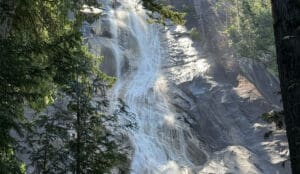
The corridor is packed full of fun stops between Horseshoe Bay and Whistler. Right next door to the gondola is Shannon Falls, which is worth the quick stop, and there is even a trail right from the gondola parking lot to save you the mess of dealing people fighting over the limited spots.
For a fun, interactive app showcasing the best of the sea to sky corridor, check out the Sea to Sky Family Navigator. It’s totally free and our gift to families both local and from afar!
Helpful Links
Here are some links that will make your visit to the Sea to Sky gondola a bit easier:
It’s easy to write Whistler off as just another touristy money pit. The whole resort is designed to be a moneymaker, and tourism dollars is the only way they know how to do that. If you’ve never been here and just go by the whims of the industry, I wouldn’t blame you for it not being your cup of tea.
But then there’s the real Whistler—the one that drew people here in the first place, long before it was an international resort. That is the town that seeks authentic moments with friends and loved ones, and a kinship to nature. The good news is that it still exists. You just have to get out of the Village to see it.
As a Sea to Sky family, we are constantly in and out of Whistler (our daughter was conceived here!), but when we actually want to book a staycation, Nita Lake Lodge is at the top of our list.
Just 4km south of Whistler Village is Creekside, which was where the resort began. Back in the day, the train would deliver passengers to Whistler Creek, and people would trundle up to the gondola barn at the base of what would become the Dave Murray Downhill. From 1965-1981, this was the only way to access the mountain by a lift. Then, when the Village was built, all attention shifted northward and creekside became a mostly forgotten relic.
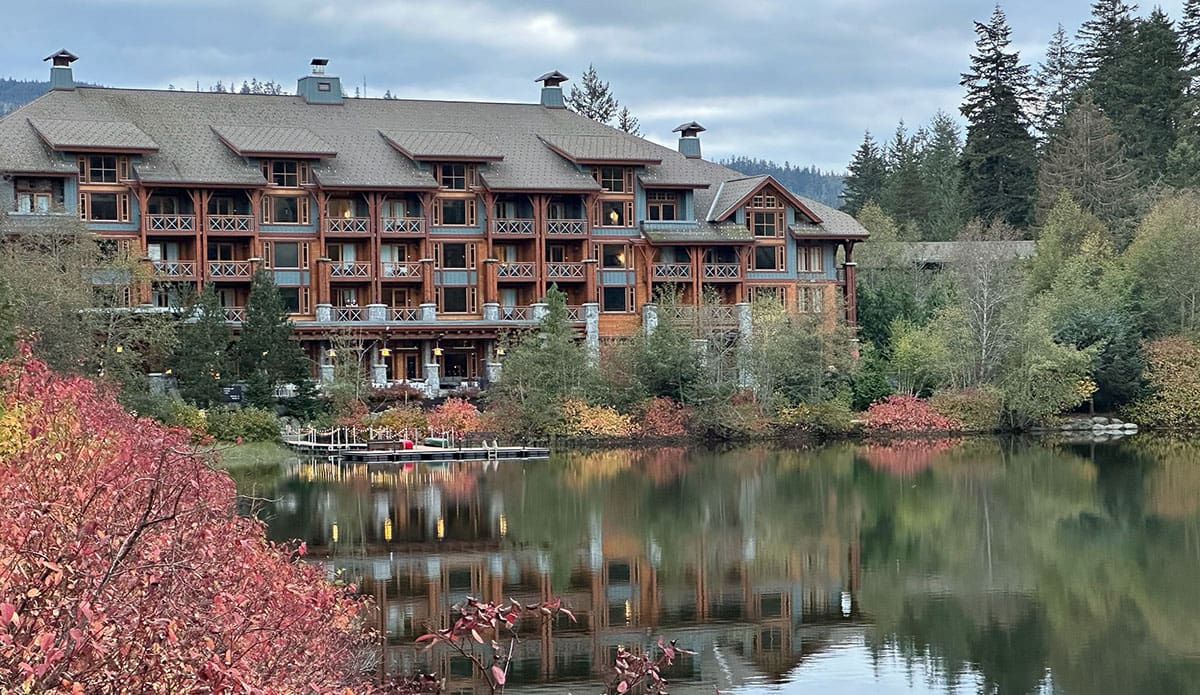
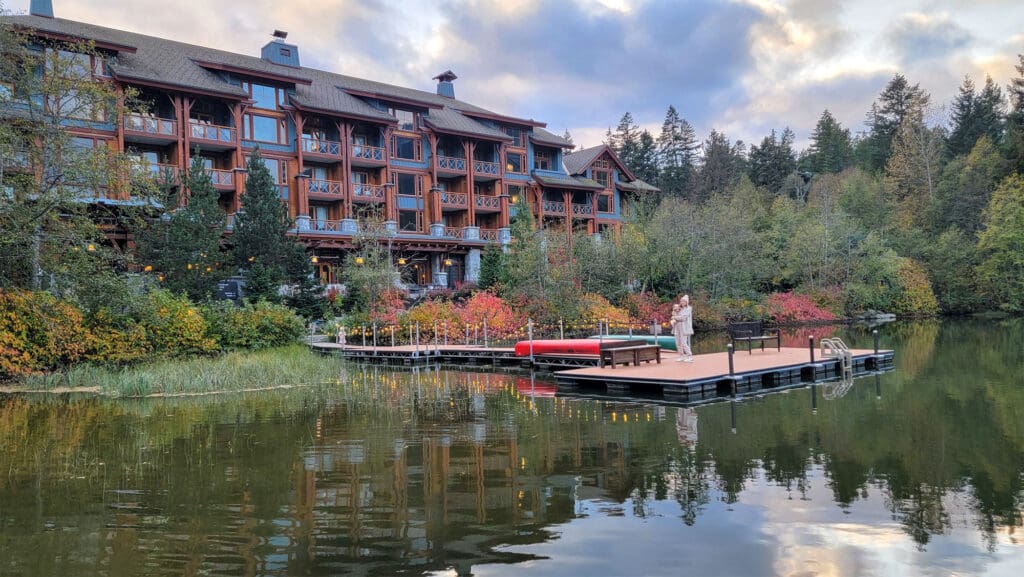
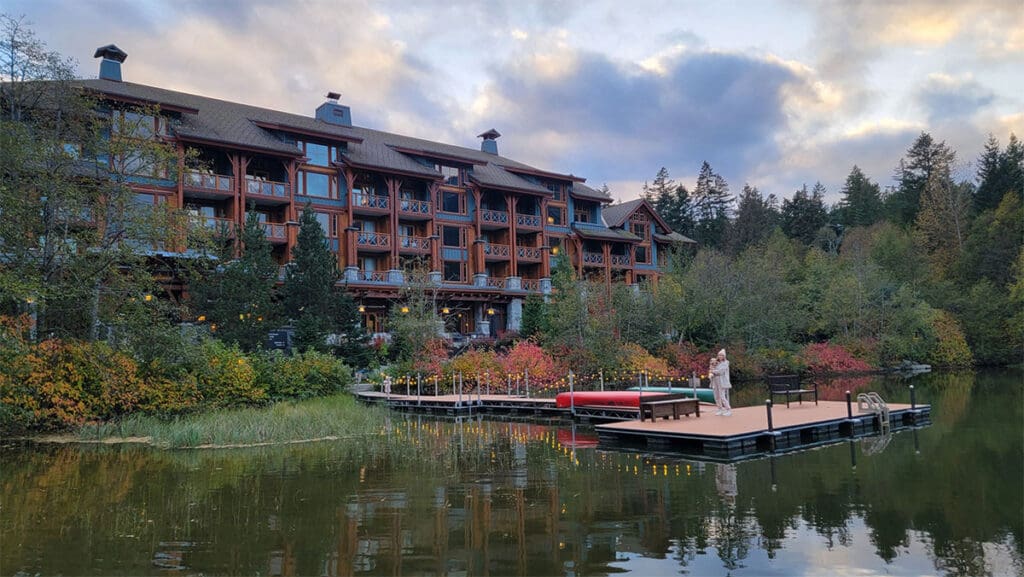
Creekside had a bit of a revitilization in the early 2000’s. One of the big improvements was a hotel on the shores of Nita Lake. It was larger than anything else in the area, and with a degree of class mostly reserved for larger hotels. They call it the Nita Lake Lodge, and over the years has become a hidden gem for people looking to get away from the hustle and bustle.
For a family with small children, we prefer the scene, in fact. Really anyone who prefers a laid-back, more local vibe to the touristy scene would enjoy Creekside.
The Nita Lake Lodge
The beauty of the Nita Lake Lodge is in the details. From the natural wood decor, to the earth-toned color motif, the design feels like a rustic lodge but with all the modern day amenities. We found it to be a perfect blend of quality construction that didn’t feel over-the-top.
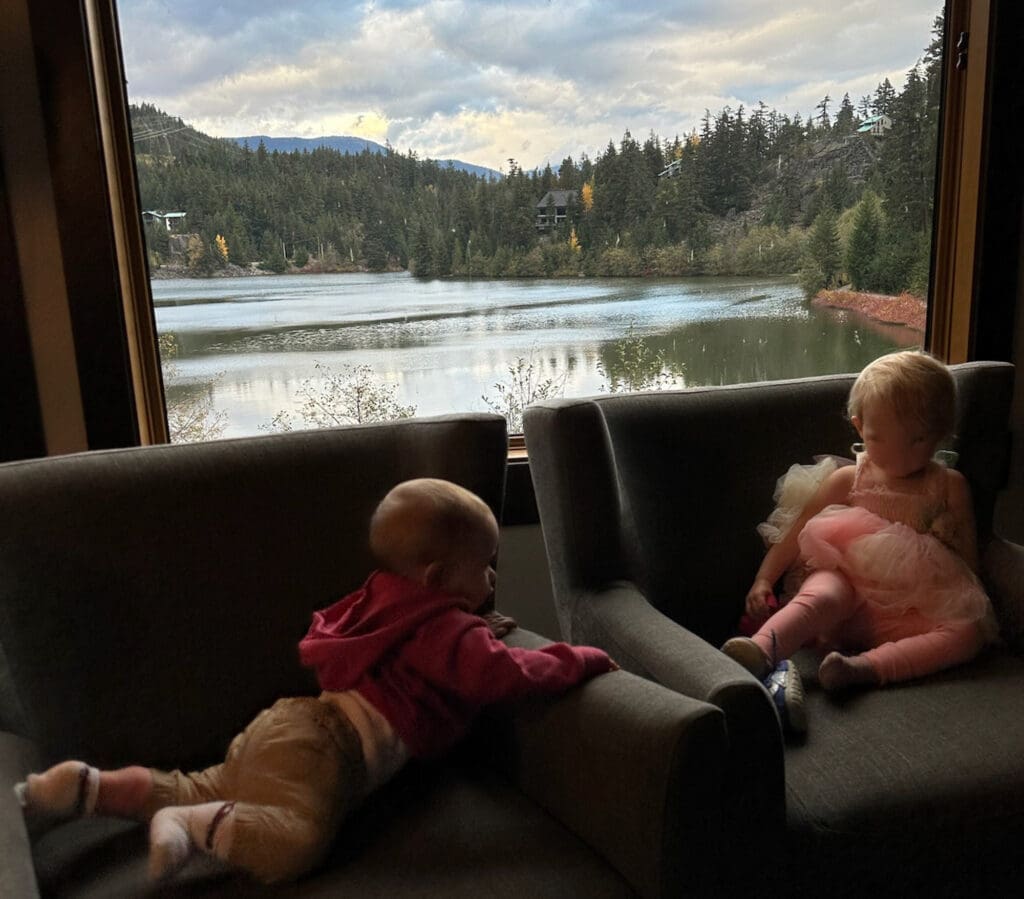
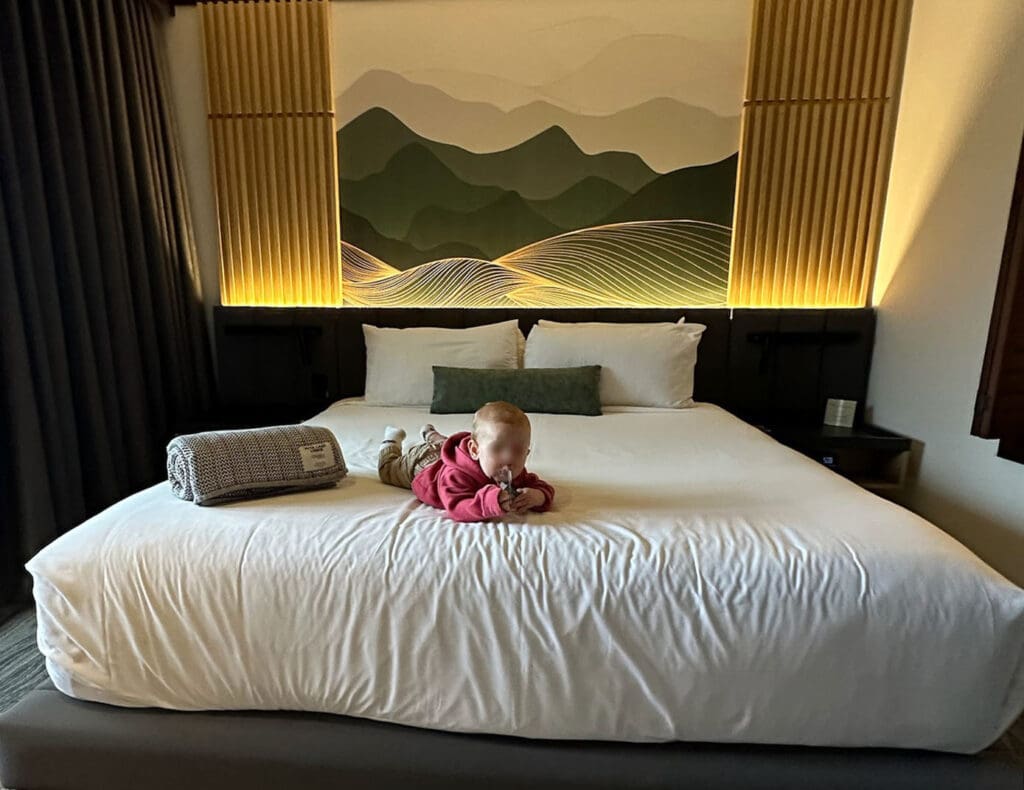
In the room, the comfort was next level. We had a lakeview suite with a massive king-sized bed that had excellent comfort, and a private balcony overlooking Nita Lake. There is a small living room area with couches that allowed our family to feel close without being cramped.
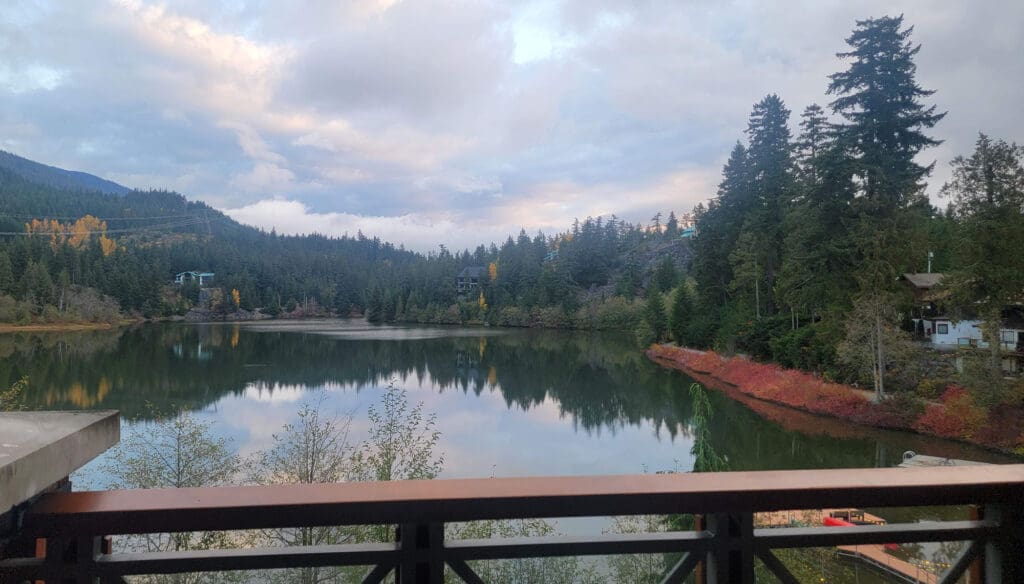
The view from our room looking northward.
But perhaps the best part of the suite was the bathroom. More specifically, the remarkably large bathtub could fit us all in for a bath time that felt like our own private hot tub. Luckily we had great weather during our stay but if luck wasn’t on our side I would have had no problem wasting a stormy day away in the comfort of our suite.
Summer at Nita Lake Lodge
Summer is one of the best times to visit Whistler in general, but Nita Lake Lodge is extra special. The valley trail is right outside the back door, allowing for hours upon hours of biking around the valley. Mountain bike trails exist on both sides of the valley… you can take the creekside gondola up Whistler mountain for the bike park, or head to the west side trails for some classic enduro riding.
Alpha lake park is right next door, so you have beach days covered. Keep in mind the water is quite cold… but summer temps can be above 30 degrees celsius, so a cold dip can be very welcome. The playground is also one of the best, and features a grove of old-growth trees right out the back.
All in all, summer is an excellent time to visit Nita Lake Lodge and creekside in general.
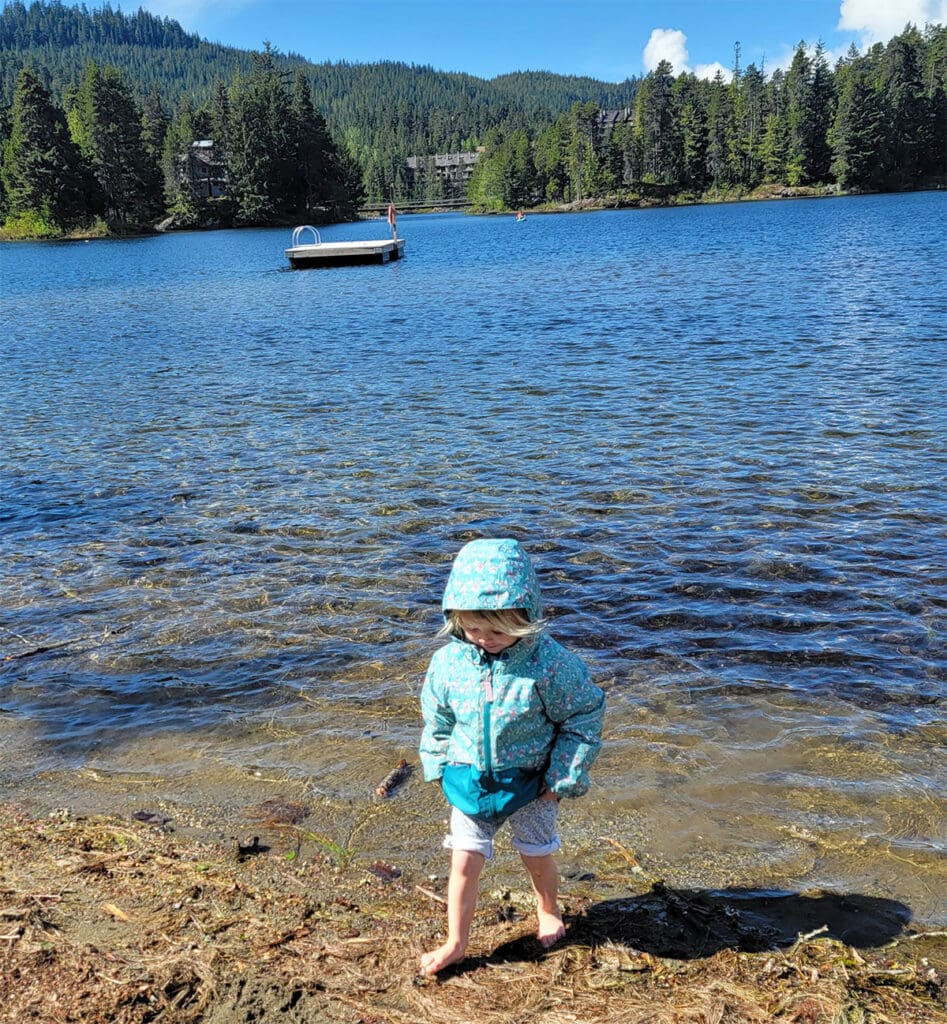
This picture was taken in the spring, hence the jacket… but the view is the same!
The Pool and Sauna
The pool sits in the back of the hotel on ground level, which is an ideal location for reasons I’ll explain shortly. While the pool itself isn’t anything remarkable, it’s what is next to the pool that makes it a bit more of a treat.
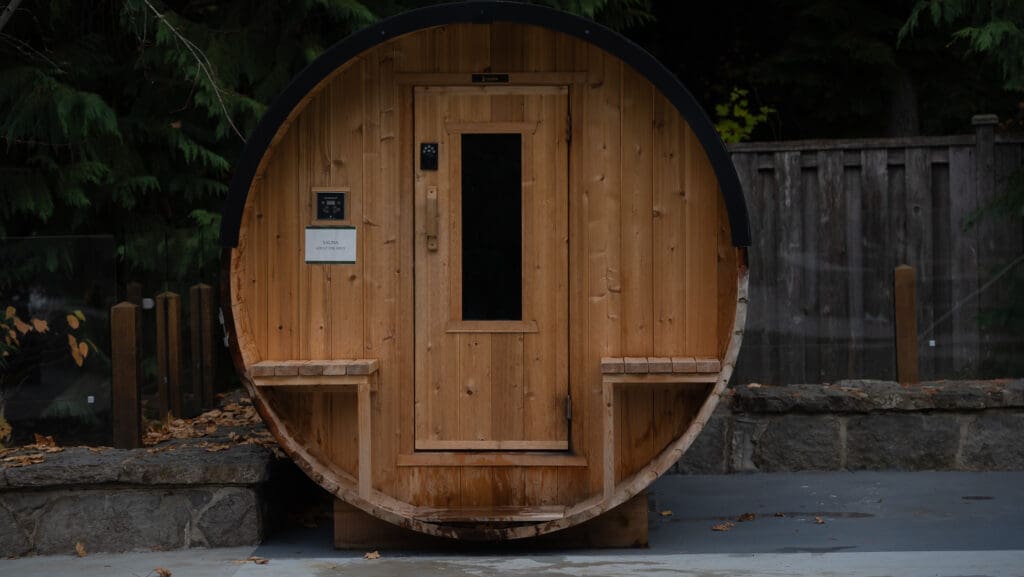
The sauna is a relatively new addition that sits on the pool deck, enticing those who enjoy a good sweat with a poolside session. For those brave enough to make the 100-or-so meter trek to the lake, you can test your mettle with a cold dip right afterward, offering one of the easiest access saunas to a natural cold plunge in Whistler.
Nita Lake comes straight from glacier-fed Whistler Creek, so you can be sure that it’s colder than most. In the wintertime you can often find that someone has cut open a hole for those who really want to test their willpower by lowering past a sheet of ice. But those who know the benefits, will find this appealing, and a large majority of people might think this is crazy. I’m in the former group and appreciate the ambiance of nature to really exaggerate the extreme feeling of a cold plunge under ice.
A classic cedar barrel sauna next to the pool, with the glacier-fed Nita lake less than 100m away.
The Restaurants at Nita Lake Lodge
Nita Lake Lodge has a few different options for food, all on different price/quality scales. Inside the hotel you have The Cure lounge. It has a relaxed feel with some excellent options for pub-style food with a bit higher quality than most pubs in town. The burgers use local ingredients and are a standout in my opinion compared to much of the other pub fare in Whistler. We ate here the first night of our trip.
Despite the kids rowdiness, we were welcomed and given a nice corner table away from other guests, allowing us to be a little more at ease with them than usual for a restaurant.
Another option is Creekbread, a staple in Creekside for almost 15 years that was recently acquired by the Nita Lake Lodge. It’s only a block away from the hotel and always has a warm, welcoming vibe with the wood-fired pizza that ends up being one of the hottest seats in town. We preferred to order takeout and eat by the lake to avoid the lineups and crowded atmosphere. This was also to do others a favor to not deal with our loud and messy children.
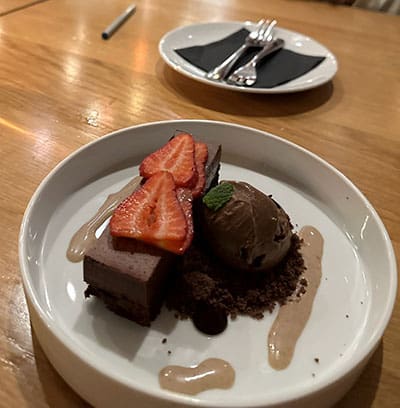
But the signature restaurant at the Nita Lake Lodge is The Den, the upscale choice for more than just guests. The restaurant prioritizes local ingredients as well and the varied dishes suit a wide variety of palettes. I wouldn’t call myself a food critic so I won’t go into detail other than every one of us was happy with the amazing food and dessert, which is not an easy feat with our diverse tastes.
To Sum It All Up…
Staying at the Nita Lake Lodge is an ideal choice for families who prefer adventure over shopping, the quiet over the hustle and bustle, and a bit of luxury without the pretension. The staff is warm and welcoming to small kids, and the adults don’t get bored with the diverse menu and activities that surround the hotel.
With three lakes a short walk away, there is no shortage of things to do, and the village isn’t that far if you do want to go. But we love the feel in Creekside, it feels like our second home. So check the hotel out if you are looking for a bit more than your average accommodation, but don’t want (or need) the extras that often come with the price tag to match. We highly recommend getting some cozy indoor/outdoor travel slippers to enjoy while there. We will definitely be back!
We care about the recommendations we make. We sometimes (not all the time) use affiliate links to help keep the site running. Learn more about our Review Policy here.
Heads up: This guide contains affiliate links. If you buy through one, we may earn a small commission at no extra cost to you — it helps keep our guides free. It never changes our picks or their… Read more: Splurging at the Fairmont Chateau Whistler
Whistler, BC is a little town with a massive reputation. Once the site of a quiet fishing lodge, the valley at the top of two watersheds is now an international tourist destination.
It’s easy to see why the vibe attracts so many. It’s close to an abundance of nature, it’s easy to navigate (even with micro-humans in tow), and visitors have their pick of world-class hotels and restaurants to suit any budget. But beyond the resort facade, there is a core community of people dedicating their lives to the pursuit of getting outside and exploring the wild.
As a 16-year local exploring the Sea to Sky corridor (and a visitor since I was a kid), I have been fortunate to experience the ins and outs of the area for most of my life. Now that we have two small children, we are rediscovering the valley in a whole new light.
Local Tip: Whistler has two different clocks. Before 10AM is a quiet mountain town with plenty of space to breathe. After 10 it’s an international resort with lineups and crowds. If you can beat the masses, you’ll be a step ahead for all the activities, no matter what season.
This Whistler family travel guide is packed with insider tips, family-tested activities, and flexible options for every season to help you plan the perfect trip.
Summer in Whistler is arguably even better than the winter!
Whistler With Kids: The Quick Version
Drive from Vancouver Airport (YVR)
~2.5 hrs from the terminal
Drive from Downtown Vancouver
~1.5 hrs from Burrard/Georgia
Best months with kids
Anytime, really. We love March-April for skiing, and September-October for less crowds.
Picking a good vacation isn’t easy, especially when you’re an active family looking for more than just a passive resort stay. We want to fully experience an area, get dirty, and build real memories. As a purpose-built resort municipality, Whistler makes this incredibly easy.
A Car-Free, Safe Village
The main village was designed in the early 80s as a pedestrian-only zone. When you are traveling with toddlers or kids, this means unparalleled safety. You can let the kids be a bit more free-range without constantly worrying about vehicle traffic.
Nature Everywhere You Look
Whistler sits in a temperate rainforest in the Coast Mountains. Being at the top of a mountain pass, numerous lakes take residence in the valley. Just in town, there are five lakes within a 10-15 minute bike ride of the village. You will find 800-year-old trees, incredible biodiversity, and fresh mountain air just steps from world-class amenities.
Activities for All Ages
There are things to do here for everyone from babies to grandparents (and great-grandparents, for that matter). Whistler has arts and cultural museums, golf courses, shopping, mountain biking, and one of the world’s best ski resorts. All of it is easily accessible from the village, either by a short bike ride or a few minutes by car.
Getting Here: The Sea to Sky Highway
Whistler sits roughly 2.5 hours north of Vancouver International Airport (YVR).
By Car
Driving from Vancouver to Whistler is easily one of the most beautiful stretches of road on the planet. The highway traverses the Coast Mountains along Howe Sound toward Squamish. From there, it’s roughly 40 minutes uphill, past Nch’Kay and Black Tusk mountains. You can easily rent a car from YVR or downtown Vancouver.
We’ve built the Sea to Sky Navigator app to make traveling the highway fun, breaking up the trip with cool stops all along the way. Check it out, it’s completely free!
Parking in Whistler
Whistler has ample parking. The challenge is finding free parking. The day lots 1-5 in the village offer 12 hour parking for a decent rate; last we checked it was $12. Hotels are significantly more, as is street parking or in the parks. Overcrowding is a thing so it’s best to take public transit or rent a bike if you can.
There is free parking in creekside at the parkade, however you can’t park overnight. Same with lots 6-8 on Glacier Drive on Blackcomb in the upper village.
By Bus & Ride Sharing
Skylynx is the most common transport option directly from YVR to Whistler. Epic Rides is a highly affordable option that departs from downtown Vancouver. You can also use Poparide, an app that helps drivers get some extra gas money while giving passengers affordable transportation.
How Many Days Do You Need in Whistler?
Several decades later, and we’re still finding fun spots to go in Whistler. So the answer is, as many days as you can possibly fit. You’ll want to come back. But we know that’s not realistic, so here’s a quick-hit itinerary if you have limited time.
Length of stay
What you can realistically do
One day
Village and Lost Lake
A weekend (2 nights)
Village, Peak 2 Peak, Lost Lake, Rainbow Park
Three to four nights
Village, Peak 2 Peak, Lost Lake, Rainbow Park, Creekside, Train Wreck
A week
Longer day trips to Pemberton, Squamish, and Callaghan Lake
Where to Stay In Whistler With Kids
Where
Area
Budget
Best for
Kitchen?
HI Whistler
Cheakamus Crossing
$
Biking families
Shared
Riverside Campground
North of Village
$–$$
RV, cabins, yurts
Yes
Nita Lake Lodge
Creekside
$$$
Quiet luxury, lakeside
Some units
Four Seasons
Upper Village
$$$$
Service, Lost Lake access
No
Smaller Budgets
HI Whistler: The most affordable hotel-style accommodation is booking a private family ensuite here. Located in Cheakamus Crossing (the 2010 Athlete’s Village), it is perfect for families who love mountain biking right out the front door.
Riverside Campground: Just north of the village, Riverside offers RV camping, cabins, and yurts. You are right next to the Scandinave Spa and the Lost Lake Trails, making it a fantastic basecamp.
Moderate to Luxury Budgets
Nita Lake Lodge: If you like luxury amenities but want to avoid the loud busyness of the main village, this Creekside hotel is our absolute favorite. The rooms are massive, the bathtubs are incredible, and the location right on the lake is unbeatable. Read our full family review of Nita Lake Lodge here!
Nita Lake Lodge feels like its own private escape.
Four Seasons Resort Whistler: It’s hard to go wrong here. Aside from top-notch room furnishings, the staff goes above and beyond to make kids feel welcome. It’s a short walk to Lost Lake park and the Chateau Whistler golf course.
Fairmont Chateau Whistler: As close as you can get to the slopes on Blackcomb without sleeping in the lifty shack. It’s pricey, but oh-so-luxurious, and the service is from genuine people who are just plain caring and nice.
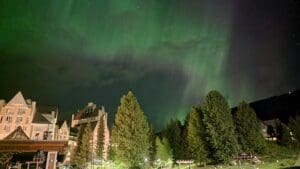
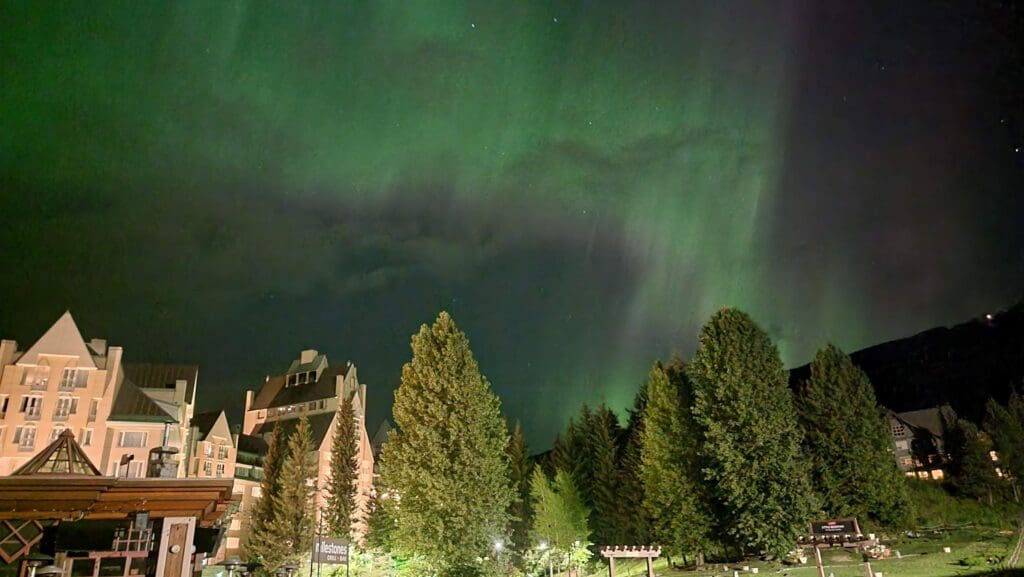
Northern lights not available all the time.
Top Things to Do in Whistler with Kids (By Season)
Year-Round
Peak2Peak Gondola: The quintissential day activity. Go up one mountain, ride across a world record breaking span to the other, and go down the other one.
Whistler Village: It’s a glorified shopping mall in the mountains, but it’s still worth cruising around.
Winter Activities
Skiing and Snowboarding: Consistently ranked among the best ski resorts on the planet, the family learning zones on both mountains are world-class. It’s pricey, though, but you probably know that if you are coming here. Kids 3 and under are free, however. The Epic Pass is by far the best value if you’re going to do more than five days on the mountain.
Tube Park: Easily accessible from Blackcomb’s Excalibur gondola, the tube park offers varying runs of difficulty for all ages. The minimum age is 3 years and minimum height 36 inches.
Ice Skating:The Olympic Plaza in the village offers free outdoor skating in the winter with cheap rentals. Try to go mid-afternoon to avoid the evening crowds.
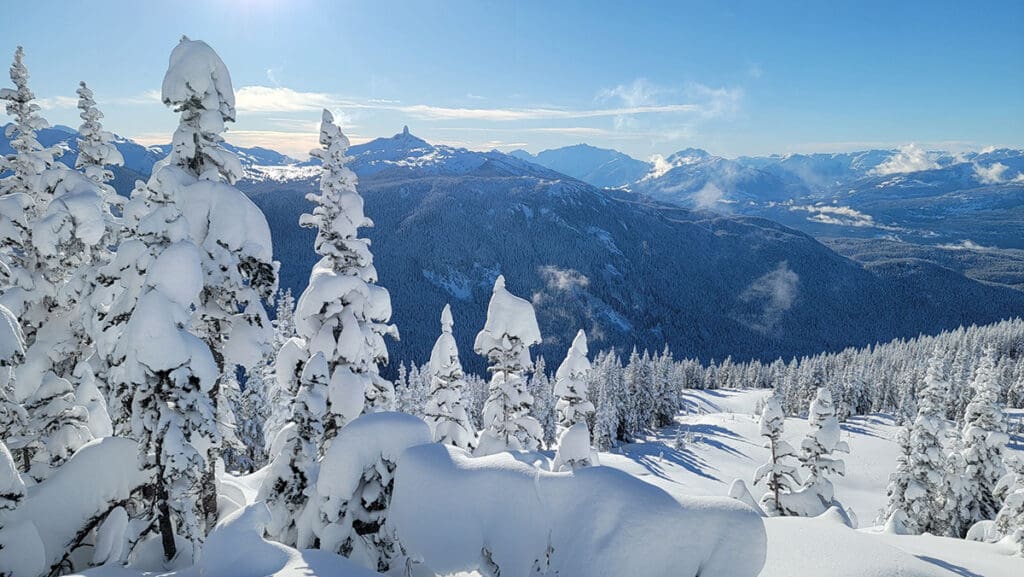
The views in winter are something else.
Spring & Fall Activities
The Valley Trail: Whistler’s paved trail network connects the entire town. It is perfect for family bike rides (this is where we rigorously tested our Strider Balance Bikes!). A number of rental shops can get you and your kids outfitted. We are fans of Whistler Eco Tours and Arbutus Routes.
Nature Walks: The forest comes alive when it rains. Check out the Train Wreck trail or Cheakamus Lake trail to see the old-growth trees and powerful river rapids.
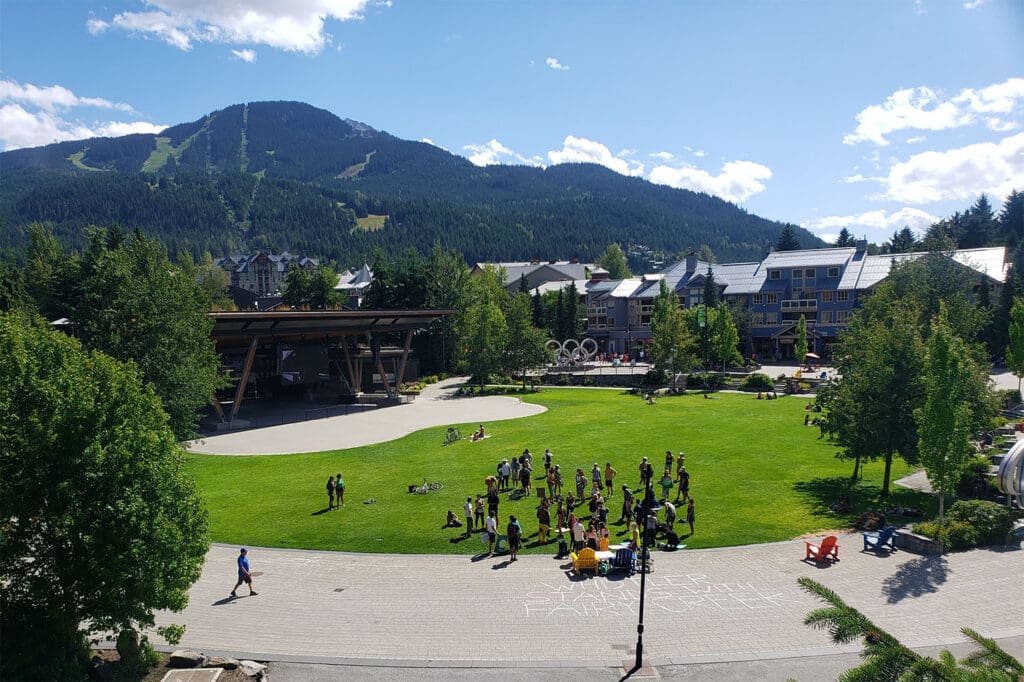
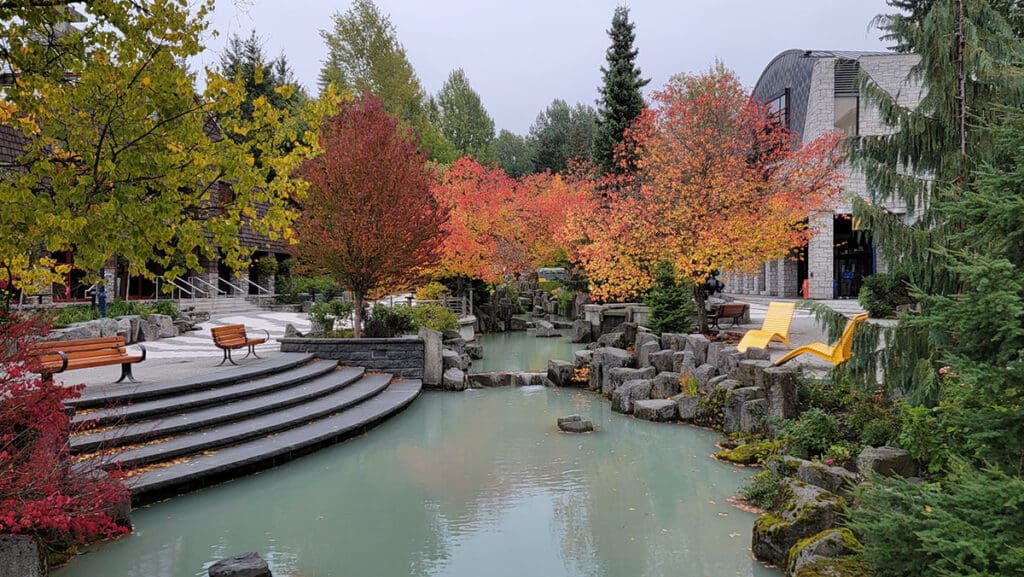
The fall colours come alive in Whistler Village, thanks to some great intentional landscaping.
Summer Activities
Lost Lake Park: The warmest of the major lakes, featuring a large grassy park and beginner-friendly cross-country mountain bike trails. You’ll find flush toilets here and food trucks in the summer months as part of the Park Eats program.
Ziptrek Ecotours: Zip between Whistler and Blackcomb mountains through the old-growth canopy. For smaller kids, the TreeTrek keeps your feet on suspension bridges rather than ziplines. Minimum age is 6 for standard ziplines, or 10 for the massive Sasquatch.
River of Golden Dreams: Rent a canoe or hire a guide through Whistler Eco Tours to lazily float between Alta Lake and Green Lake. It’s a 2 hour journey, and you can book a tour with Whistler Eco Tours.
Whistler Mountain Bike Park. This is a crowd-pleaser, and worth a visit if you ride bikes. Don’t let the crazy stunts dissuade you, there are mellow trails that are still super fun and worth a gander.
Best Family-Friendly Hikes in Whistler
Whistler has more hiking trails than there is time in the day. Here is a rundown on some of our favorite hikes for families to enjoy the best of the valley. You can also check out our page for the Best Toddler-Friendly Hikes in the Sea-to-sky for more ideas.
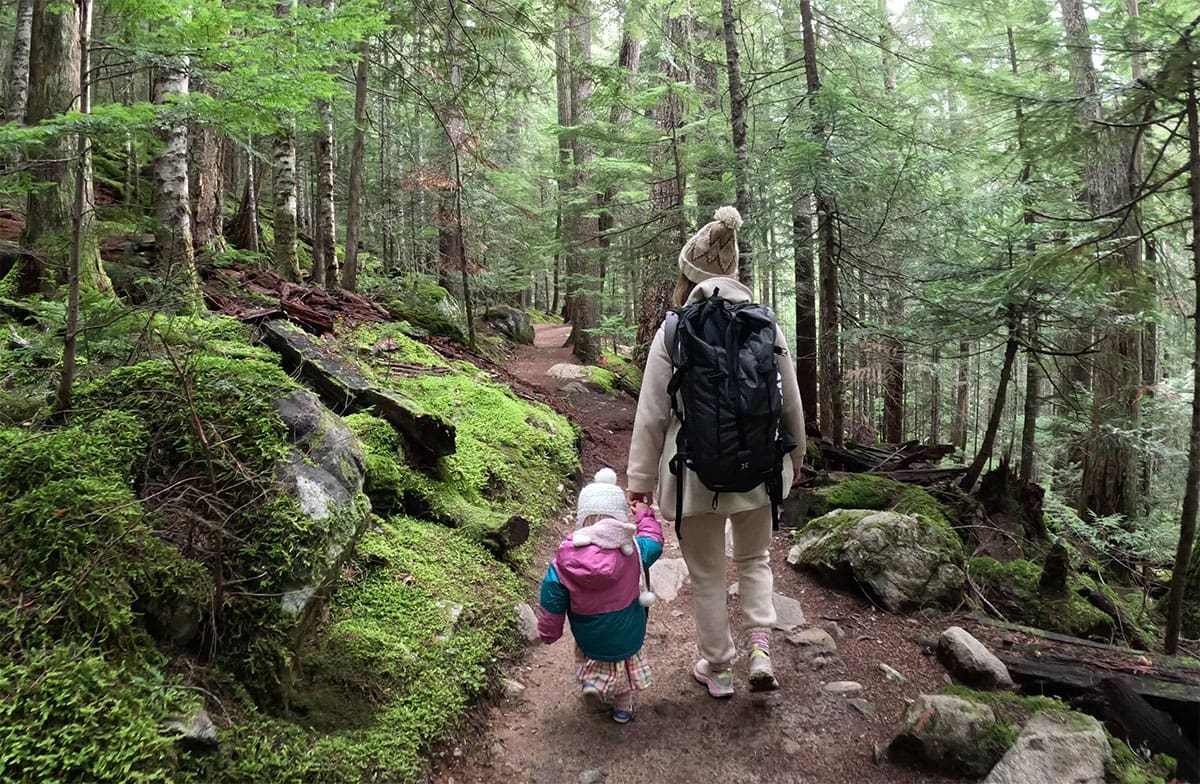
In our opinion, this is the best hike for families in Whistler. It is a fairly gentle, out and back trail that takes you into an ancient forest, with trees that are over 800 years old. The trail winds up at Cheakamus Lake, a glacier-fed beauty that can be seen from the top of Whistler Mountain.
The road can get really bumpy (and dusty) in the summer with lots of traffic. Be sure to take it slow, and avoid if you have a low-clearance vehicle. It’s managable, but just take it easy if you don’t have a SUV or 4×4 to deal with the potholes.
Train Wreck Trail
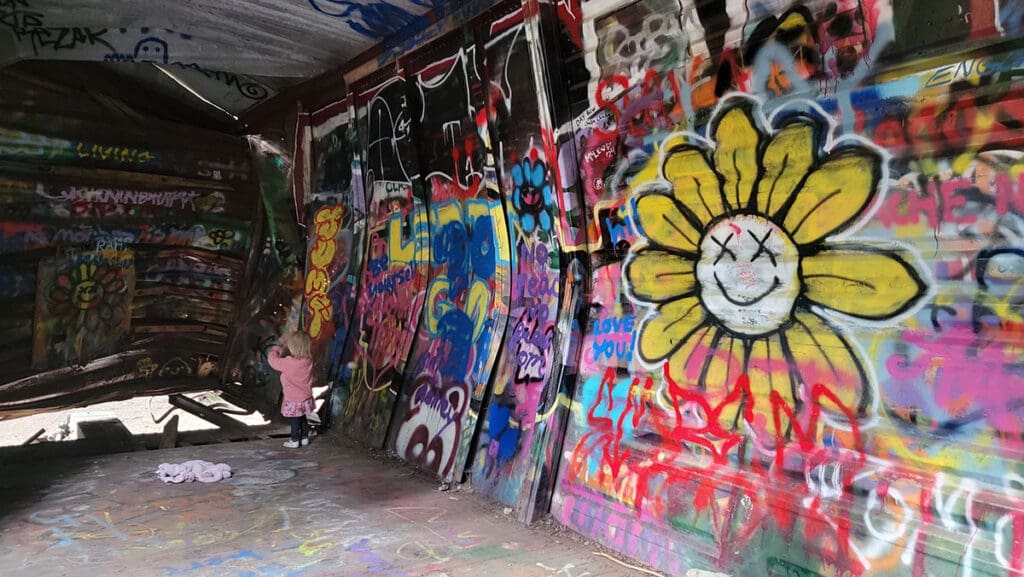
The trail winds through a beautiful forest near the Cheakamus river, ending up at the site of an old train wreck. Since then, people have sprayed graffiti all over the train cars to give a unique look in the green forest by the river. Kids love it, making for some truly unique photo opportunities.
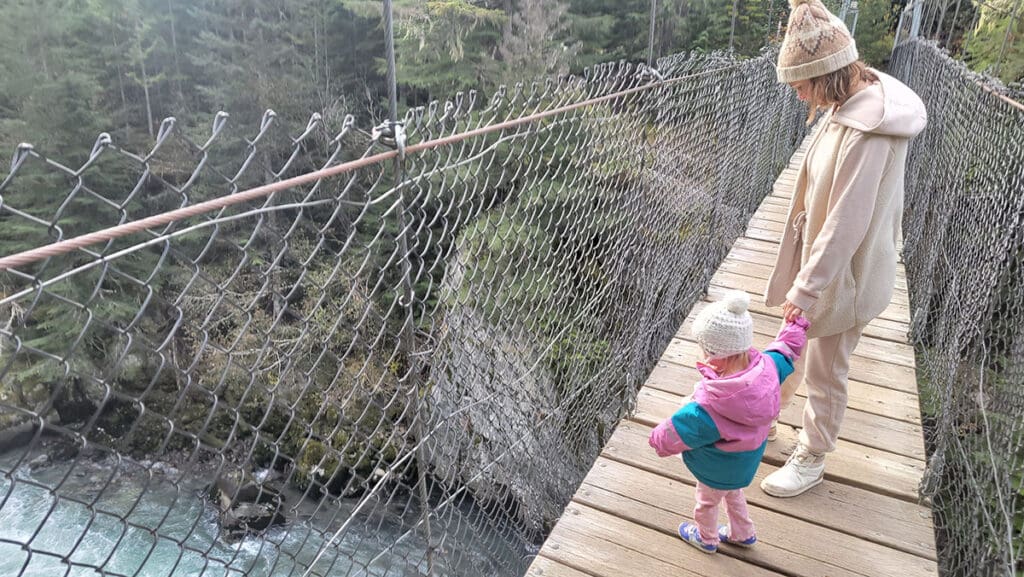
The suspension bridge can be a bit intimidating, so just be sure to have kids who are a bit uneasy with heights close by.
Whistler Interpretive Forest / Logger’s Lake
The big highlight we like here is the short 450m hike from the parking lot to Loggers Lake, an old volcanic crater that gets warmer than other lakes due to the basalt basin the lake sites in. There is also a can’t-miss suspension bridge that kids love!
The Rainy Day Plan
The travel agents might “forget” to tell you that Whistler is in a temperate rainforest. While that may turn some people off, it’s also why the place is so green and full of life. Lean into it, dress appropriately, and explore the forest when it soaks up all the water coming down from the sky.
But even that can get old after a few days. Here are some other activities to enjoy:
Whistler Library: Right in the heart of the village, it’s a beautiful space that is kid-friendly. In addition to books you’ll also find movies, a “library of things”, and computers.
Audain Art Museum: Younger kids might get bored here but older kids and adults will appreciate a bit of culture. The museum has rotating collecitons and First Nations art that is beyond impressive.
Squamish Lil’wat Cultural Centre: Learn about the First Peoples who have been here for over 10,000 years. This joint effort from the two nations whose land Whistler sits on is a fascinating glimpse into the cultures of two distinct nations, with their own languages, clothing, and customs.
Meadow Park Sports Centre: A pool and ice rink. Need we say more?
Escape! Whistler: Whistler’s own set of escape rooms that will challenge even the most crafty amongst the family.
The Best Playgrounds in Whistler
Olympic Plaza
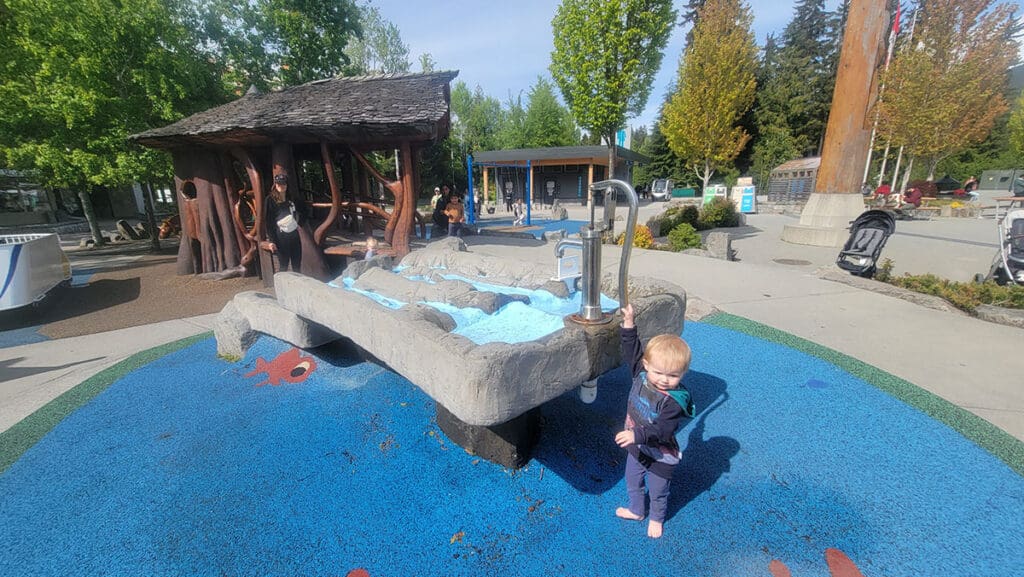
The Olympic Plaza at the far north end of the village has a fantastic, natural-style playground that is open year-round. There are numerous shops and cafés nearby, so kids can play while parents sip coffee.
Alpha Lake Park
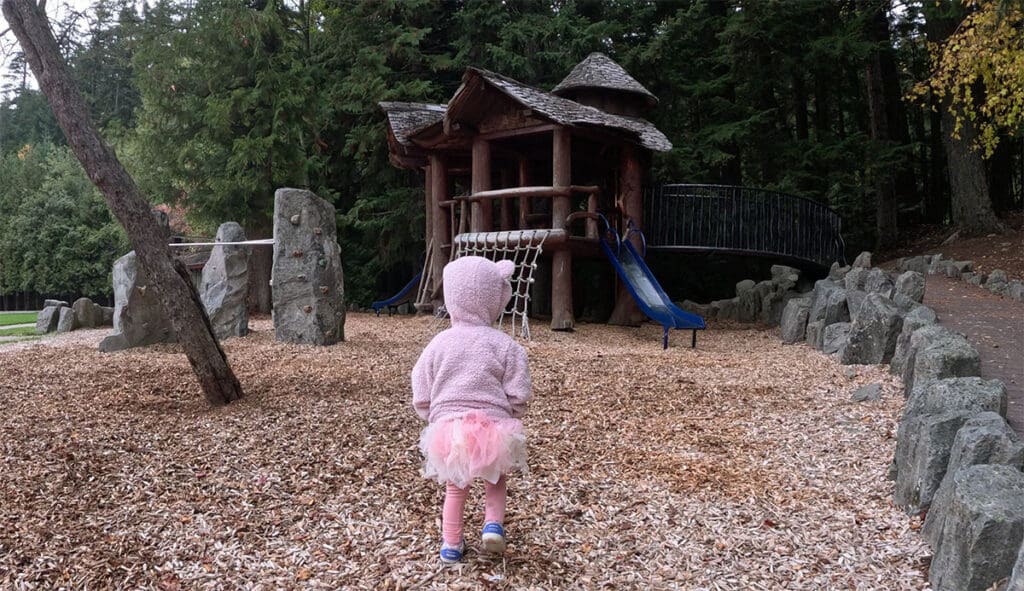
The playground at Alpha Lake Park offers a unique treehouse like structure, with real metal slides. It also has a small climbing wall, a large swingset, a great beach, and a dog park.
The awesome custom play structure at Alpha Lake Park
Where To Eat With the Family
El Furniture Warehouse: Known for its highly affordable food menu. It gets busy, so hit it at off-peak hours.
Pasta Lupino: A local Main Street favorite for decades. Filling, affordable, and kids love the spaghetti.
Splitz Grill: Whistler’s famous burger joint. We highly recommend saving room for the banana split(z).
Creekbread: One of the best family-friendly restaurants in the valley, serving wood-fired pizza with organic ingredients in Creekside. High chairs are prevalent as this is one of the most kid-friendly restaurants in Whistler. They don’t have a dedicated kids’ menu, but what kid doesn’t like a cheese pizza? Really, that’s all we need on a menu for our kids to be happy.
Day Trips from Whistler
Brandywine Falls
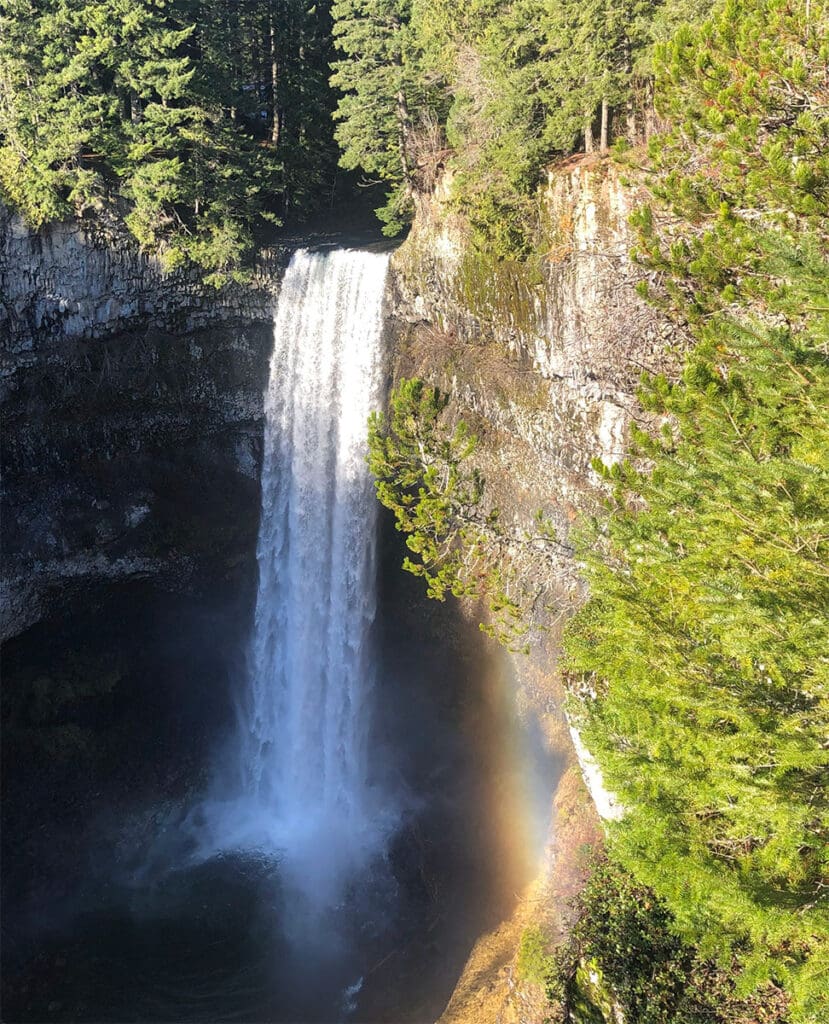
Brandywine Falls provincial park offers an easily accessible viewpoint of the waterfall, just a short 10 minute walk from the highway. In the winter months the waterfall can freeze up for a really spectacular display.
Callaghan Valley
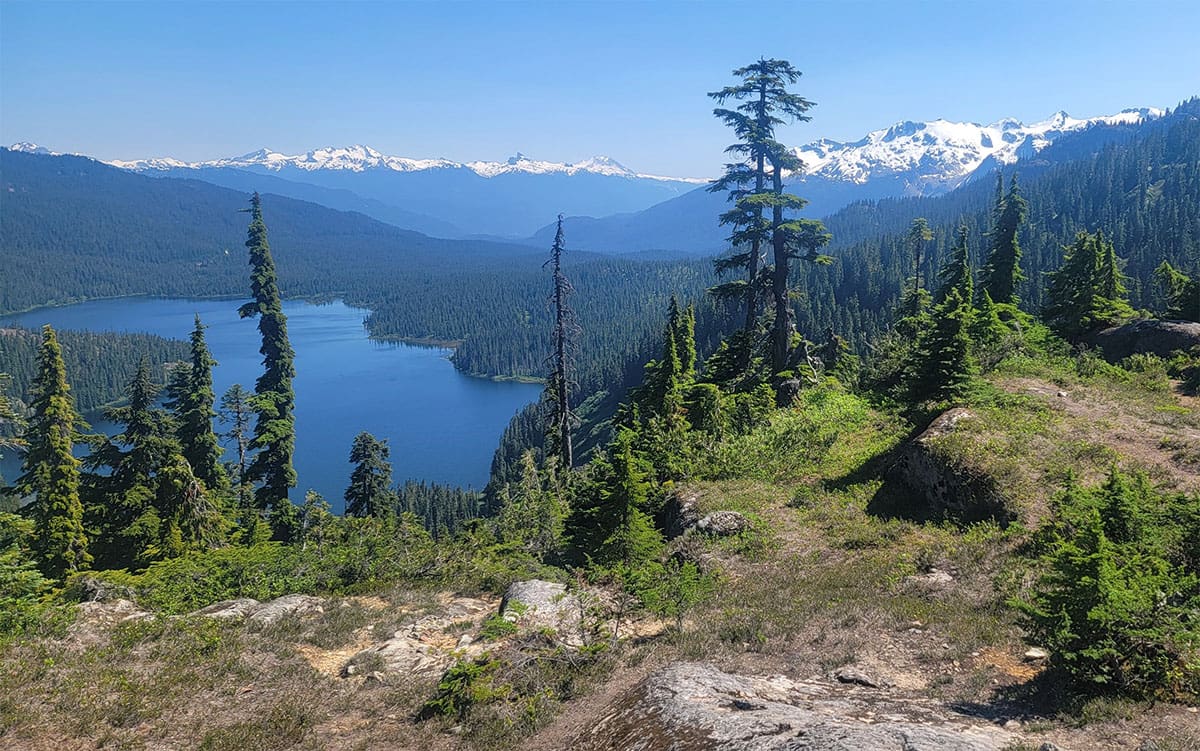
The Callaghan is just 15 minutes south of Whistler and opens up a world of options. In the summer, it’s all about the lake. Callaghan Lake Provincial Park is a gem for camping, (small) boating, fishing, and hiking.
The Callaghan Lake road is genuinely rough, so smaller cars will have an issue with the trek. That said…. we’ve seen it all on this road. It depends on how much you like the undersides. But like Cheakamus Lake, it’s worth the trek.
Callaghan lake and valley from the far side.
What a Family Weekend in Whistler Actually Costs
It’s true that Whistler is on the expensive side, but in comparison to a resort int eh US or Europe, it’s pretty comparable. In the busy months, expect at least $200/night for accommodation, all the way up to $1000/night in a top hotel during prime time.
Activities will range anywhere from $150-300, and often give discounts for kids, but it’s totally kid-dependant.
So a healthy budget for a long weekend away is $1000-2000 for a family of four, given you aren’t counting every expense. You can definitely do it a bit cheaper, and for sure can spend a lot more. But if you can budget that, it’ll be a good time in the valley without feeling like you’re missing out.
Summer is just as busy as winter, if not more these days, but the shoulder seasons do offer deals both on accommodation in the restaurants. So if you can plan accordingly, there are definitely savings by going against the grain.
Free
Costs money
Valley Trail, lakes and beaches, playgrounds, Train Wreck, most hiking that isn’t on Whistler/Blackcomb
Anything to do with Whistler/Blackcomb, Ziptrek, Bungy Jumping, ATVs/Snowmobile, etc.
Bears, Weather & Staying Safe
Whistler is in a valley at the top of a pass in the Coast Range. It’s wild nature, marketed as a resort. There are real risks and hazards here, but it’s all manageable. The first big thing that people worry about is bears. They are here and have been here longer than people.
So you need to be smart about how you interact with bears. Always make noise when walking on trails (even the Valley Trail, you’ll see bear scat frequently along the way). When out picnicking, make sure you keep your foot contained, and never leave unattended. If you do, try to hang it up in a tree, away from other people, or lock it up in your car, if possible.
The weather can change in an instant, so always have an extra layer. Higher up on the mountain it can even snow in the summer, so be prepared for anything.
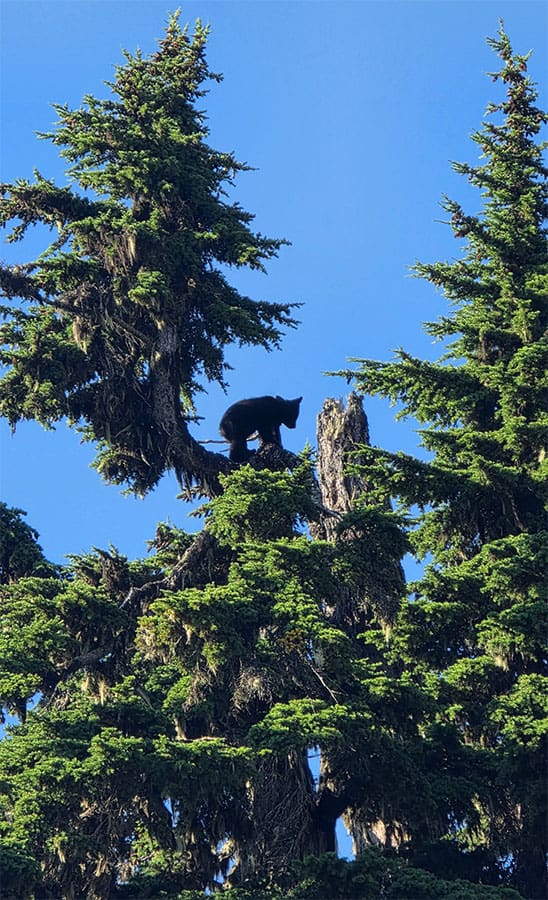
The cubs can be scared, but mama was not far away, snorting and giving a nice warning to keep clear.
Local Tips For Visiting Whistler
Beat the Crowds: The biggest local secret? Most tourists don’t go out before 10 AM. If you are out the door by 8 AM, you’ll have the trails and mountains largely to yourself.
Shoulder Season Deals: May-June and October-November offer huge savings on food and accommodation.
The Weather: We are in a temperate rainforest. There is no such thing as bad weather, just bad gear. Check out our Gear Reviews to ensure your family is packed properly!
Planning the whole Sea to Sky trip?
Get our free app to help you plan out all the adventures along the Sea to Sky highway — every stop between Horseshoe Bay and Pemberton, sorted for families.
Absolutely. Whistler was purpose-built as a pedestrian-friendly resort. Between the paved Valley Trail, the numerous playgrounds, and the easy access to nature, it is one of the most accessible outdoor destinations for families with kids of all ages.
What is the best month to visit Whistler with kids?
For summer activities, September is incredible—the lakes are still warm, the dirt is tacky for biking, and the summer crowds have gone home. For skiing, late January through February offers the most reliable snow conditions.
Do I need a car in Whistler?
No! If you stay near the Village or Creekside, you can easily navigate the town using the free local shuttle system, the paved Valley Trail, or simply walking.
How many days do you need in Whistler with kids?
As many as you can get! Realistically, you don’t want to do less than two days. But everyone has a limited schedule, so try a long weekend to get your bearings. If you’re a mountain biker, you can stay busy for a lifetime. After 16 years as a local and even longer as a mountain biker, I’m still finding trails and routes that I’ve never tried before! Then add Squamish and Pemberton, and you unlock another dimension altogether. Same goes for hiking.
Is Whistler expensive for a family?
No lie, it can be. But it can also be incredibly affordable. Accommodation is probably the biggest expense, so if you are into camping, there are countless options around the valley on crown land. Food can be pricey but if you purchase groceries in Squamish or Vancouver before getting here, it’s often significantly cheaper. As for activities, they can add up, or you can just enjoy nature, which is free.
What is there to do in Whistler when it rains?
There is plenty to do when it rains. Number 1 is get outside! It’s a rainforest and the forest comes alive. We’re fans of Cheakamus Lake but if you want to stay closer to town, check out the Emerald Forest. If you prefer to stay inside, the Library is great, as is the Meadow Park Sports Centre. Or for a fun family activity, check out Escape! Whistler, the local escape rooms.
Can you take a stroller on the Peak 2 Peak Gondola?
Yes, the Peak 2 Peak has plenty of space for strollers. It’s perfectly safe to bring a kid onboard.
Are there bears in Whistler?
Yes! There are black bears that live in Whistler, and have lived here long before humans made it a destination resort. We’re in their space, not the other way around. They are active from early spring until November-December. They will mostly keep their distance with two exceptions: They are attracted to garbage, which is why there are the bear-proof garbage bins everywhere. Also, a mom will defend her cubs, so if you see a set of cubs, don’t stick around, as cute as they may be. Otherwise, they will keep to themselves and leave people alone.
Come Back in Another Season
The beauty of Whistler is that it truly is a four-season place to play. Every time we go back, there is something unique about the landscape we can enjoy. Even if you’re not a hard-core skier, the snow and silence in the winter is worth a visit. The rainy season may scare some people off, but it’s a rainforest, and it’s remarkable when the forest comes alive. Don’t just visit during the busy season, it does get quiet here, and the restaurant deals during the slow season are worth it in themselves.
Feel free to get in touch with us if you have any questions, we love to share the magic of this place beyond the usual tourist haunts. Hopefully we’ll see you out there!
Sure, you can book an all-inclusive beach vacation and call it a day. But is that truly travelling?
Of course not. It’s an easy way to take some time off, but it’s not immersing you and your family in the lands, culture, and special places that truly make a destination worth visiting.
EFA contributor Matt Maddaloni went with his family to Costa Rica in March 2025. Not one to take the conventional route, Matt and his crew set out for adventure in the mountains, jungles, and beaches of Costa Rica. They decided to do something a bit different, and documented the trip through their eyes. The result is the above half-hour special dedicated to exploring Costa Rica and what makes it special.
Playing games with your family can be one of life’s great pastimes.
And passing time in remote places in nature, many will argue, is the best of all pastimes. However, until now most games were relegated to a deck of cards, and maybe a portable chess board. If you’re bringing a hatchet or axe along, you can add in axe throwing. That was mostly it for family games for a long time.
Now Helinox has flipped that entirely with the release of four new games that pack up small and allow you to bring along for any type of trip, including long hikes with a backpack. The same company that revolutionized the camping chair is now taking another stab at leisure time, but now with a social and competitive focus.
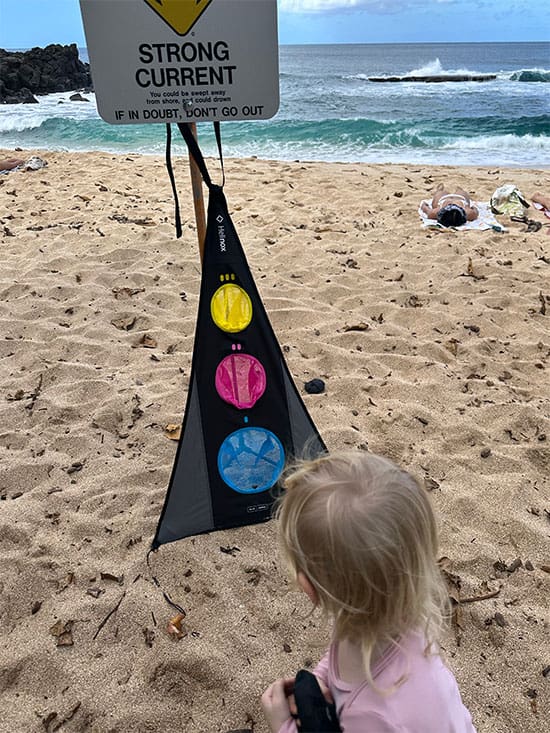
We had a chance to test out their PLAY series while on a trip to Hawaii. While our kids aren’t big enough for all the games (it clearly states the age limit), there were a few that they really had some fun with. We will share more about that, below.
Might be too basic or too advanced for different kids
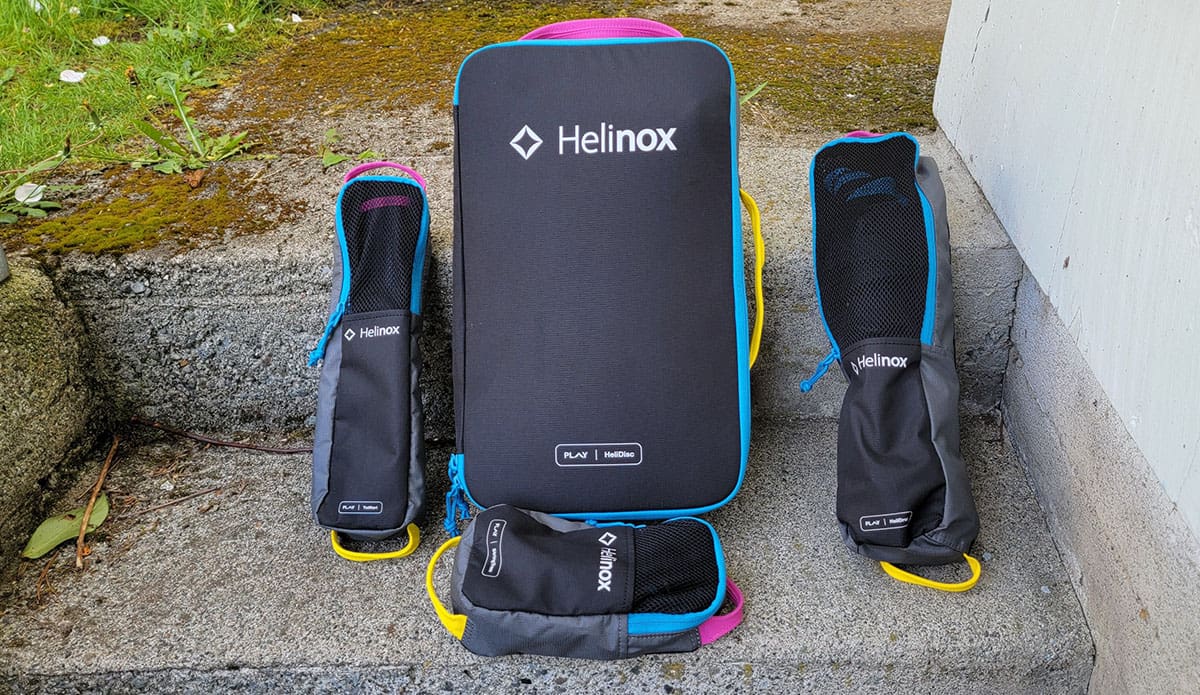
The PLAY series comes with four different options: HeliDisc, StringTrees, YutNori, and HeliDrop. Each game is unique, and comes in a different size.
StringTrees ($60 USD)is the smallest, lightest, and most packable of the lot. It’s basically a game like shuffleboard where you whizz a ring across a taut string that you tie between posts, trees, or any other freestanding vertical object. Scoring is simple – get as close to the end without going over.
HeliDrop ($80 USD) is a classic bean bag toss game, but with tiered levels, having the smallest hole being the most valuable.
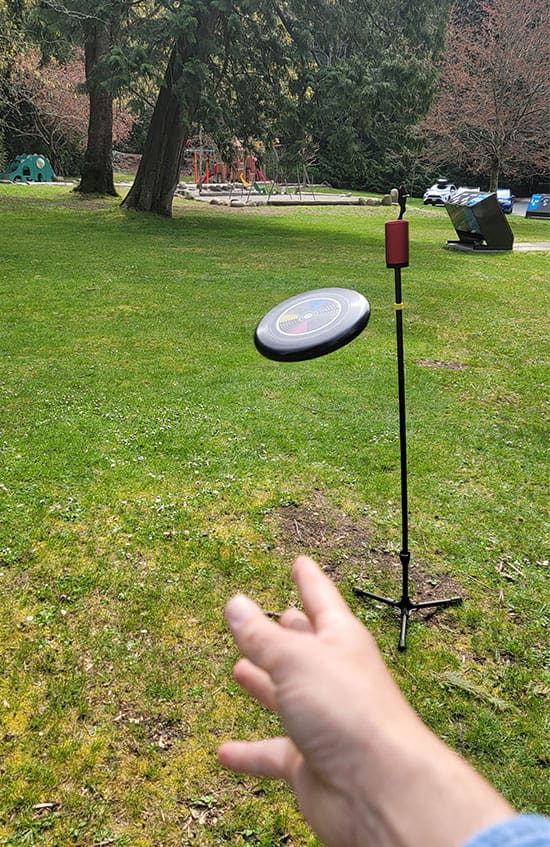
HeliDisc ($100 USD) is a target game where you try to knock the other person’s target off with a flying disc. It sounds simple, but it is actually quite hard.
YutNori ($40 USD) is a classic Korean game that involves strategy and can be played on any surface.
All the games speak to different skills, but the common thread is they are best played in groups.
What We Like About Helinox PLAY
The games are easy to set up, and weigh next to nothing in your pack (although HeliDisc is rather bulky). This means you can take these games into some wild places. And for those traveling with small humans, this can mean hours of enjoyment and bonding.
The material is durable and built to last – just like Helinox’s other offerings in the camp furniture space. So we anticipate having these games in the pack for many years to come.
But remote camping isn’t the only use. We’ve taken these games to the park for a picnic, and packing them along isn’t any extra hassle due to the lack of space and weight it occupies in the bag/wagon.
Games for Little Ones
We found StringTrees to be the simplest of the games, and our two year old loves it. She doesn’t exactly play by the rules, but you’d be hard pressed to find a toddler that can stay within the lines at all times. That doesn’t matter, she loves it all the same.
The other game right up her alley is HeliDrop. This is the classic bean bag toss game, but with three levels. As you can guess, the smaller hole gains more points. While scorekeeping isn’t really on the agenda for her, she has enjoyed the coordination required to get it in the hole. She’s even started to take a couple steps backward to challenge herself even further.
Games For Bigger Ones
Two games weren’t really applicable to our small family, but would suit larger kids and adult groups much better.
HeliDisc is like a harder version of disc golf, where you have to hit an opposing target with a flying disc. It’s a lot tougher than it looks. It was the bulkiest of all the PLAY series, So it’s not really one to go backpacking with, but it also is the most challenging, meaning it has staying power.
Yut Nori is the other one, and it’s more of a board game to play on the picnic table. To be totally honest, we didn’t test this one because our kids are too small. But we can update here when we get word from others on how it was.
Who Should Get These Games?
These games are great for anyone who wants to make the most of the outdoor experience and minimize screen time. It allows for a challenge for people of all ages, not just kids. So really, anyone who values a bit of competition outside will like these games. Bonus points if you’re trekking in with a backpack!
So bottom line… these games suit a wide range of groups, not just families. We love the smaller ones and will use the other ones for other family group gatherings. You don’t need to get them all, but one of them will probably speak to you and your family the best.
You can purchase the PLAY series Here (non-affiliate link).
Jeremy Jones has been a mentor to many in the snowboarding world.
His career has been on an upward trajectory most of his adult life, moving from professional racing to freeriding, and then as a leader in exploration under his own power.
But where many of his protegés have never met him, his influence is perhaps no greater than on that of his own children. For most of us, our parents are our greatest teachers, and guide us to become our own independent selves, before the leash is gone and we head out into the world untethered.
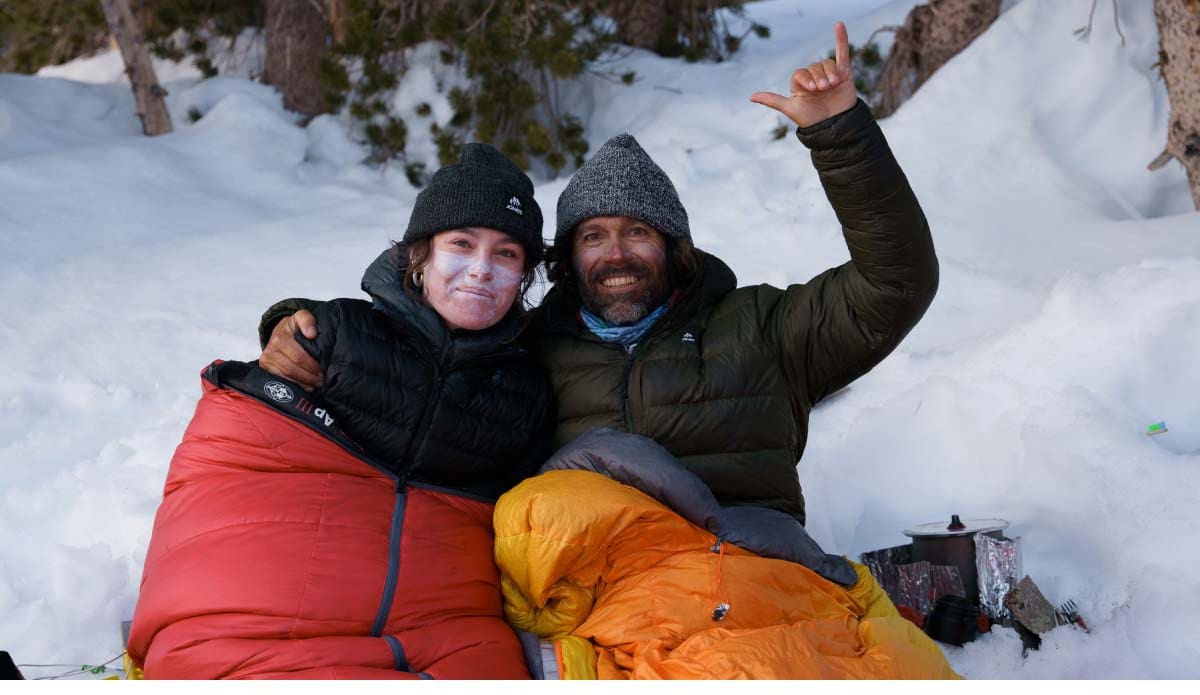
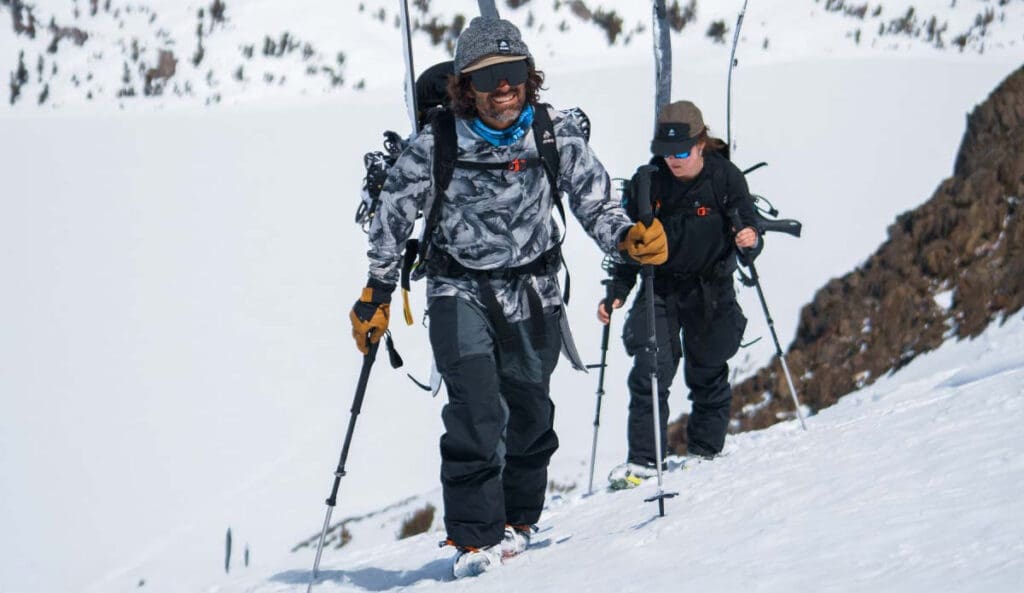
Jeremy took his daughter Mia on a splitboarding trip to the High Sierra in may of 2024, a few months before she left for college and made her own mark on the world. They brought some filmers along and documented the trip. This is the result.
For me, as a father, I can only dream of the day where I can also take my daughter into the mountains that provide clarity and remove the distractions of everyday life. It’s a goal that will take years to realize, but is worth it in the end. There will be many steps to take before we can strap on our boards, pack our backpacks, and set out into the backcountry, however it is a goal worth pursuing.
For any of us as adventurous parents, we hope that all the hard work teaching our children will result in a shared love of an activity that fuels us. This movie is the type of inspiration to keep going, to spend those days on the bunny hill, knowing that eventually it will all pay off.
You can’t reinvent the wheel. But can you reinvent the chair?
Turns out you can, and on multiple occasions, 13 years apart. And in doing so, you can improve upon an already great product with a few simple innovations that make it that much better.
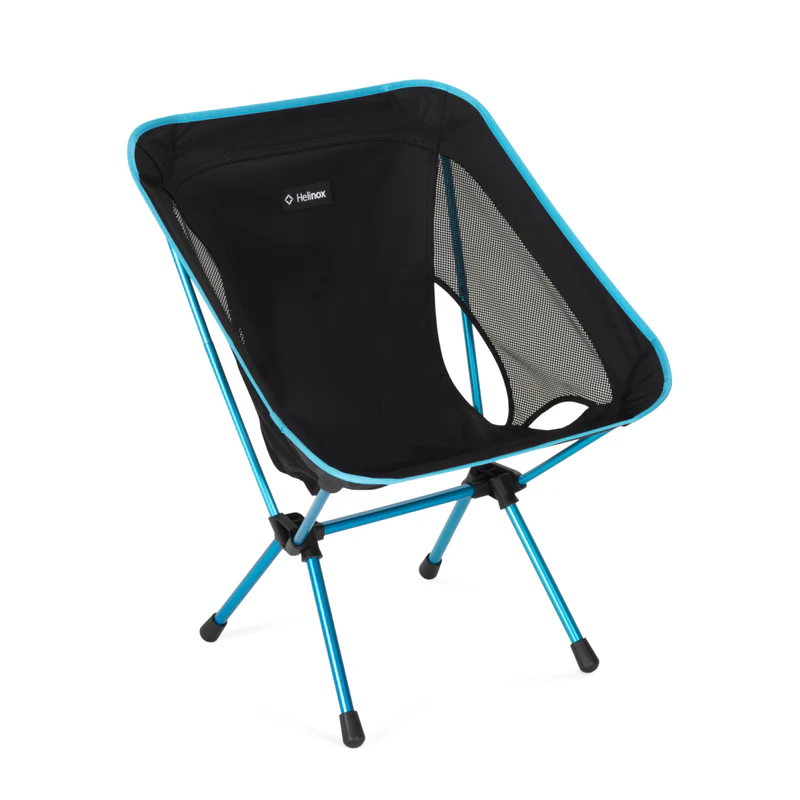
I’m talking about the new Chair One [re] from Helinox, a brand that has become synonymous with lightweight, packable outdoor gear. Chair one started it all in 2012 and now, in 2025, they finally have a version 2.0.
If anyone has tried the Chair One (or any of its many copycats of the past decade) you will know that it’s a step above in comfort and portability for a camping chair. It was so successful it basically set a new course for design. But is the new redesign worth the hype? Well, our family has been testing the chair for the past few months and I can say that the new features are more than simple bells and whistles. Read on to see what the changes are.
Weight: Capacity: 320 lb Seat Height: 28 in Materials: Recycled Polyester and aluminum Price: $129
Pros: More comfortable and durable than the original. Cons: A bit too heavy for the ultralight crowd. Side holes might prove to have more wear over time than the first design.
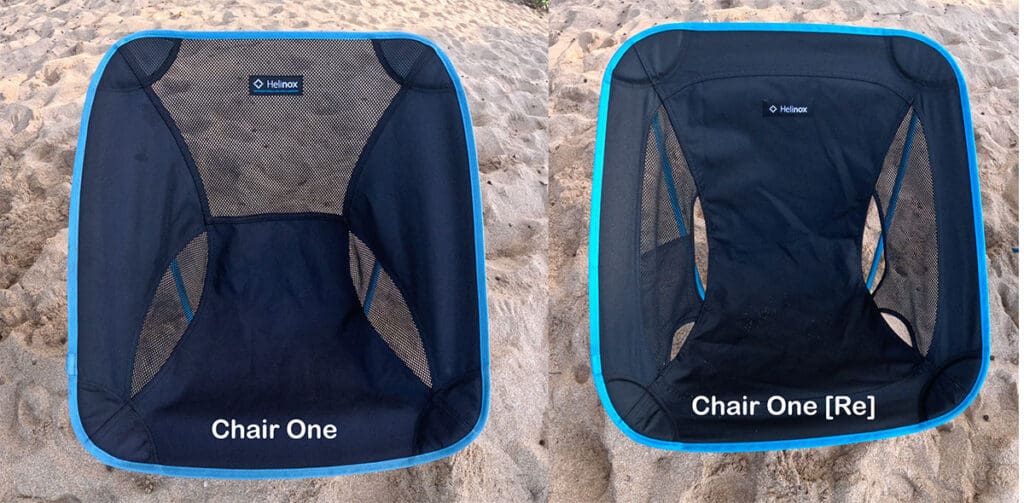
At first glance, the new chair looks pretty similar to the original. The shape is roughly the same and it uses roughly the same frame and seat design. But on closer look, it’s the subtle differences that add up and make this chair that much better. We will get into more detail further down.
The big distinguishing difference that I noticed right away is the seat height is 2.5 inches (or 30%) higher than the original Chair One. This is a good thing for people who are getting older (like the dad who is writing this now) or people who are tired after a long day at the office. The difference is subtle enough to not take away from a good quality sit, but noticeable enough to remark upon in a review.
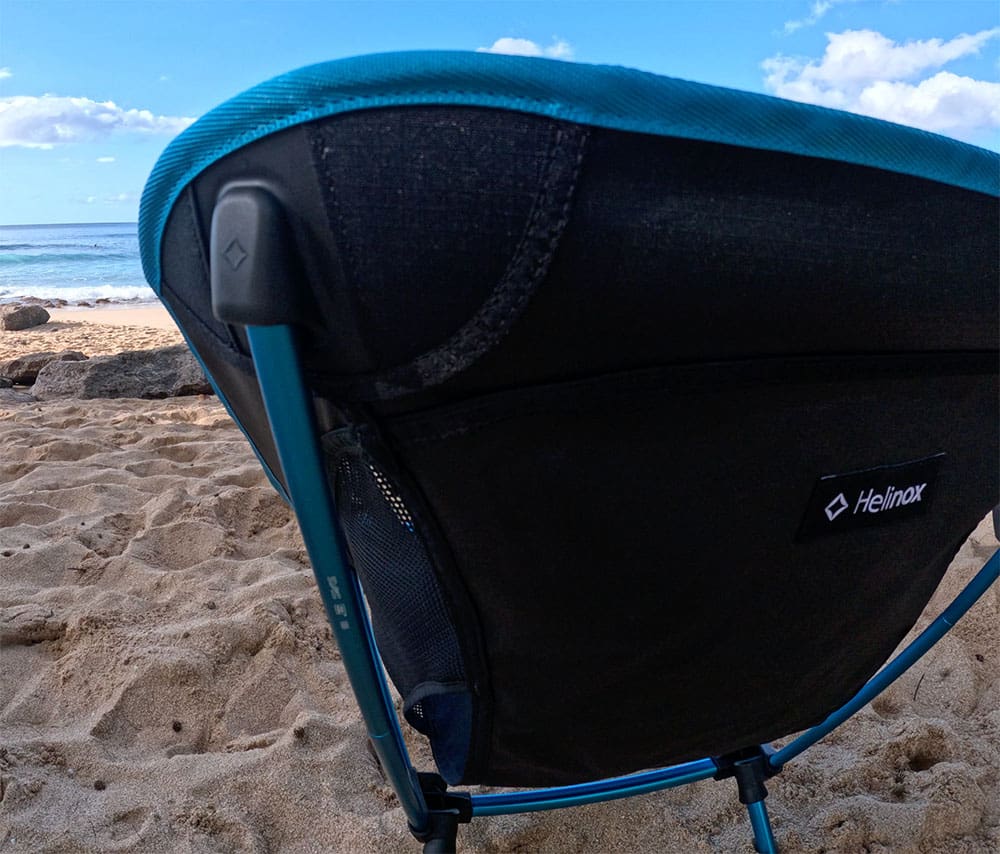
Basically every component of the chair and what makes it unique got a big upgrade. One big comfort item that may be difficult to put your finger on why it’s so much more comfortable is that they have added a second tension line around the perimeter of the seat, meaning weight is distributed more evenly. This allows them to make some modifications in the fabric, like cutting out holes in the butt cheek area to provide a more custom fit.
Chair One [re] Vs The Original Chair One: A Comparison
Chair One
Chair One [re]
Price (USD)
$99
$119
Weight
1 lb 15 oz.
2 lb 7 oz.
Capacity
320 lb
350 lb
Seat Height
25.5 in
28 in
The differences are subtle, but end up being a major upgrade in comfort and durability.
You may or may not know that the Chair One is the original design of the camp chair renaissance that has occurred over the past decade. It’s a welcome innovation over the ever-prevalent fold up chairs that were awkaward to carry and left your lower back feeling disfigured. Those chairs never left, but with the new redesign that the Chair One spearheaded, camp chairs have a whole new level of portability and comfort.
Speaking of portability, that’s probably the standout feature of this design. It packs up small enough to fit in the water bottle compartment on the side of a daypack, and setup is quick and easy.
The big additions to the redesign are some of the subtle differences providing not-so-subtle results. One is the socket joints that attach the seat to the frame. That is probably the area of highest wear on our original Chair One, so it’s nice to see that they have addressed this issue with something more durable and long-lasting.
Another bonus is the hubs on the frame are reinforced, giving even more durability and quick assembly time, adding value to the investment over the long haul.
Helinox also is one of the industry leaders on more sustainable materials. All the materials used are either recycled or repurposed, making sure that less harm is done to the environment over the long run. The Polyester fabric will undoubtedly shed microplastics, but it’s durable enough to do so much slower than cheaper materials.
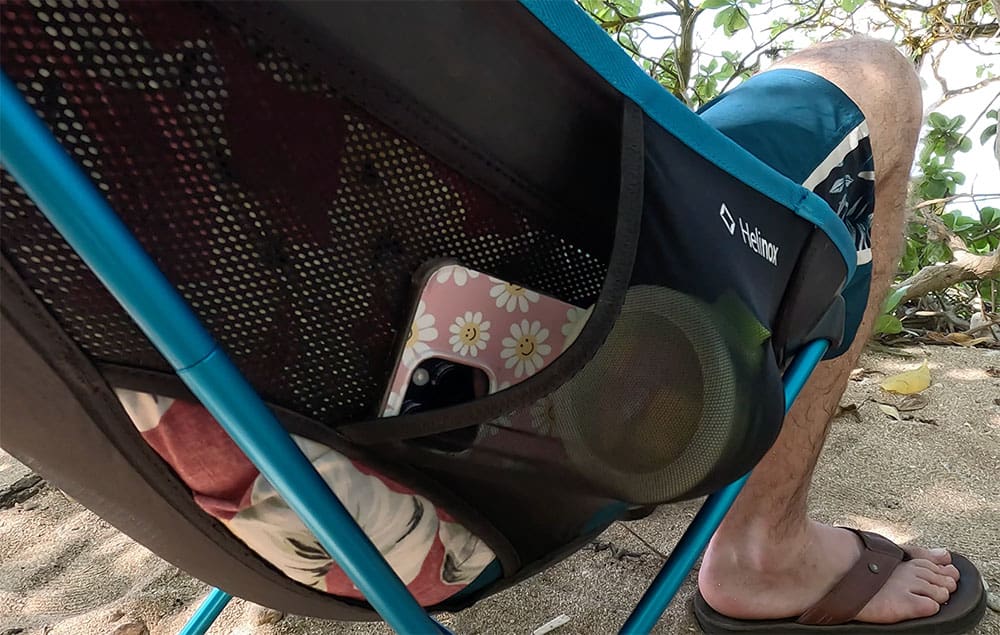
The side pocket is a much welcome addition, especially for families with small children needing constant snacks.
At 2.25 lbs, it weighs a tad more than the original which clocks in at just under 2 lbs. This 8 ounce difference is negligible to some, and a dealbreaker to others. But those people are probably going the super-ultralight route and opting for the Chair One Zero or another lightweight (albeit less comfortable) chair.
With the extra holes, the new seat design has the potential for more rips and tears and things to go wrong. I suppose it will depend on your kids, and
While we as parents in our 40’s enjoyed the extra seat height, it also provides a higher center of gravity over the Chair One. This can be troublesome if you have a kid like our 10 month old who loves to climb anything within reach. He learned pretty quickly how to tip the chair over, but has yet learned how not to. So we’ve made a habit of leaving the chair on its side if we’re not sitting on it to lower his level of temptation. We also have Helinox’s Beach Chair, which is a bit lower to the ground and safer for our creepy crawly.
Final Thoughts
The new Chair One [Re] is a significant upgrade. Fans of the Chair One (and Helinox products in general) probably won’t need this review to know that the chair will be well designed and made from quality materials. They’ve earned their reputation over the past decade as a leader in reliable portable camp furniture.
Is the redesign worth the extra 20% on the price tag? I’d say so due to several standout features such as the improved socket joints and extra line of tension. Those features alone will make the chair last much longer over time, thus makeing it a better investment in the long run.
If you have a Chair One now and are satisfied, you can probably wait until you need another. But if you’re buying out of necessity and can afford the extra $20, it’s worth it to have extra comfort and durability, and an improvement on a product that set a new trend on outdoor camping comfort.

![Helinox Upgrades Their Iconic Chair One With a [Re]boot](https://excellentfamilyadventures.com/wp-content/uploads/2025/03/Helinox-Chair-one-re-review.jpg)
![a close up of the seat attaching to the frame on the helinox chair one [re]](https://excellentfamilyadventures.com/wp-content/uploads/2025/03/Attaching-seat-to-frame-on-Helinox-Chair-One-Re.jpg)